worked with blue beads. And truth to tell, Hamdoun reaped from his first day in the new trade nothing but the admiration of some of his fellows and the disdain of the rest:
He was flighty, hopping about like a sparrow, going from Raef to Muhammad and skipping from Muhammad to Said, patting each of them on the shoulder, grinning into his face like a simpleton, then turning until the basket brushed the face of the one he addressed, and saying: “Look!” But his fellows did not always meet him with the acclaim he hoped for; indeed some of them met him with what he had never expected at all, planting on the back of his neck a kick that made his back shudder and made the new basket groan, as though the blow had touched it too.
But his joy in the basket soon melted away as time melted, and in its place a mean reality came to squat like a mountain upon his chest: he had fled from one begging only to fall into another, and scarcely escaped that before falling at last into a new and viler begging! At first he tried to make life come to him. He would fix with his eye the people carrying their bundles, without going near them, as though his eyes were saying: “That you are tired — that is obvious enough... but do not expect me to run to you as if I were a beggar. Here I am, if you wish... provided that it is you who come to me!” His comrades, meanwhile, never flagged: hustling, shouting, joking, cursing, running after this one, blocking the path of that one, patting a third on the arm so that he might take notice and load them with what he carried. And by sheer insistence they sometimes won enough to repay the face they had spent; and there they would be, carrying a load for ten piasters, or fifteen, or more, while Hamdoun stood fixed like a crag at the western entrance of the vegetable market, where the market meets Maarad Street. That was his stand, and he would not budge from it.
But Hamdoun soon understood that this stand he was taking was certain to drive him to utter ruin. His mother — pity her — was selling her heart and her lungs for
piasters, sweeping here, scrubbing there, washing yonder; and in her hut she had taken to watering the earth with blood that the coughing wrung from her chest. And she had sworn by the mercy of his dead father never to show him a piaster again: he was fifteen — was it not time he ate of the toil of his own right hand? So Hamdoun found nothing for it but to comply. The people before him preferred almsgiving to the granting of justice: they hurried to the abject one, the one who moans, and turned away from the proud man who expects from life a right and not a charity. And since such was the way of men, and such the way of his comrades, why should he hold to his plan, like some beast of the wilderness the fates had flung out — no water, no pasture, no companion? By God, he would whine, the whole day long; he would din the abject tune into men's ears; he would crawl before them — for that was the sure way to move the hearts of those who believe in abjection and moaning and crawling. And Hamdoun set
to whining. Hamdoun set to chasing people, greedy and voracious, wishing he could carry them along with their bundles and toss them into his basket for piasters... His comrades kept shoving him aside, envious of his gleaming basket, and time after time they made off with the livelihood. And there came a day when an old woman approached Hamdoun to have him carry her vegetables; but one of his fellows, Saber, shoved him violently and snatched the bundles from the old woman's hand, saying: “I always carry for you, lady. This one is my ‘ghlouji.’”
Hamdoun did not know what to do. Should he fall upon his rival and knead him to a pulp, or leave him his livelihood, lawful and blessed? To fall upon him was a matter that called for serious thought, for Saber had two hands like pitchforks: had they closed upon Hamdoun, they would have flung his ribs into the belly of his basket! But he could not sit quiet under the insult. His very stomach told him so: for some time now Hamdoun's food had been no more
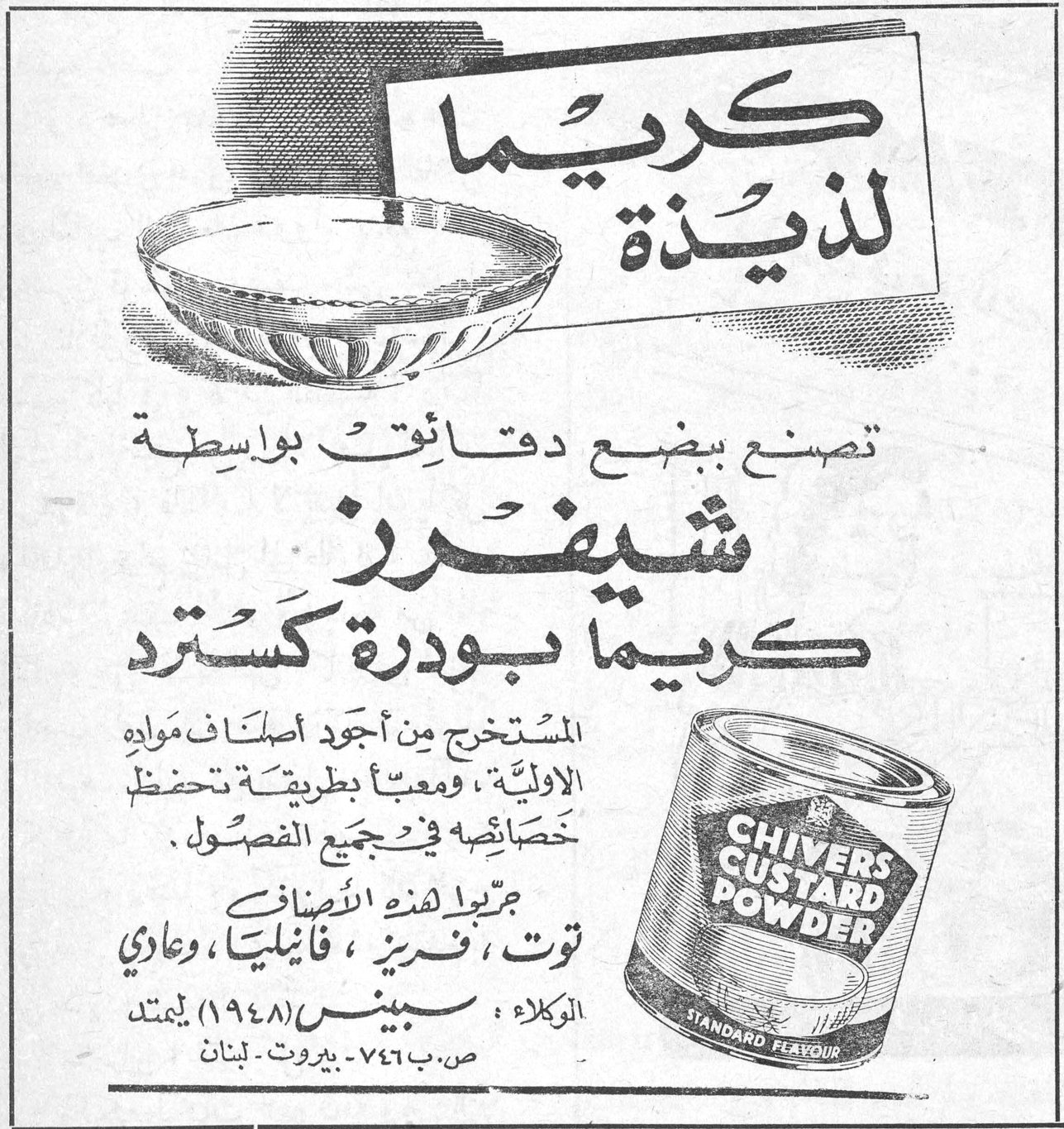
Chivers — Custard Powder Cream
A delicious cream
Made in a few minutes with Chivers Custard Powder Cream
Extracted from the finest kinds of raw materials, and packed in a way that preserves its properties in all seasons.
All these flavors: mulberry, strawberry, vanilla, and plain
CHIVERS CUSTARD POWDER
STANDARD FLAVOUR
Agents: Spinneys 1948 Ltd.
P.O.B. 746 — Beirut — Lebanon