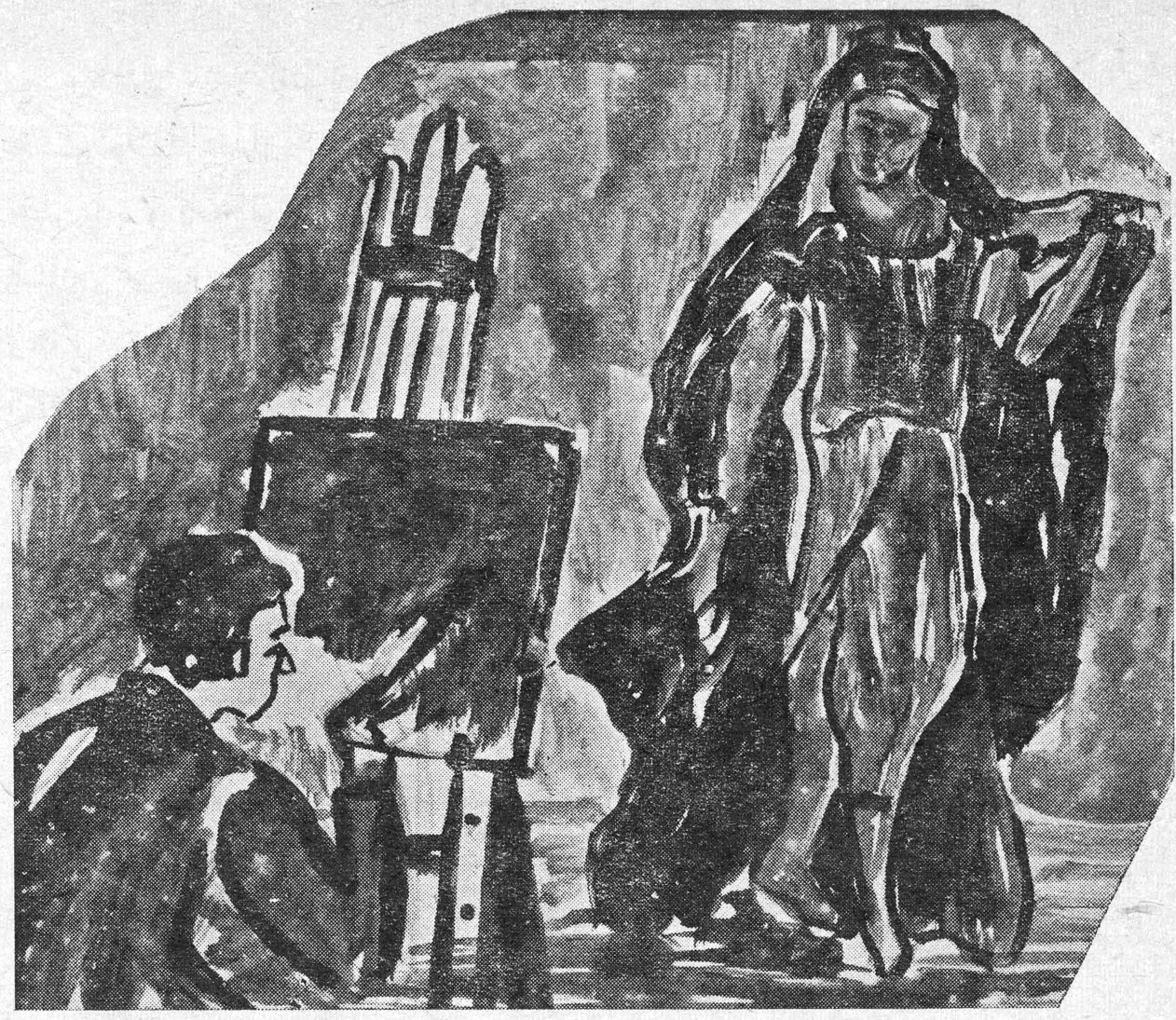

The mannequin "Randa" had grown used to the company of the rising young artist "Ragheb" on her way home from the salon where she worked on the shore of the Mediterranean to the humble room she shared with her crippled mother in the quarter that remains of old Beirut — the Emir Munzir road. And in this nightly stroll, repeated through the evenings of spring and summer these four or five months past, the artist's feelings had moved from a mutual answering of hearts to a blazing infatuation. He had first come upon her on her late returns, taking the same road she took. Then he began to frequent the salon, keeping to a solitary table, tucked away in a corner, watching her as she appeared now and again, swaying with her supple figure among the tables.
He would observe her every night from behind a glass of drink, sipping at it the whole evening through, a pen in his hand that he trailed along however it fell as Randa swayed. Naturally, all his pictures came out on a single model: his beloved, the beautiful "mannequin," with her thick chestnut hair, her languid eyes and velvet lashes fluttering haughtily above an aquiline nose, a full mouth, and a delicate chin; then a neck, a turn of the head, and a waist bound that day with a striped sash from which flowed a loose golden robe, recalling what the women once wore in this beautiful corner of the old East.
But events did not run as Ragheb was accustomed, and matters did not grant him the walking of Randa home to her humble room as on every other night. A young
man of wealth and ease, whose admiration for her Ragheb had scented for some time, had put himself in her way; yet no open sign of it had appeared until the surprise he sprang upon him this night, as she came sailing in her sheer yellow sabiri among the tables; and when she reached his table he leapt from his chair and greeted her by kissing her hand, and pressed her sweetly to share his table, if only for a little. The pen stopped its running, and the blood rose to the artist's cheek; but he kept his calm and his concealment, watching from his far corner Randa's confusion — all coquetry and charm — after her new cavalier had drawn back the chair for her and seated her at his side.
Before Ragheb knew it, a violent dizziness had come over him, and a flood of cold sweat. Despite his straying mind he managed to hold to his coolness — the passivity of a man with no power to defend his sweeping love, which began to give ground to the beats of the dance music and the resolve of the wanton youth, his arm about Randa's waist, feeding her green eyes with gazing and enticement.
An insistent question pressed itself on him: "Why did I not declare my love to Randa before?" He felt at it a violent wrath against his own short reach, which nearly made him burst in this crisis. For one thing forced the truth of his case upon him: that he was poor and destitute like Randa, and that neither of them, in the creed of money, was fit for the other; and so he had preferred sanctifying to profaning until fortune should smile upon him.
It had never occurred to him that his girl was of the clay of women: enamored of admiration, avid for flattery. Instead, a blind idea had taken hold of him, born of pride, by which — and by it alone — he would physic his sorry position;
whether it meant deliverance from his cowardice, or revolt and the defense of his dignity. Was not