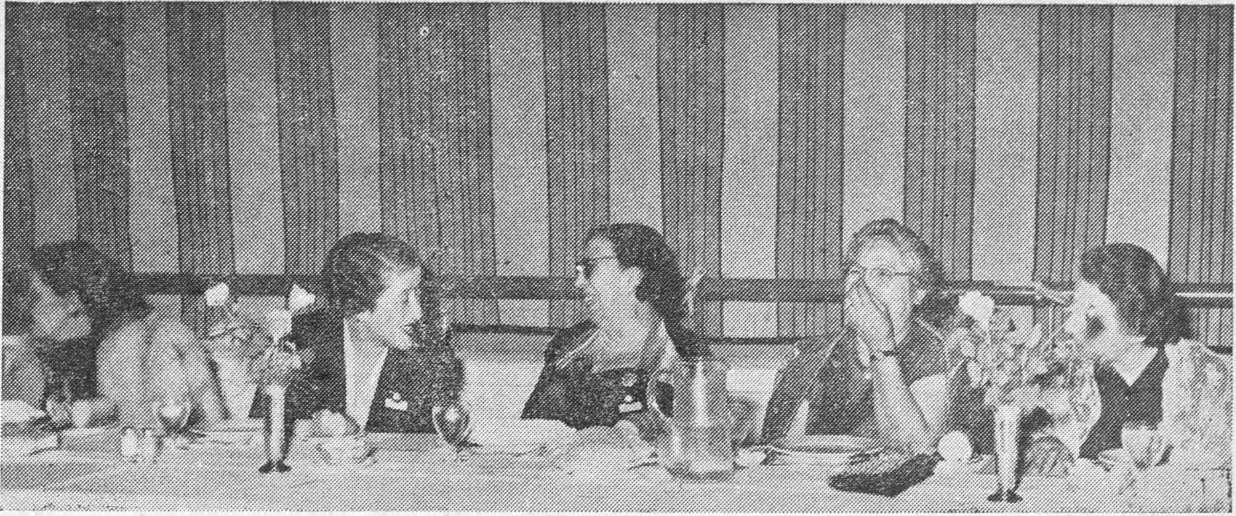
At the luncheon at the airport at the invitation of the Municipality of Beirut. Miss Ibtihaj Kaddoura, president of the General Arab Women's Union, appears with, at her right, Mrs. Adila Bayhum al-Jazairi, president of the Syrian Women's Union, and at her left Mrs. Jamila Atiyya, head of the Egyptian delegation, and Mrs. Asia Wahbi, head of the Iraq delegation, then Miss Zulaykha al-Shihabi, president of the Jordanian Women's Union
— Working to establish and strengthen cooperative societies to supply the peasant with money, implements, and seed, in order to facilitate the working of the land and the marketing of his products.
Third — Distributing state lands to non-landowning cultivators and generalizing small holdings, on condition that the above-mentioned cooperatives be generalized.
Fourth — Drawing up a long-term plan for wiping out illiteracy, so as to arrive at compulsory rural elementary education.
Fifth — Requesting the appointment of women social guides for the countryside in the Ministry of Social Affairs, drawn from the women's organizations concerned with rural affairs.
(a) Directing man and woman toward industry and agriculture.
(b) Creating a market for village industries.
Seventh — Creating industrial and agricultural vocational schools for boys and girls.
Eighth — Creating health centers for guidance and prevention, increasing the number of physicians, and then securing their livelihood so as to encourage them to work in the countryside.
Ninth — Demanding that governments improve communications and pave the public roads.
Tenth — That the reform of the countryside be carried out at the charge of the citizens, not of foreign projects.
Advancing the Family Economically
First — Improving the major industries and expanding them in the form of national joint-stock companies, to curb industrial monopoly.
Second — Safeguarding the rights of the worker by working for the application of labor legislation in the Arab countries.
Third — The necessity of equal wages for the two sexes for equal work, in proportion to the local standard of living.
Fourth — Encouraging national products:
(a) by holding exhibitions of them;
(b) by the patronage of men and women alike;
(c) by increasing the duties on foreign products whose like is manufactured in the Arab countries;
(d) working to improve national products and to watch over their prices.
Fifth — The patronage of national products by governmental and private institutions.
Sixth — Cooperation of the Arab women's unions with the offices for the boycott of Israel, to tighten the economic blockade upon her.
Seventh — Expanding the commercial markets:
(a) by lifting the customs barriers among the Arab countries to secure economic unity;
(b) opening new world markets, provided that our commercial relations rest on a basis of reciprocity.
Vocational Schools and Juvenile Reformatories
First — Generalizing vocational schools in the cities and villages, as suits each environment among them.
Second — Generalizing institutes of social service in all the Arab countries.
Third — Generalizing juvenile reformatories, the women's organizations to have the right of supervision over them.
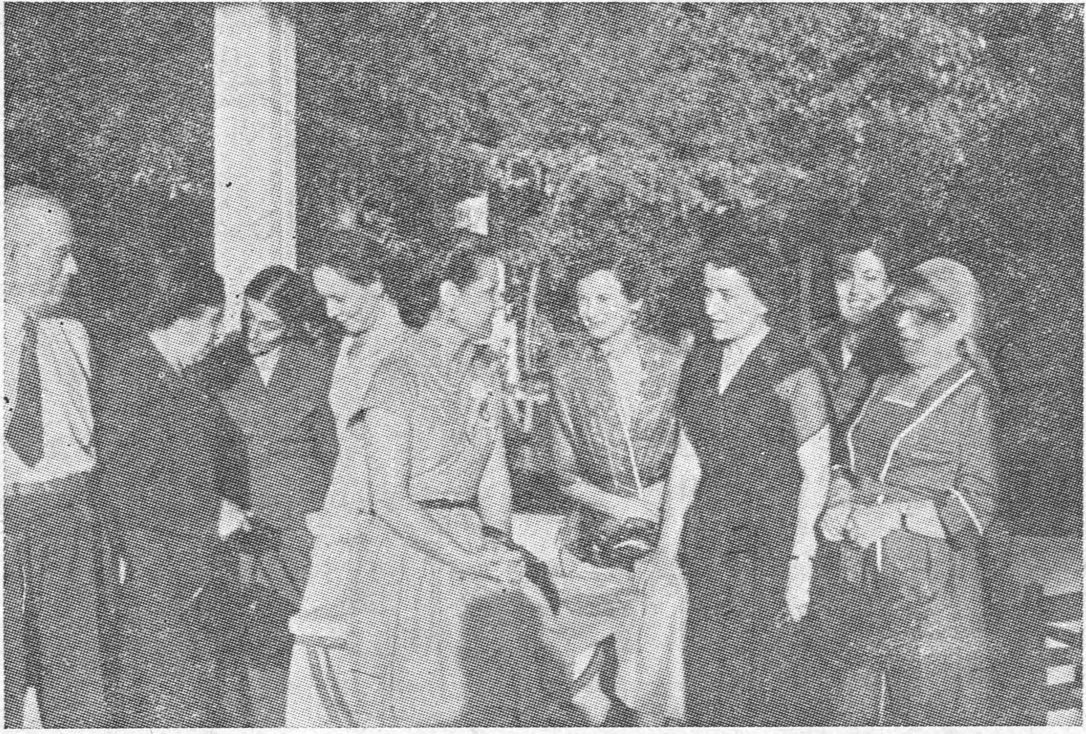
At Mrs. Anissa Rawda Najjar's invitation to the "Fawwar" — what do you suppose the hostess is so warmly discussing with the Egyptian delegation?? And what talk is this between Edvick Shayboub, Hawa Idris, and Dr. Lam'an al-Damluji?