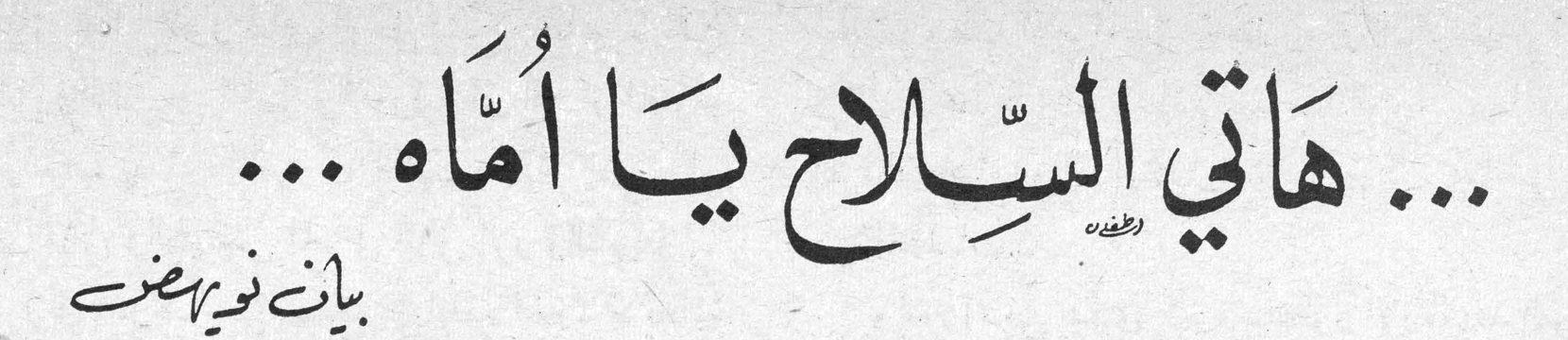
Come, my Arab brother, come to the Holy City, to the town for whose sake Omar crossed the deserts. Come and see with your own eyes how your Arab brothers, the people of Jerusalem, live, and how they stand fast before the enemy's fire and his savage assaults, with faith and courage...
Here we are: this is Jerusalem, and this is the Sheikh Jarrah quarter. And there — do you see that old building? In a wretched room, one of its cracked rooms, lives Umm Amer.
You may ask: and who is Umm Amer? She is simply
Umm Amer. So she introduces herself, so the people of the Sheikh Jarrah quarter know her, and so the people of Jaffa knew her.
In that wretched room sat Umm Amer, a woman who had not reached her fortieth year, but whom sorrows had broken down until she seemed an old woman of seventy. There was nothing of furniture in that room but a wretched rug and a threadbare mattress, on which slept a young man in the first spring of his life, wrestling with fever. Near the mattress sat Umm Amer, wiping with her tender hands the sweat streaming from the feverish brow of her only son.
The sleeper opened his eyes, and by the light of the dim lamp he saw his mother's face. She smiled at him encouragingly — and how gentle her smile was — and the boy sank back, surrendering to the stupor of the fever. Umm Amer was always smiling. She smiled at the neighbor in morning greeting, at the guest in welcome, at the child in play, at the stricken and the sick in consolation. But no doubt the sweetest of her smiles were those she gave her only son. When she smiled at him, pride and admiration were drawn upon her face, and from her eyes shone the light of faith and the tenderness of motherhood. All her feelings and emotions took form in that smile. And how many
a night Amer slept with that smile in place of a hot supper, on the cold nights of December.
•
Memories circled in her head, and she remembered that ill-omened day when she left beloved Jaffa, and with her her son Amer, who had not yet reached his tenth year. As for her husband, he refused to leave the land on which he had crawled as an infant and grown up as a boy, and which he had then watered with the sweat of his brow. Umm Amer remembered the day Abu Amer came with two rifles and said to her:
Take this rifle, Umm Amer, and hand it to Amer when his arm grows strong, and tell him: "Your father died a martyr."
And Abu Amer carried the second rifle and went out into the orchard to lie in wait for the enemy, while Umm Amer went out of Jaffa with her only son, forever. On the third day after her arrival in Jerusalem she received the news of her husband's martyrdom, after he had killed five of the Jews; she raised her head to heaven, as was her habit, and said: "O Lord, deliver the homeland, for its nourishment is heart's blood and souls."
Umm Amer sighed at the memory of the wounded homeland, then turned toward her sleeping only son. Her heart was torn as she heard his moans. Only a week ago she had sold the one chair she owned to buy food for her boy — so what could she sell now? She looked about the corners of the room, considering it. Sell the rug? It is worn and old; and who would buy it? Suddenly a shudder ran through her body, for her eyes had fallen on the most precious thing in existence — on a rifle hung upon the wall. Sell it?? No, no, no. If she sold it she would be selling the memory of the dear martyr, he who had charged her to hand it to Amer when he grew up. But Amer is dying, and nothing can save him from death but the price of this rifle.