then in arranging the various athletic programs.
On the green stage the dreams and hopes dance; the little flowers sway coquettishly to the strains of the music, and souls reel at the sound of virgin voices soaring and roaming.
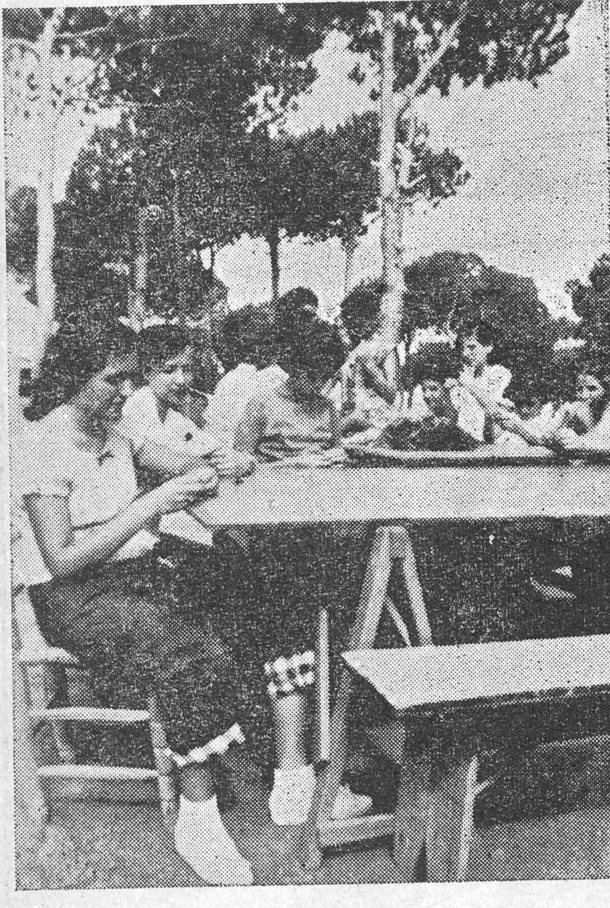
Folk dancing is an art that refines the soul and fills the spirit with gladness, and a time has been set aside for it; acting, too, has a large share in the camp, since it is a miniature and directed picture of life as it is. And quickly our girls feel the pull of poetry and art out there in the open country and in the shade of the wood; they sit before a teacher from whom they take up various arts, such as leather-carving, drawing, and handicrafts.
Each week has a program in which the arts are mingled, just as each day at the camp has a full and prepared program: neither sleeping nor rising is left to improvisation... and thus we apply the verse that says: "To every thing under heaven there is a season."
Around the hill are springs bursting from the depths of proud
mountains, to which the campers go for outings, for drinking, and sometimes to eat. And there is no harm in a fleeting glimpse of these short excursions: the girls divide into two parties, one going ahead of the other and leaving behind it directions and papers pointing out the way it has taken — or sometimes leading it astray — while the second caravan marches stumbling along on the track of the first, floundering; and in all this there spreads a merriment beyond all merriment, and laughter rings out, innocent and resonant, until at last they find their way to the "treasure," where "trays" of tabbouleh and dishes stand ready.
"One cannot think of evil here." So spoke Miss Layla Shahin, leader of the vanguard at the camp; and along this path, far from evil and from the very thought of it, her battalions march. Forward, then, Layla — you and your Laylas!...
"Today our excursion is to Beit Chabab — are we ready?"
"The Munjidat are always ready!" The whistle sounded, and each girl took up her kit, not forgetting her nature notebook, in which she records every new thing she sees and gives a report on it. And at Beit Chabab, this time, we set down our loads and went about touring the workshops of industry, which live on despite the tightness of the purse and the scarcity of encouragement, moral and material, and which produce manufactures it is our duty to value and to strengthen.
These bells that ring among the valleys in the forenoon, sending enthusiasm and the love of life through our nerves, and carrying us at evening, with their rapture, to a safe night's rest — they are the product of very small workshops in which Beit Chabab stands alone. And pottery — whose manufacture has so advanced in the developed
countries that they have come to treat it as an art, adding to it and boasting extravagantly of it — is still, as an industry here, a frail infant, needing nourishment to live and grow strong. As for the weaving mills, most of them resting on handwork, they lift their heads to peer out at the world of light, but the window is very narrow and the door is locked. Where is he who will throw it open wide, so that industry may be freed and range the breadth of the sky?... Without knowing it, and between earnest and jest, the girl took a lesson in certain industries, and then learned how to value a craft; for the camp's idea moves toward schooling souls in the facts of real life.
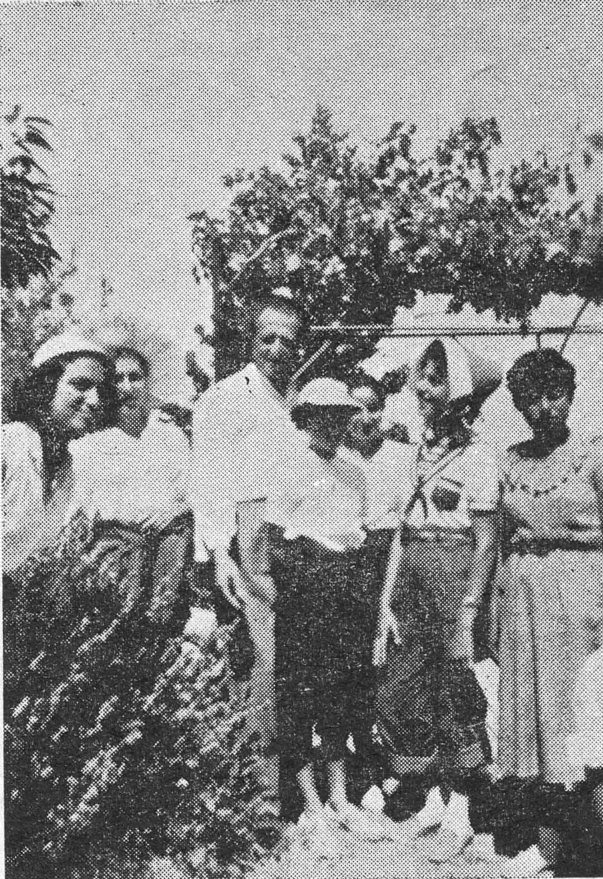
At Gemayel's Qaysariyya: "Come to me, little ones." With these words our famous artist received the troop of campers. "Come, that I may sow in your tender souls the seed of knowledge glowing in the spirit of art, and feed your mouths with the most delicious of provisions, one to lead you to the love of truth and to a feeling for everything on which your eyes alight." And indeed the little ones gathered, and a quarrel
With Gemayel in the gardens of the "Qaysariyya"
At the hour of handicrafts