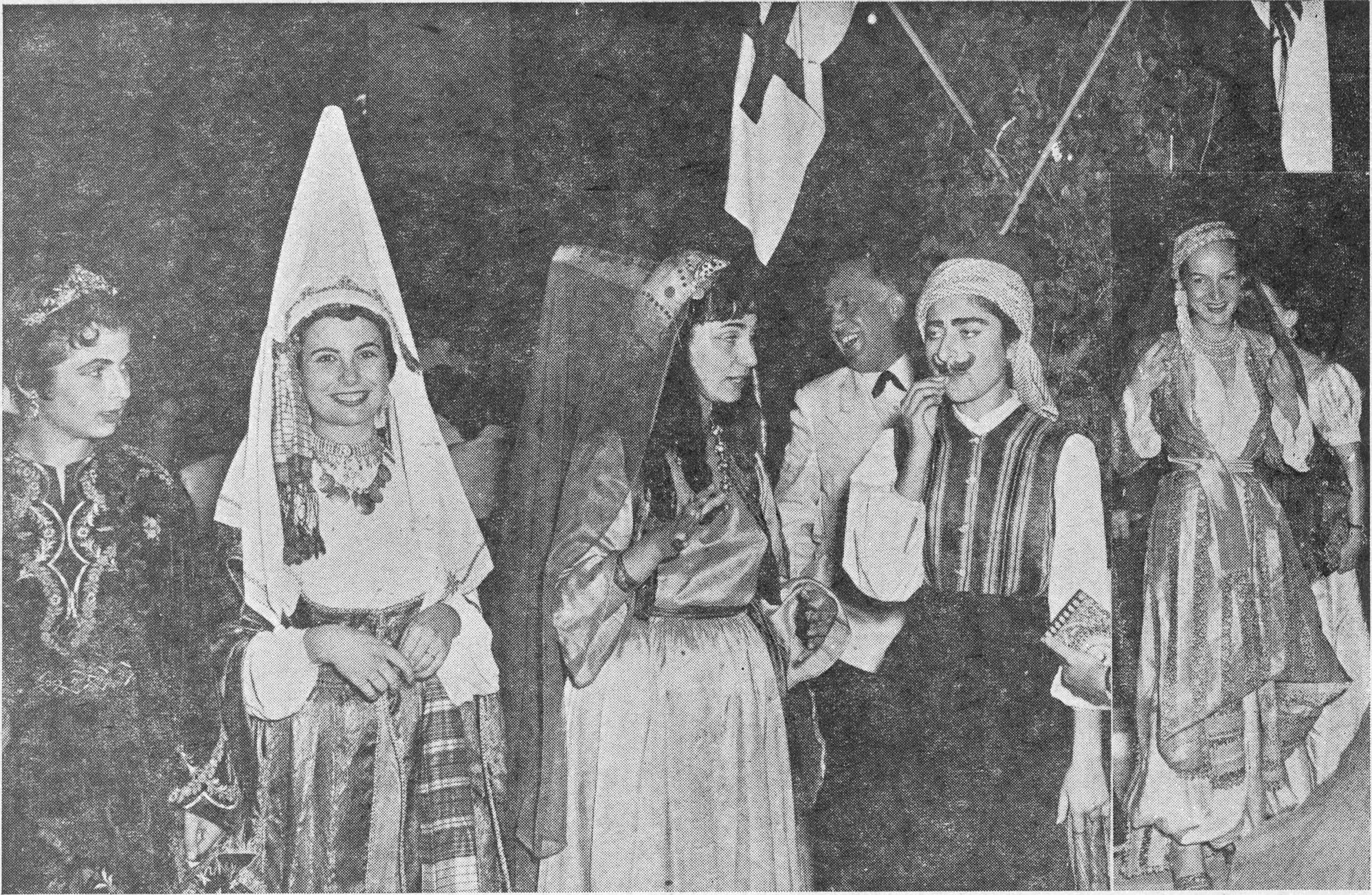
The "Stambouli" costume, worn by Miss Salma Diab; Mrs. Wadia Saba, the "tantour," mid-nineteenth century.
Two villagers of the old days; Miss Thabit, after the tantour was given up in the middle of the nineteenth century.
dress the family had preserved through four generations gone by since its first wearer — with a jabot redder than her flowing kerchief, redder than her ravishing hair, and at its center a skullcap studded with little gems of strung pearl and massed emerald!
And it seemed to please the labbadeh-wearer, Miss Bshouti, to play the one and only cavalier to the five remaining women — not thereby departing from the vanity of males in every age, even if she was a woman! For she took it upon herself to amuse the company with her droll antics... and soon enough she made way for...
a Lebanese emira in a gown of violet velvet, embroidered with pure gold, with a long train that swept the floor. Upon her lofty head sat a diamond diadem, a "falank," joined by two borrowed braids; with it, and with her consummate Eastern beauty, Miss Diab had every right to sweep along in the raiment of those who once were reared upon the seat of rule! And had Emir Maurice Chehab not been kept from attending for reasons of health, he — the Director of Antiquities — would have assured us that the twin of Miss Diab's costume stands in the museum of the Beiteddine palace!
And just as we noted above that the Commission's
costume was an exquisite copy of the model of Miss Thabit's dress, so it may be said that the costume of the sixth contestant, Mrs. Kanaan, the representative of The Woman's Voice, was a happy copy of Miss Diab's model — a trained gown and a black velvet "polka" jacket embroidered in gay colors, and a cap whose surface interlaces gold thread and beads, from which a silver band dangles over the forehead, its pieces swaying beneath a sheer veil!
And it was as if the matter grew confused for the members of the jury — who outnumbered the competing contestants! — and the choice between the newly made and the time-honored, of one and the same kind, proved too hard for them; whereupon the Commissioner, Mr. Michel Touma, the giver of the prizes, proposed an even settlement among them. The committee issued its decision, with the contestants circling round the decision: all six were winners — not only for the felicity of their costumes, but for the daring embodied in their taking the first step — which the dear homeland willed to be the herald of a series of living, delightful exhibitions that lend it, through the dress of its enchanting beauties, its unique local color and its lovely popular stamp!
And with the conclusion, the beginning begins...