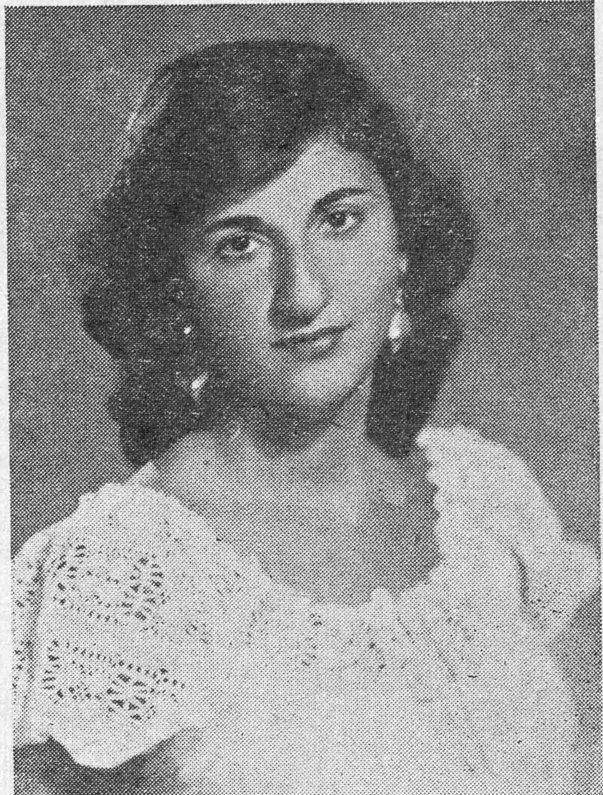
Every day, new faces look in upon us from beyond this endless blue expanse... And at the opening of this summer, our mountains welcomed Mrs. Helen Khal with her little boy Tarek. She is of Lebanese origin, born in America, and the wife of Mr. Youssef al-Khal, a former editor-in-chief of this magazine and at present an editor of the newspaper "Al-Hoda" in New York. It gives me pleasure to welcome Mrs. Khal as I present her to the readers of "The Woman's Voice," filled as I am with the utmost admiration for her calm, dark-hued comeliness, her measured speech, and her aware, unhurried thinking:
Q — What is the overall impression you have formed of Lebanon, as an American visitor?
A — I do not feel myself American in the atmosphere of Lebanon, the homeland of my parents and my husband — not even in the heart of America, where I was born and grew up.
Lebanon is an attractive country, enchanting in its nature, and it seems to me the inhabitants do not feel the force of this beauty, which the stranger glimpses the moment he sets foot on its soil. The most striking thing I have noticed — and I cannot keep silent
about it — is the overwhelming disorder, which almost veils from people the true beauty of life; and they encourage it by working to entangle their own affairs, and that leads them to anxiety and agitation... Among the manifestations of this disorder are the buildings: beautiful as single units, but discordant as a group, owing to the lack of harmony between one building and its sister, and between it and the surroundings that encircle it... so that it appears in a threadbare frame that robs it of its charm and stamps it with a chaotic look. In my opinion it is essential that the people begin to grasp this truth and unify the form of building and its harmony with the setting; for the beauty of a single pine tree in a garden, however great, will never surpass the charm of a harmonious forest upon the hills.
Q — What is your view of the Arab woman's struggle, from your reading and your reflections?
A — There is no doubt that the Arab woman's leap is bold and progressive, and her duty as a free citizeness calls her to be watchful for the future of her country; for she is the first builder, as mother of the rising generation.
The development of peoples, wherever it may be, does not begin with the grown, but in early upbringing; and therefore fathers and mothers are responsible for guiding and rearing their children not only physically but psychologically, intellectually, and spiritually. I believe in unity of education, because it is the first step toward unifying the country, and it is indispensable if man aspires to an ideal life; unity must embrace both school and home. This is an arduous step, but if many devoted themselves to attaining it they would certainly reach a result. And I do not speak of Lebanon alone — this is my personal opinion; for the world has become small, and no division may
be made among the parts of its being. Its problem in Lebanon is a miniature picture of its problem in the greater world, so that solving them both, in every country, would be a way toward finding a unified direction in education among the peoples of the whole world.
Q — The American mother tends to give her child complete independence of self; is the result usually practical and successful?
A — Before entering upon this inquiry, I must point out the educational and social difference between the state of things in America and in Lebanon. The man here marries with the aim of preserving the species, then looks upon his child as one of his possessions; he does not consider him a person with his own thoughts, opinions, and inclinations in life — whereas the child is like an arrow launched ever forward, and his road is other than the one his parents knew.
Cultivated parents in America — and I do not say all — appreciate their educational duty: they watch over their children and guide them in childhood, and they provide them all their needs, so equipping them to enter the battle of life by the best means possible; nor do they regard their children as the property of their hands. But some incline to excess, as when they allow their children an independence whose essence they do not grasp, and then the danger is grave. This is a new step in education, and it may be said that we shall not see it here in our generation, or in our children's generation.
Q — The American woman is known as man's companion in work; how, then, does she reconcile work and home?
A — A woman may work after her marriage, but such women are few; and if she works, it is after her children have reached an age at which their going to school spares them some of her