If the villager in my country could make of his village alone a republic unto itself, he would not hesitate... The Zahlawi is a Zahlawi before he is a Lebanese, and so with the man of Shweir, the man of Bhamdoun, and the rest. For every town or village of ours in Lebanon has its own particular color, its distinctive stamp, its familiar dialect, and its legends and strange tales that grandsons hand down from grandfathers and sons from fathers. And how grand those legends are when fancy colors them and the naive imagination toys with them — an imagination that never soars beyond the bounds of the village, but flutters over its leafy wood, hovers about its dark caves, swims in the waters of its unfailing springs, and alights in its lonely windings and its rugged, deserted paths.
Come with me to one of the villages of the ancient Metn... Brummana, that gentle town grown up in the lap of aged pine forests. In Brummana, as in every village, there are stories, tales, and scenes. The shadow of the past has not receded from that patch of my country; it still hangs here and there over houses upon which time has dined and supped, and over gaunt, pallid huts... and who knows — perhaps they were the palaces of yesterday!!
The pictures and tales of the past are tended and minded by none but the old folk, who, if they could, would stop the wheel of time so that we might live forever the life of yesterday — rich in its restful simplicity, in its stability — as they describe it, naturally!
I came upon Abu Salim sitting at the doorway of his house, which exceeds him in age and years. I greeted him with a Lebanese greeting, which he returned with a hospitable, welcoming smile. Abu Salim wished to talk with me, to empty out the memories and tales the past had stored in his pouch before he should take final leave of his house, his field, and his vineyard... I stood listening as he spoke in a Lebanese Brummana dialect unmarred by polish or refinement, and knew him for a Druze,
sounding the heavy qaf without twist or softening!.. Abu Salim told me of the beautiful life of the past, which has no equal.. of his ceaseless struggle to win the blessed morsel of bread.. of the townsfolk's love for one another.. of the heroism of his forefathers and their renown — one of them had been among the valiant soldiers of Ibrahim Pasha.. another had subdued lions and tamed them with a single one of his piercing glances.. and another had killed "the hyena" with one blow of his thick stick, which he had brought back with him from the land of "Argentina." Abu Salim also told me of the generosity
and openhandedness of our forefathers, of their piety and their tolerance — except where the guarding of honor was concerned — and then he said: "Tfouh.. on these days, and a thousand tfouhs!! Days when a woman has become free, loose, and straying (saving the listeners' presence!) — she raises her voice like a man, talks politics, and comes and goes without leave or license!"
And in the thick of this onslaught a woman's voice rose from inside the house: "Oh, come now!! You forgot, Abu Salim.. you forgot to tell her about Umm Salim, about her toiling and moiling... washing here, baking here, drudging away over yonder to help you bear the times?! What ails you, you ingrate?!"
And through the darkness of the room I glimpsed the shadow of a woman whom infirmity had overtaken before her husband, confining her to bed most of her days — one of the unknown women-soldiers of our mountain!..
•
And Brummana keeps pace with the current of progress and prosperity, for the movement of building and construction there goes forward apace. As for the hotels, they are very many, crouching on nearly every hilltop or the slope of some pretty knoll. Most of their guests are our Iraqi brethren, people of good cheer and song. At the "Pine Palace Hotel" I came upon an Iraqi boy singing, and I interrupted to ask him his favorite song. He answered at once: "'Ammi ya bayya' al-ward" — "Uncle, O seller of roses." And when I mentioned to him the song "Ya 'awazil falfilu," which has become more widespread than "Kulluna lil-watan lil-'ula lil-'alam," he laughed and said with brimming wit:
"We love roses, not pepper!" And
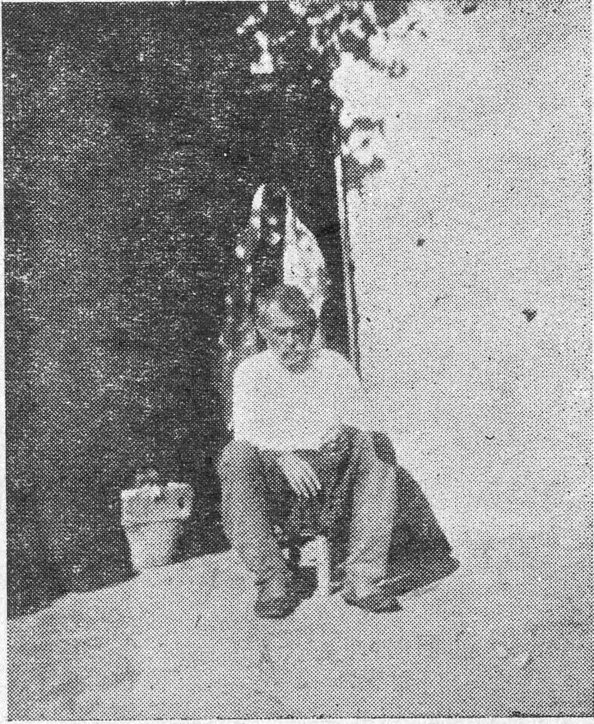
Uncle Bou Salim