other consideration; there is the psychological side, which these books all but neglect. One well-known teaching book confines whole chapters of the book to a series of prohibitions, every one beginning with "don't" and ending with a short homily: (Don't do that...) (Don't touch this...) (Don't say...) (Don't talk...) (Don't rise from a gathering before...) — don't and don't and don't, in a preaching manner that wearies grown-ups: how much more the little ones, who arrive — and must arrive — at the discovery of their surroundings by experiment. Such a spirit is enough to make of the small child a vessel into which the preachers pour whatever they please, without allowing the child's individuality to take shape.
We hear those who call for model schools, but we hear no call for setting the teaching material aright. And how can schools be model schools if what is taught in them is not model material? There is no room here to point to the necessity of providing the model teacher — that is a separate subject on its own.
The composition of a curricular book — any book — for the teaching of any subject must be a complete piece of work, not at odds with the psychological theories upon which the model school and the model home are founded.
The Arabic curricular books lack, in their spirit, the quality of
being an auxiliary educational force alongside their technical, subject-matter task. The grammar books, for example, still hold up Zayd who struck Amr, and other examples of the kind that cannot breed in a child any human sensitivity.
Love is a trait we must plant in the small child so that it becomes part of his very character, and I do not believe that an example like Zayd who struck Amr and hurt him can lead to anything of the sort... Why, one wonders, should it not be said that Zayd visited Amr, or something of that kind??
Or why should the arithmetic book not be turned to serve an educational purpose too, alongside its subject purpose, so that its examples close with much care and much aiming at the mark — saying, for instance:
Since Ghalib was a kind boy who humored his little sister, his mother rewarded him with three apples; he ate one of them and gave his sister one — how many has he left?
And why does the Arabic reading book insist on vexing the pupil with its strange vocabulary, its preachy matter, and its dry presentation, in a fashion the grown-up can hardly endure — how much less the child? I could wish there prevailed in our books a spirit like the one we feel in the foreign reading books, when
they resort to color, to invention, and to the help of sweet, attractive pictures, and when they touch in their stories on human themes of kindly bent — like the story of the princess who loved the prince because he was a hero and a gallant who helped the weak and the poor. The word "love," or "affection," rarely appears in our Arabic curricular books; and if it does appear, it is with the sensation of one who feels he is mentioning before the young something that must not be mentioned, or broaching a subject the want of frankness about which is still a force of hideous repression in our young people.
And after all this, the difficulties of the Arabic book prescribed for the young are still being raised and taking on solid shape; the men and women teachers feel them whenever they put them to the touchstone of the new methods. May all this, then, spur our friend whom we were visiting — who, I know, has in her head a plan for a curricular book on teaching the language to the young — to make haste in carrying out her plan; for woman has been, and remains, the nearer in reach to the child's mind and psychology, and her book will in turn be a spur to others toward a similar attempt, so that the young may find in their hands books that join technique with charm and with the considerations of psychology.
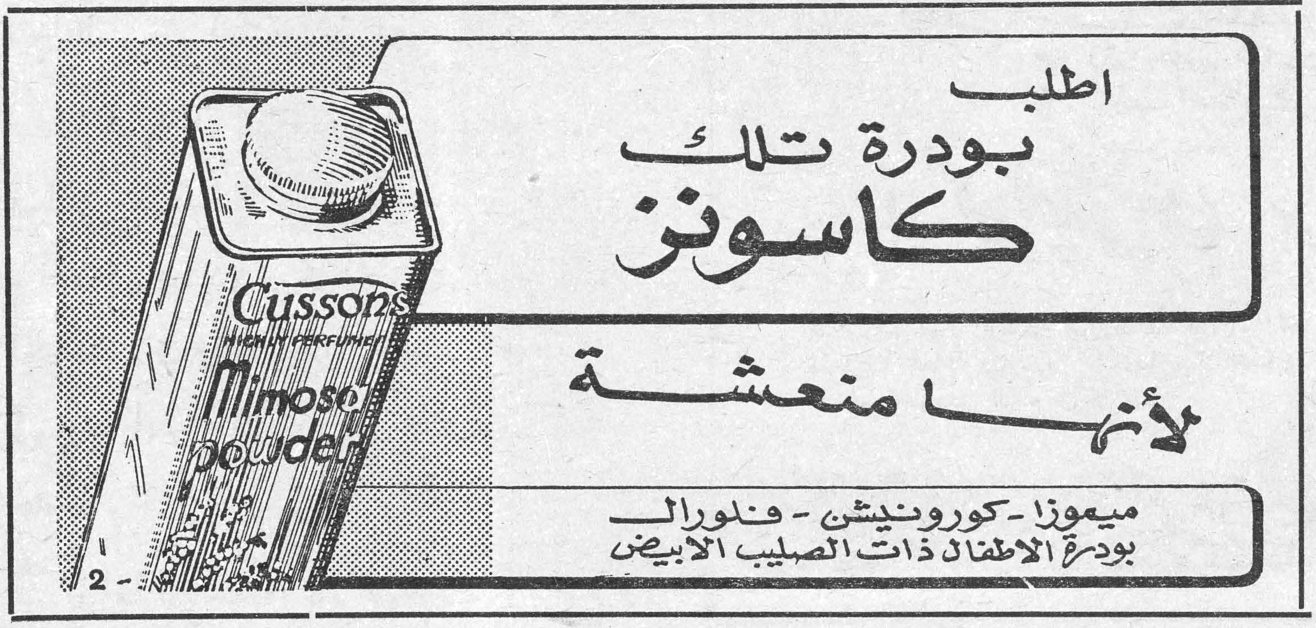
Cussons Talcum Powder
Ask for Cussons talcum powder, for it is refreshing
Mimosa — Coronation — Floral
The baby powder with the white cross
Cussons Mimosa powder