doing of any positive deed. Julia rose up in the face of this crippled state of affairs and revolted against it
with a wrathful revolt — she into whose depths Western thought had penetrated by way of her culture, giving her new impressions of social and even of spiritual life, and making her understand that she was a creature who could begin from herself, toward herself, and so create new customs, conceptions, tastes, and values suited to the pillars of her own personality.
Julia understood that she was responsible for her own life — which means that she was called upon to build it as she herself wished, not as the man wished. And she was mighty and positive in her rebellion. Mighty, because she protested, as a human being, against the condition to which society had brought her to kneel. And positive, because she did not revolt merely for revolt's sake, but handed the daughters of her sex a program of reform in which she drew the fundamental lines of a rightful married life. She dared to say no to the worn-out, familiar conditions. She gave up everything; indeed, matters had dragged on longer than they should, and the time had come when woman must rise and march in the caravan of civilization. And she said yes, because from her very first move she preserved the moral values and made them the fundamental rule of the course she followed all her life; hence her refusal of final negation.
Julia demolished only in order to build, with her husband, a revolution whose effect reached far into the social order; it overturned conditions nearly a century old, and the two of them lit up the darkness of worn-out human dogmas, and contributed to a great degree to every constructive social renaissance, despite all the material and moral difficulties that stood in its way. Julia answered the call among the sons of the country, in word and in deed, to strengthen the bonds of harmony and union among the various creeds and customs; and the two of them made of their house, for the thinkers of that age, the connecting link and the knot of attachment and understanding among the people of the pen, of letters, and of patriotism.
Julia was pained by sectarianism, and by the splitting of the Lebanese into two mutually repellent camps. She kept this pain within herself and set her mind on fighting it, for she knew, with her piercing intuition, that the value of a thing lies in what shows of it, and that a person is called to account only for a deed that has come into existence and become subject to examination and debate. Conscience is quick in its shifts, rich in its currents — beautiful and radiant at times, ugly and feeble at others. But what is its worth if it remains a conscience that never passes beyond its owner to others, and never comes out into the stage of true action so as to bear fruit? Is a man called to account for the mere wish to kill, if he does not kill? And is he rewarded for the mere wish to spread good over humanity, if he does not truly act to accomplish it?
Badr and Julia worked to wipe out sectarianism, and
their work began with their own life: each of them respected and hallowed the beliefs of the other, and they gave to Lebanese society children who love both religions and hold sacred the creeds of both religions — because man has never yet, since he was fashioned a man, been able to separate his thinking from his feeling. He would weigh reason above feeling; but feeling refuses to occupy the second place in which the idealist would set it, and insists on running side by side with reason, so as to dye all its decisions with its own dye, by virtue of its partnership in judgment.
The child who grows up in the arms of a Christian mother is bound by his feeling to hallow Christ and the Virgin Mary along with the performance of his spiritual duties. And the child who is reared in a house managed by a Christian mother cannot but love Islam and defend it. Lebanon will never be rid of its internal crises and its sectarian problems until we raise our children to love all sects and all religions, as Julia and Badr did. They drove the first wedge into the edifice of sectarianism in 1913, and they went on fighting it until time folded them away into the darknesses of the other world.
They were two free human beings who affirmed their selves without ceasing, and who answered to the reality of their labors; they chose, and took upon themselves, the gravest and the noblest of tasks, and they marched with their homeland in the caravan of civilization, fighting every current that stormed against its being, whether cultural, political, or sectarian.
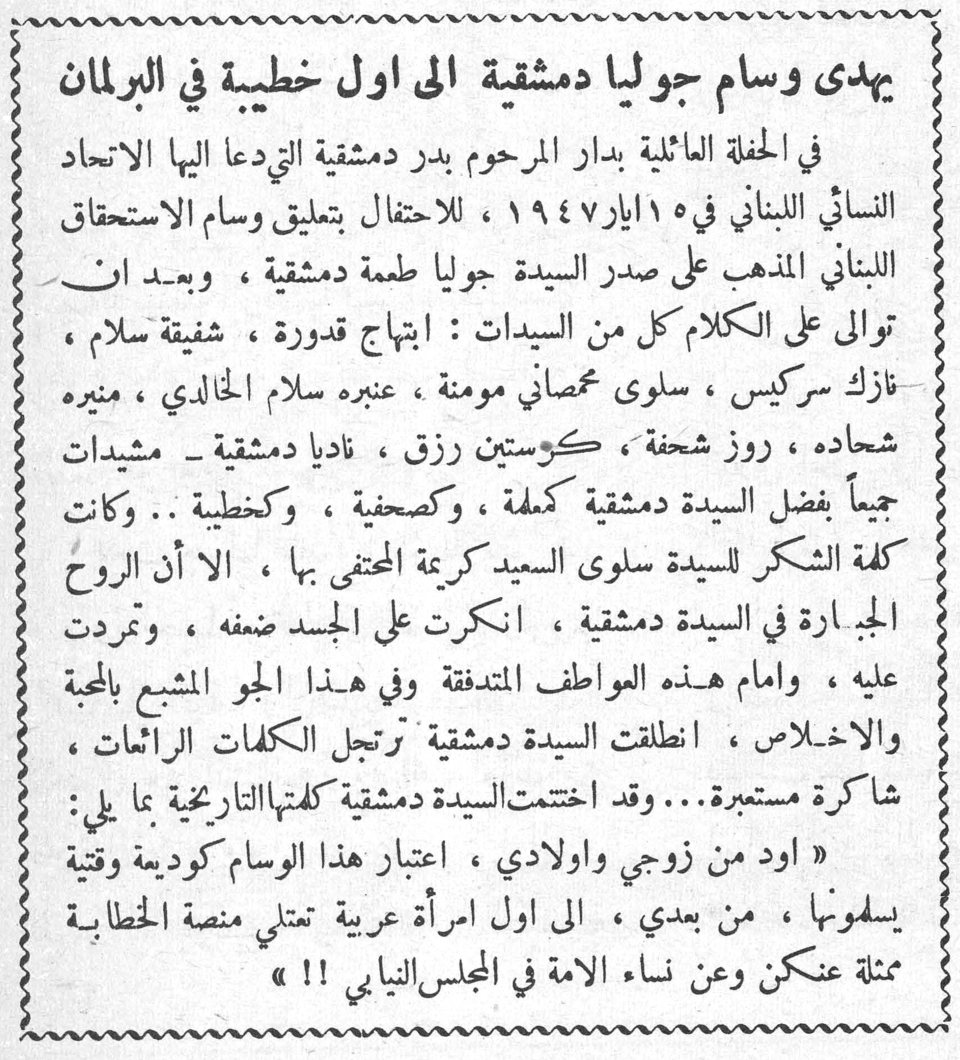
At the family gathering at the home of the late Badr Dimashqiyah, to which the Lebanese Women's Union issued invitations on May 15, 1947, to celebrate the pinning of the gilded Lebanese Order of Merit upon the breast of Mrs. Julia Tu'mah Dimashqiyah—and after speeches given in turn by Mesdames Ibtihaj Kaddoura, Shafiqa Salam, Nazik Sarkis, Salwa Mahmasani Moumina, Anbara Salam Khalidi, Muneera Shehadeh, Rose Shahfa, Christine Rizk, and Nadia Dimashqiyah—all paying tribute to Mrs. Dimashqiyah's merit as teacher, as journalist, and as oratress—the word of thanks fell to Mrs. Salwa al-Sayyid, daughter of the honoree. But the mighty spirit within Mrs. Dimashqiyah denied the body its weakness and rebelled against it; and before these outpouring emotions, in this atmosphere saturated with love and devotion, Mrs. Dimashqiyah launched forth, improvising splendid words, giving thanks, going on... And Mrs. Dimashqiyah closed her historic speech with the following:
"I wish my husband and my children to regard this medal as a temporary trust, which they shall hand over, after me, to the first Arab woman to mount the orator's platform as your representative, and the representative of the women of the nation, in the Chamber of Deputies!!"