in parade; the last car represented a Lebanese girl seated before the kibbeh mortar, under an arbor from which hung clusters of grapes of every kind and color, while young men danced and sipped arak to the sound of the shepherd's pipe.
After the parade of cars, admission to the exhibition was announced. Its wares were spread out under the cypress and cedar trees, and the governor and his party set off strolling about and reviewing the industrial and agricultural varieties on display.
They went along surveying the craftsmanship of Jezzine until they reached the pavilion of Maroun and Emile Abdelnour, built of pine wood, in which were hung knives of every kind; he also exhibited a great dagger fitted with spangles and mosaic that commanded admiration.
The procession then resumed its way to the pavilion of the energetic Jezzine craftsman Mr. Karim Qattar, famed for his art in Western-style wares.
When the review of Jezzine handiwork was over, the turn
came of the agricultural products, where varieties of legumes and fruit, modern farm implements, and poultry were on display.
• On the eighth of September, seventy newspapermen and newspaperwomen accepted the invitation of the American News Office to visit the Damascus International Fair and to see 'Cinerama,' a three-dimensional film presented by the United States. After a sumptuous dinner given by the Office, the seventy journalists proceeded to the open-air gathering-place, and there passed two hours that were, in truth, the most delightful thing they saw at the Fair — for the Cinerama machine carried them from Spain and the bullfight, to Milan and the opera 'Aida,' to the water-canals of Venice, to Vienna, and to the natural splendors of America — all this and more to the accompaniment of stirring music, the like of which they had never before seen or heard.
On this occasion we promise our readers a detailed reportage on the Fair, to appear in the coming issue.
• The Palestinian Arab Women's Union invited, on Friday, September 3, a select company of people of thought to tea at the American University Alumni Club, in honor of Mr. Alfred Lilienthal, author of the book 'What Price Israel?'
The party was given on the occasion of Mr. Lilienthal's presence in Lebanon, and the circles of guests gathered around the honored guest in an atmosphere of affection and good cheer, owing to the warm friendship this American author bears toward the Arabs — a friendship made plain in his book's glorious defense of the Palestine question.
The president of the Palestinian Women's Union, Mrs. Wadia Khartabil, welcomed Mr. Lilienthal and drew his attention to the great importance which the Arabs, and the refugees in particular, attach to the new book he is now engaged in writing — a book which, it is hoped, will contain a truthful picture of the million Arab refugees in their desperate condition, together with positive, practical proposals to help restore them to the homelands that were usurped from them.
Then the guest of honor rose and, in his quiet tone, gave thanks for the lofty sentiment his Arab friends had returned to him in every Arab country he has visited, and especially in Lebanon; he went on to explain the difference between Judaism and Zionism, asking that the two not be confounded, and hoped, in closing, that he might always prove worthy of the good opinion of those who have placed their trust in him.
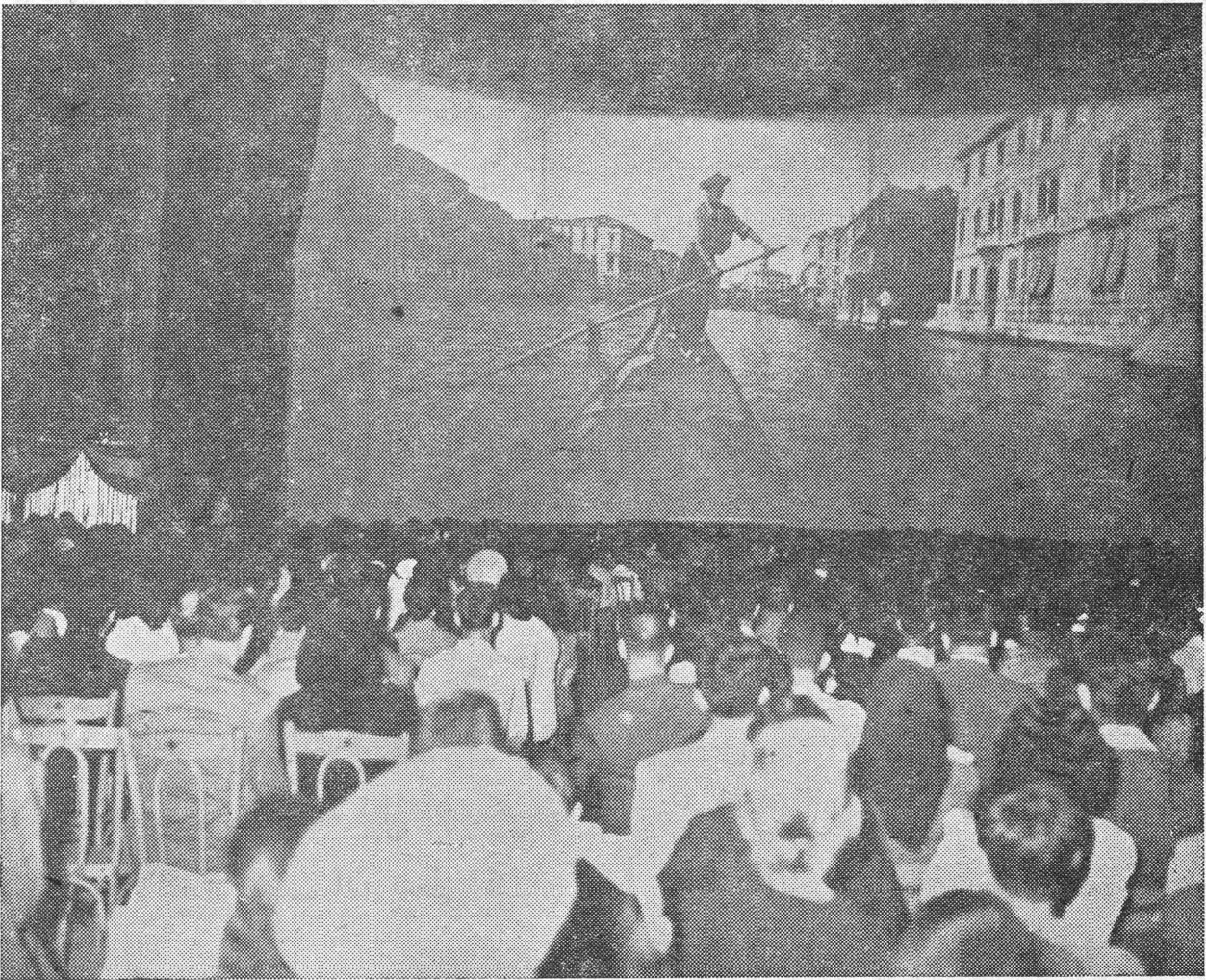
The crowd of spectators during the showing of one of the scenes of the canals of Venice in 'Cinerama'