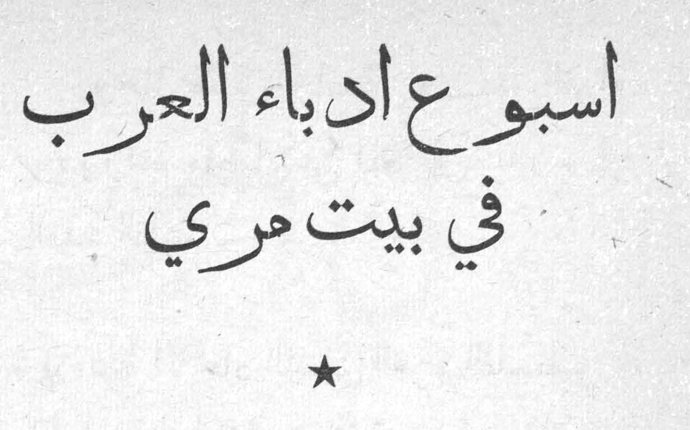
If life is movement, activity, and fruitful work, then the Ahl al-Qalam Society has proved, in the congress it convened at Beit Mery, that its veins throb with the heat of life, and that the Arab writer is bracing himself for fruitful work with complete ardor, so as to carry out his mission toward his nation in full.
And the writer's mission is arduous, its goal far off; none succeeds in fulfilling it but he who has been granted the endurance to bear hardships, and given the patience to cross distances however vast.
One of the results of this movement was that it set the writers of Arabic face to face with what is asked of them; it is thus a blessed movement, bringing us good tidings of arrival at what we long for. Let us, then, keep every gratitude for those who labored for it, and offer them every thanks.
The most important thing I observed in the honorable members of the congress — a handful of the writers we know — is, on the one hand, a complete comprehension of the mission to which they are called, and, on the other, an admission without evasion that Arabic literature has fallen short, until now, of examining the problems of the Arab nation.
And to know the disease, upon my life, is no small thing; so long as the physicians of Arabic letters have understood the disease, they are without doubt in earnest about finding the remedy. Every
problem that confronts them is, after that, secondary... For to feel the need of a thing is the road to finding that thing — or has it not been said that necessity is the mother of invention? The important thing is that they have felt the need to face any problem on the road to arrival.
Among these problems is an important one, the problem of the duality of language, which Mr. Fouad Ephrem al-Boustani laid on the carpet for discussion. This problem will certainly find a solution suited to the writer's need; it is not for the writer to halt the wheel of his progress because of pebbles that lie across his way; rather he must strive to smooth his road and pluck these pebbles from his path, and that comes only by persevering in earnest and by facing difficulties with courage and daring.
As for the duties of the state toward writers — facilitating the means of production, protecting literary property, granting freedom of thought and of speech, and securing a dignified livelihood for them — and then their own duty in the state and in Arab society, Mr. Abdel Halim Abbas examined all this with much awareness. This has already begun to find its natural, spontaneous solution; otherwise how could this congress have managed to convene, but for what was expended for its sake in material and moral encouragement? And how could the writer have wrested this right, but for his attempt to perform a duty he understood aright? For duty and right are joined and interdependent; the one does not exist if the other does not. Nor do we deny that it is in the nature of letters to be a giver before being a taker, and the writer must give before he takes.
Dr. Mustafa Jawad examined at the congress a vital subject
which we cannot but liken to the operation of transfusing new blood into the body of a sick man, giving him strength and vigor so that he pulses with life once more. This operation is the effective methods that lead to creating terms which express the needs of modern society in science, philosophy, and literature, and to unifying these technical terms in all the Arab countries together — a long-breathed labor, not accomplished between one day and the next, but demanding effort, sincerity, and disinterestedness. And then, is not this work of the very substance of the mission of the writer, whose task it is to portray his age and his society? How shall he portray them if he does not provide himself with the tools to do so — and what are the writer's tools but these words?
And we may say that the subject which Dr. Kamil Kilani treated with such freedom was among the most delicious subjects of the week of letters — not to mention the poetry evenings that ran through this week, brimming with pleasure and enjoyment.
In setting down these words we do not mean that the literary congress was complete and comprehensive — that could not be, this being the first time such a congress has been convened — but we do say that the benefits it yielded were many. And as we congratulate the Ahl al-Qalam Society in the person of its president, Mr. Salah Labaki — whose labors in this cause the country has appreciated, presenting him with the Order of the Cedar in the rank of Officer during the visit the members of the congress paid to the House of the Nation — yes, as we congratulate him on this recognition, we say: may every congress find the people of letters well and advancing.