Kanaan: It is embarrassing in the extreme for a stay-at-home mother like myself to take the field against two capable educators like Mrs. Cortas and Miss Dughan — who have sifted learning and teaching, and waded through understanding and comprehension, from the farthest ends of the earth to the nearest — ... and it would ever have remained so, had not a certain incident befallen me only yesterday. I was going over the matter again, as I do every time, drilling my child in her many lessons at supper before nightfall, as though I were a night-school teacher, after having worked as cook, seamstress, and nurse all through the day just past... until I found my way to the house of a friend, seeking "a change and a lift" and a recovery of strength after all the "explication and composition" — with a touch of the "headmaster"!
I knocked at the door... and waited a minute... during which I could hear from within threats, recitations, and noisy repetitions... I jabbed at the electric bell in agitation until the door swung open — and I would have imagined my worries had opened with it, had I not been met by a sufferer like myself, taking refuge in flight and blocking my entry. I was certain he was the "night teacher," pursued by my friend as she finished her apologies, paying no mind at all to the caller at her door...
Then, the cup having overflowed, I sharpened an arrow that has long cut into the souls of "wretched" parents, to hurl it at our schools: that they, even the primary ones among them, are an instrument for taking stock of what parents teach their children at home, instead of the school being perforce the medium of instruction and the parents an instrument of oversight for its teaching.
Cortas: You have brought it on yourself. And I will tell you why. Your two children are compelled to follow a double program of instruction: first, the government's program, which requires every Lebanese under twelve years of
age to receive all the subjects of study — arithmetic, geography, and so on — in his own Arabic language. Second: following the French program, which in its turn requires the study of the very same subjects in its own language at the very same age. So you see that by choosing a French school you have chosen to have your two children's shoulders burdened with two full programs at one and the same time — whereas the case is not so with us in the national schools.
Yakan: And what do you say about the raising of the standard of instruction that the national, American, and English institutes pursue year after year? While I stand with you in what you explained to Mrs. Kanaan, I think you will grant me this: that raising the standard of instruction ought to work as a stimulus, not a discouragement. That "raising" must not be carried out at the expense of the students' money and their time, implanting inferiority complexes in their souls until failing examinations, repeating classes, and the like become for them the natural course of things.
Cortas: I shall take up the answer
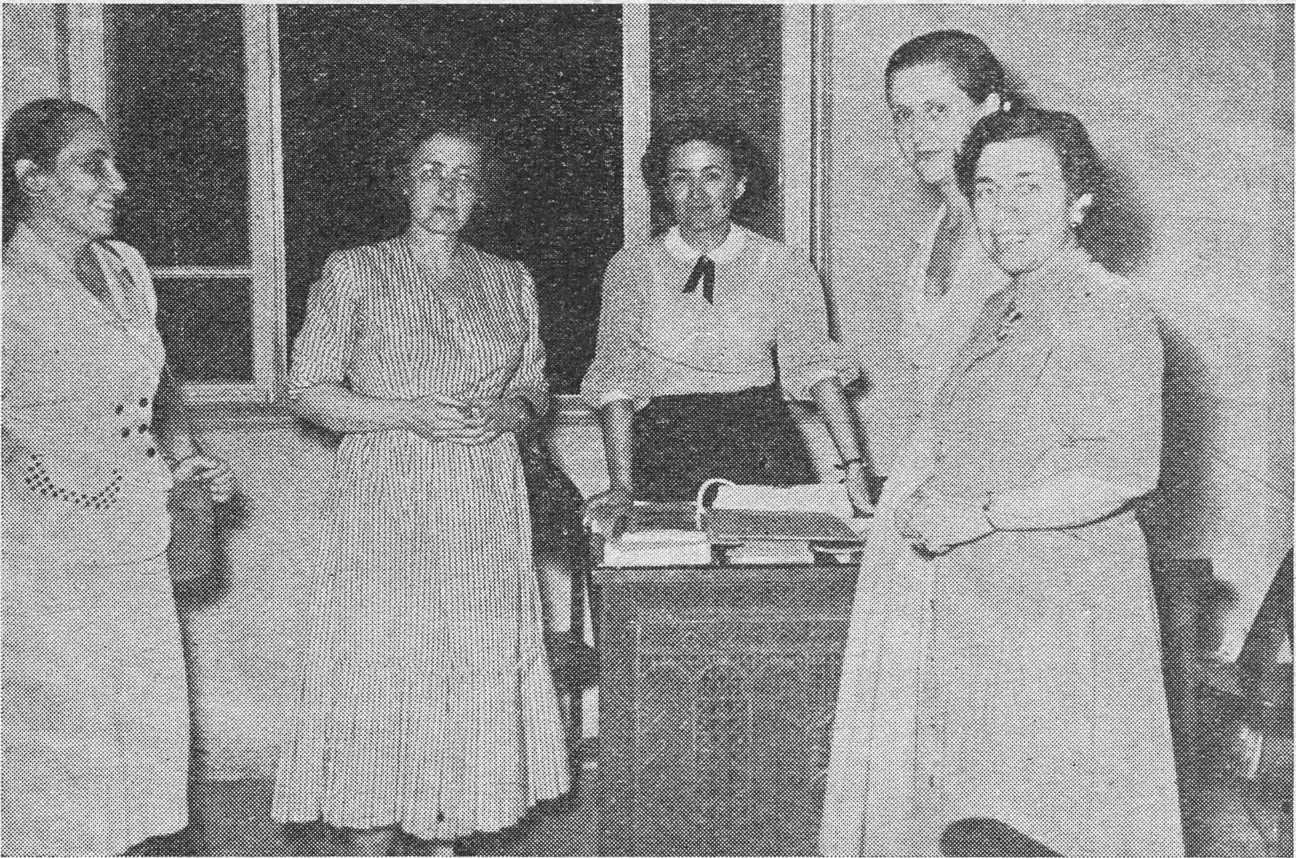
From the right, the ladies: Cortas, Yakan, Shayboub, Kanaan, and Dughan.