which our hearts brimmed... At the outset we went roaming the streets in search of some vagrant girl, whose guidance and schooling we would entrust to one of the government schools, or to a government hospital, as the situation required. We carried on with the work in this loose fashion, without any place of our own for our meetings, which we held by turns in our homes... But not much time passed before we had a permanent headquarters, taken at our own expense and fitted out, and we made ready everything needed to shelter those in whose faces the fates had scowled. Little by little we began to draw support, now from our own pockets, now by turning to those accustomed to backing charitable projects. We went on wrestling with money while money wrestled with us, until a law was issued permitting the Juvenile Protection Society, which works for vagrant boys, to assist another society resembling it in work and aim; and this assistance settled upon the 'Mabarra' — the only society working for the sake of vagrant girls... And so we began to cooperate with 'Juvenile Protection' — and in cooperation is a strength that leads on to success! Through its financial help our project was able to pass out of its narrow, limited bounds onto
its broad and fruitful road; and the Ministry of Education likewise took us under the eye of its care, assigning to us, to oversee the course of these unfortunate girls' lives, a deputy from the Police Directorate and a permanent matron..."
•
In answer to my question as to how the budget is secured in regular fashion, the president of the society, Miss Malak Kuzbari, said: "There is now in our society's treasury a surplus of money, gathered by way of charity fêtes, exceeding ten thousand liras... As for the standing springs from which we draw our aid, they are, in the first rank, the Khumasiyya Company, the Ministry of Economy, the boys' Juvenile Protection Society, and the Ministry of Education. Nor is the Governorate of Damascus without some share of the credit, for it provides the vagrant girls with their meal each day; and at times this meal reaches us by way of the Prisons Directorate, since we seldom receive the vagrant girls except through the police department — or when the vagrant girl is under arrest or under sentence — so that we may have a register to return to at need, or when the girl leaves us."
Then I asked her: And between what ages do the vagrant girls in your charge range?...
The president answered: "A girl is accepted between seven and eighteen, and she remains surrounded by our care and our attention so long as the term of her sentence has not ended or she has not been claimed by one of her relatives... In this stage we school her and train her in all the ways of life that will bring her onto the right road and fit her to be a good mother... Some of them marry from our house; some we place with one of the institutions or companies, or with the sewing houses, or in endowed homes; and another group returns to a husband's house or a father's house — all of it under our supervision and with our knowledge, so that if any relapse into wrongdoing occurs, we take the girl back into our arms until her soul is settled and the evil is driven out of her... And how often the miracle has unfolded swiftly between our hands, and we have found the fruit of our work sinking deep into the souls of these girls. The selfless love that shows in their eyes, in their treatment of us and their respect for us, is surely the best proof that this giving of ourselves does not go for nothing — and here are its results: blossoms going out into society, of whom we are proud."
•
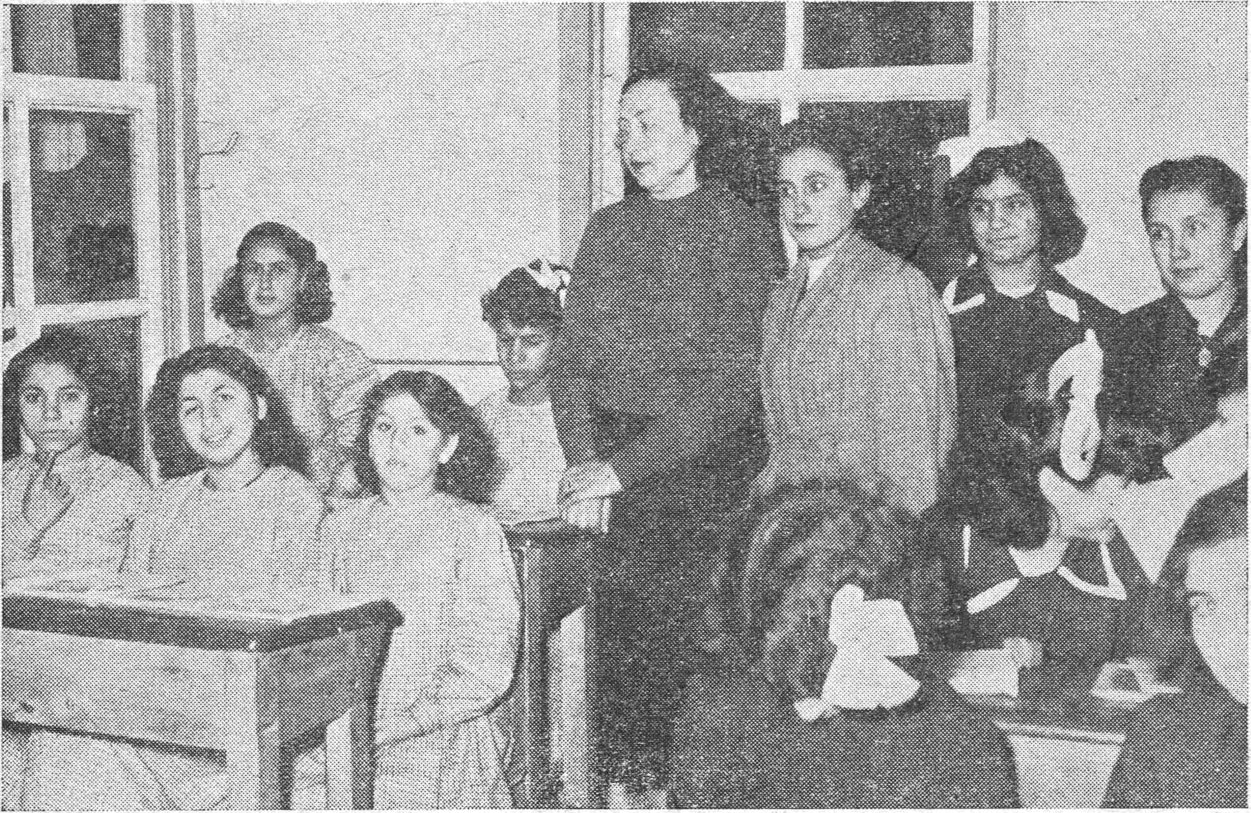
They are happy... even in class and under supervision!