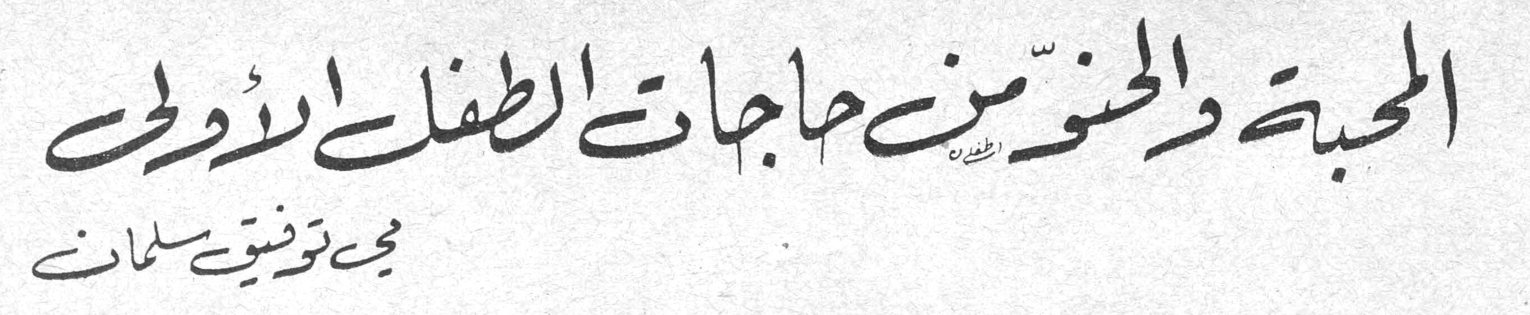
Most psychologists who specialize in the psychology of the child consider tenderness and love among the most important of the child's psychological-emotional needs.
Modern science has proved that there is no scientific or practical value in the loud outcries raised by the psychologist Watson around 1928, when he proclaimed his theory warning mothers and fathers against exposing their children to love and tenderness — whereby, supposedly, the child would be able to grow up normally, equipped with a capacity for self-reliance and with the good habits that would help him in his future independent life. This mistaken theory has been followed by many people, in old times and new, who boast that they pay no heed to the upbringing of their children but leave them to the will of nature and the whims of servants. I observed this method of upbringing when I carried out scientific studies in certain Beirut households, most of which were following this plan — which accords with Watson's theory — though ignorant of it.
Modern psychology, drawn from deep studies, proves how far Watson's theory stands from actual truth. Scientists unanimously establish that from the moment of his birth the child is in urgent need of the element of love and tenderness.
There are several ways of conveying the element of love and tenderness to the child: kissing,
cradling, hugging, smiling, and lulling; and by this sole language which the child understands in the first days and months of his life, we can prove to him that there is someone who loves him and cares for him. This necessary bond between mother and child in itself supports and completes their being a psychological unit after his bodily separation from her. From the sense of the psychological unity of mother and child, and the experiences and feelings that flow from it, he acquires reassurance in this world so strange to him,
and there begin the feeling of peace of mind, inner stability, and confidence in himself — the active elements in the building of a personality able to bear hardships and to ward off nervous and mental illnesses in the future. Freud has said: many of the causes of mental illness go back to the stage of childhood.
It is the duty of every mother to acquaint herself with these theories which science has proved. And I regard it as my duty, in the coming issue, to treat this subject at greater length.

The Gold Bug (Book Advertisement — Dar al-Kitab)
For your personal library
In the series
"World Classics"
Now published:
The Gold Bug
or the 13 most famous stories by:
Edgar Allan Poe
200 pages
Translated by Najati Sidqi
150
A Dar al-Kitab publication
The publishers
Dar al-Kitab