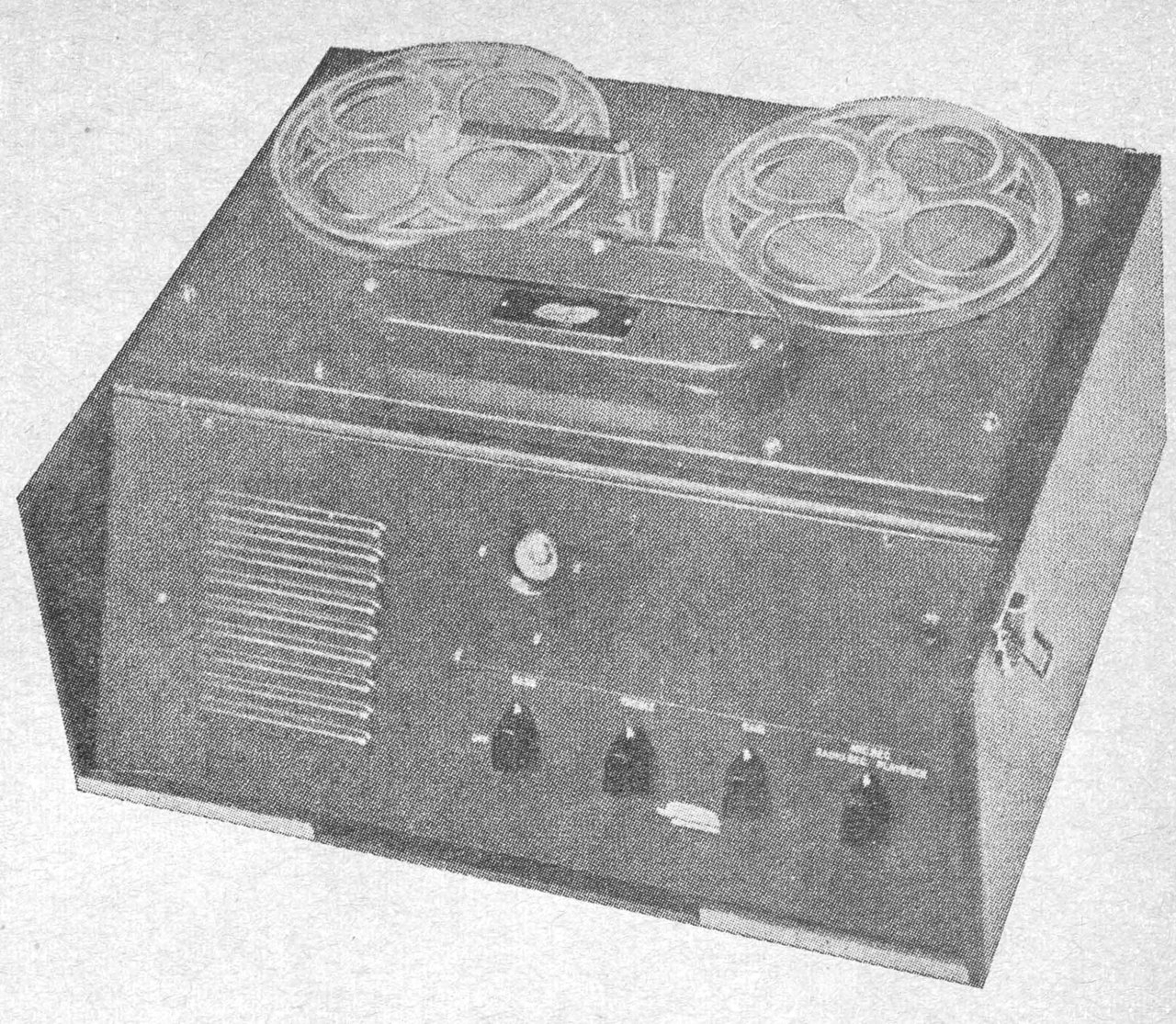
When Queen Elizabeth and Prince Philip were on their journey around the world, they recorded many conversations and interviews. They would withdraw to a quiet room and open a small case containing a recording machine, and talk to their two children as though they were close beside them. In this way they would send the talk to London, where the two little ones heard it in "Buckingham" Palace and then answered in kind, the tape carrying their tones to the ends of the earth. Thus the royal couple found an easy means of direct contact with their children, through one of the wonders of the twentieth century.
It is believed that some farmers today use the tape to hurry the pigs to their feed, since the sound rouses the animal's appetite and an insistent desire to take its fodder. One wife used the tape to record
her husband's quarreling, for the judge to hear! And so we find that the tape has begun to spread far and wide, until it has taken the camera's place in recording parties and weddings. Some mothers use it in ordering their children's lives: the mother sets the reel turning the moment she feels a quarrel has broken out among them, and this affects them more than a scolding would.
The little ones like a story not to be told always in one mold, and one mother acted on this idea and recorded a number of short tales, which the children hear whenever they wish.
Sound affects the feelings more than pictures do, and so it performs a splendid service in preserving sweet memories. It records singing, speech, and music all alike, and it has become possible to obtain a musical collection more plentiful
than records; and whenever you think of wiping the tape clean, that is very easily done.
Recording renders the voice clearly and enriches the recreational side of the lives of individuals. It seems most amusing to use the tape in study: some university students record a lecture, then hear it over again while going through the morning "routine" — dressing, for example. Fidelity in transmitting sound, and the ease of erasing the tape, are the two basic causes of its spread; and it has come as the fruit of many years of experiment. It is no larger in size than a typewriter, and inside it is a reel on which the tape winds, usually provided with something to prevent rust. During recording the tape turns by electric power, which converts the waves of sound into electric vibrations, and these develop into a magnetic state that reproduces the original sound. The greater the speed, the greater the fidelity in preserving the genuineness of the sound.
The ear passes judgment on the sound, but feeling has its place too, for choosing this machine is like buying a car or a refrigerator: the aim is to fill some need. So try the tape if you think of acquiring one — with music or with talk — and do not trouble yourself over mistakes: you can erase it whenever you wish!