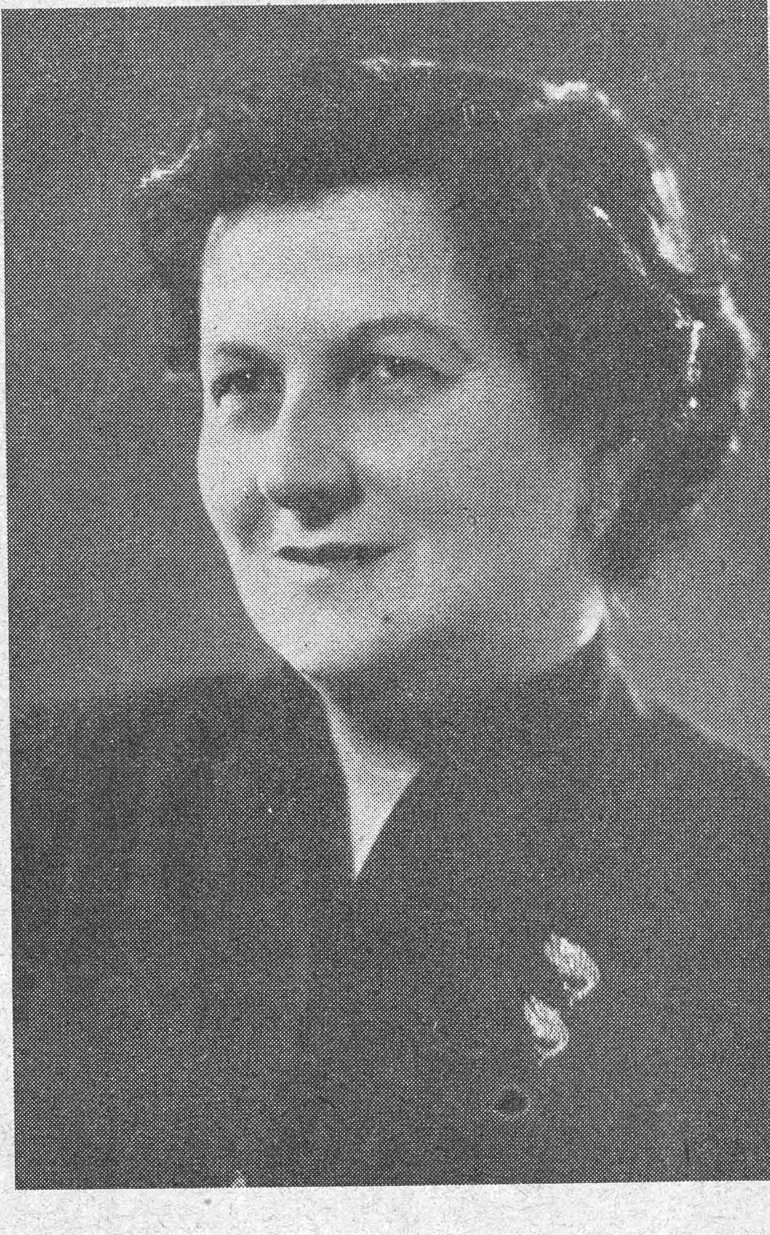
Mrs. Nabiha Najjar is the wife of our minister in Moscow, Mr. Abdullah al-Najjar. She is one of our accomplished ladies, a graduate of the American School for Girls and of the Institute of Household Management in Sydney, Australia.
Mrs. Najjar accompanied her husband as chargé d'affaires in Transjordan and as legation counselor in Argentina, and for the past four years she has been her husband's right hand at our legation in Moscow. Mrs. Najjar has her own contacts with her surroundings; in her travels she has learned Spanish and Russian in addition to French and English. She is fond of objets d'art, of the theater, and of the ballet, besides being a model housewife, accomplished in the arts of cooking and sewing.
The magazine The Woman's Voice seized the opportunity of Mrs. Nabiha Najjar's presence in Lebanon to present her to its readers in an engaging conversation about life in Russia:
Q — It would delight the readers of The Woman's Voice to know something about Russia, whose new system has been shrouded in much obscurity and in propaganda of various tendencies. Now that you have lived there four years, allow me to ask you about your impressions of life in Russia.
— It goes without saying that the civilization we know, in its various countries, is the civilization of the upper class, not of an entire people — or what the Communists call capitalist civilization. It
differs from one country to another only in degree. This is the basic difference between the Communist countries and the West. The first phenomenon that confronted me in Russia was the homogeneity of the people, the disappearance of the dividing line between classes, and the equality of countryside with city — that is, the proletarianization of workers and peasants alike in material and intellectual opportunities and in the rest of the blessings of civilization.
Q — You mean there is no difference between one person and another — that they are all one class?
— No. I do not mean by that that there does not form a kind of upper class of those with artistic gifts — musi
cians, actors, painters — and intellectual ones — writers, poets, authors, scholars — as well as of rulers, leaders, and senior officials. Soviet civilization is distinguished not by material opulence, nor by the emergence of a special upper class, but by comprehensiveness. Comprehensiveness in the provision of opportunity and in the universal spread of learning and of health and civic benefits is the most striking thing to be seen in the Soviet Union — material and cultural comprehensiveness, whether in Russia or in the land of the Uzbeks, in Armenia or in Latvia.
Q — What has been the effect of this system on the life of woman?