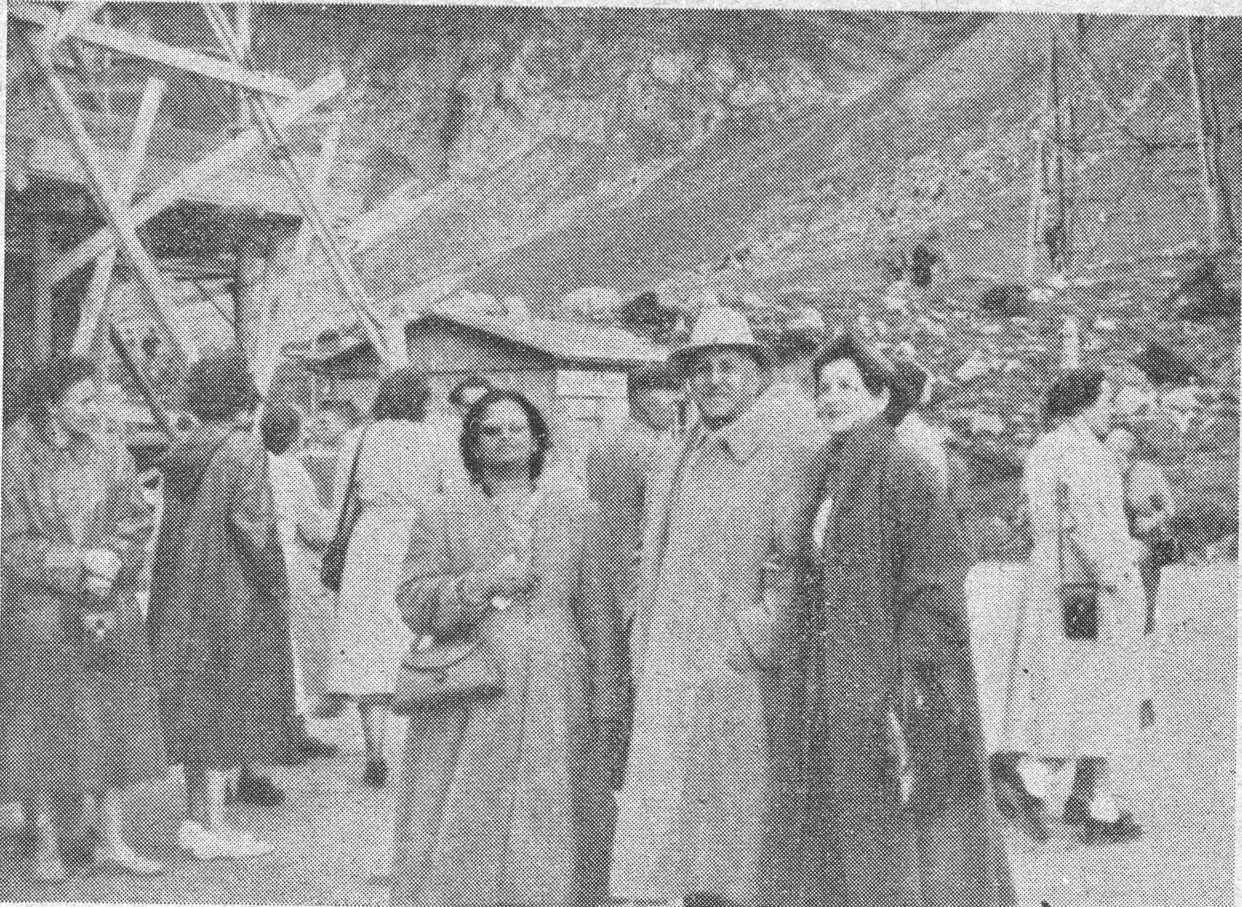
Mr. Abdullah al-Najjar, with his wife Mrs. Nabiha appearing at his left
— Everything in Russian — or rather Soviet — life bears the stamp of difference from the West; how much more, then, does it differ from us? It is subject to a swift, sweeping evolution — no wonder it has been described as permanent revolution. It seems to me that when Churchill coined the name "behind the Iron Curtain," he did not confine the term to the political difference; he meant by it also the difference in the very foundations of civilization between the old world and this world, in which the greatest social experiment in the history of mankind is being carried out.
In this world woman enjoys complete equality with man. Among the most striking features of Communism is the removal not only of class distinctions but of the distinctions of sex between man and woman, in rights and in duties, throughout the whole Soviet Union — in the Christian and the Muslim regions alike. And in the Soviet Union there are nearly forty million Muslims.
Woman there went through the last war side by side with man, and joined him in the movement of popular resistance. She now
stands with man in the positions of responsibility. She has been freed from his traditional domination. It is a mistake to understand the word "Eastern" in the phrase "the Eastern camp" in its traditional sense — for in modern usage it signifies backwardness. We must therefore understand it in its geographical sense, not its civilizational one.
I have noticed that woman is more enthusiastic for Communist principles than man — woman, in all the ages of history, has ever been the nurse of creeds. (Among those principles is contempt for showiness, vainglory, luxury, and extravagance.) Yet by nature she does not differ in inclination from her Western sister, though the ordeals that have afflicted the Soviet Union from the great Revolution of 1917 down to the present have kept her from catching up with the Western woman in appearance and adornment.
Since 1950 — that is, since we have been in Moscow — the standard of living has been rising year after year. Every year prices come down by 10 to 30 percent — this year for the sixth time. In that first year the foreign
woman in Moscow would draw every eye among the thousands of women, with her elegant hat, her frock, or her shoes; and few among the men wore a necktie, or shining shoes, or a pressed suit. Now, however, one cannot tell citizens from foreigners by their appearance.
And woman, though she is still marked by the spirit and the seriousness of the Revolution, is like her Western sister in her love of finery and adornment, whenever she can find a way to them. I say this because I notice that foreign goods are rare in the markets of the Soviet Union.
Q — How, then, does woman quench that thirst?
— They, my dear, center their economy on the interest of the country, not on the whims of its people — and would that it were in our power to follow their example.
We can learn many things from the Russian woman: in her patriotic feeling, in her social harmony, in the care of her children, in the love of work, in economy in adornment and amusement.
Q — As the minister's wife, do you feel any special pressure upon your social life?
— We do not mix with Russian society. They avoid forming social ties with members of the diplomatic corps, who do not stay long in their country — the term of service is usually two years. But I know that the Russian woman neither gambles nor fritters her time away; rather she takes part in every side of social life with the same energy as the man.
Q — How do you spend your leisure hours, and how do you face the weather?
— In the face of this deprivation of social mixing, we enjoy the closest of ties among ourselves — invitations and banquets. But the most delightful thing in Moscow is the ballet, which has no equal,