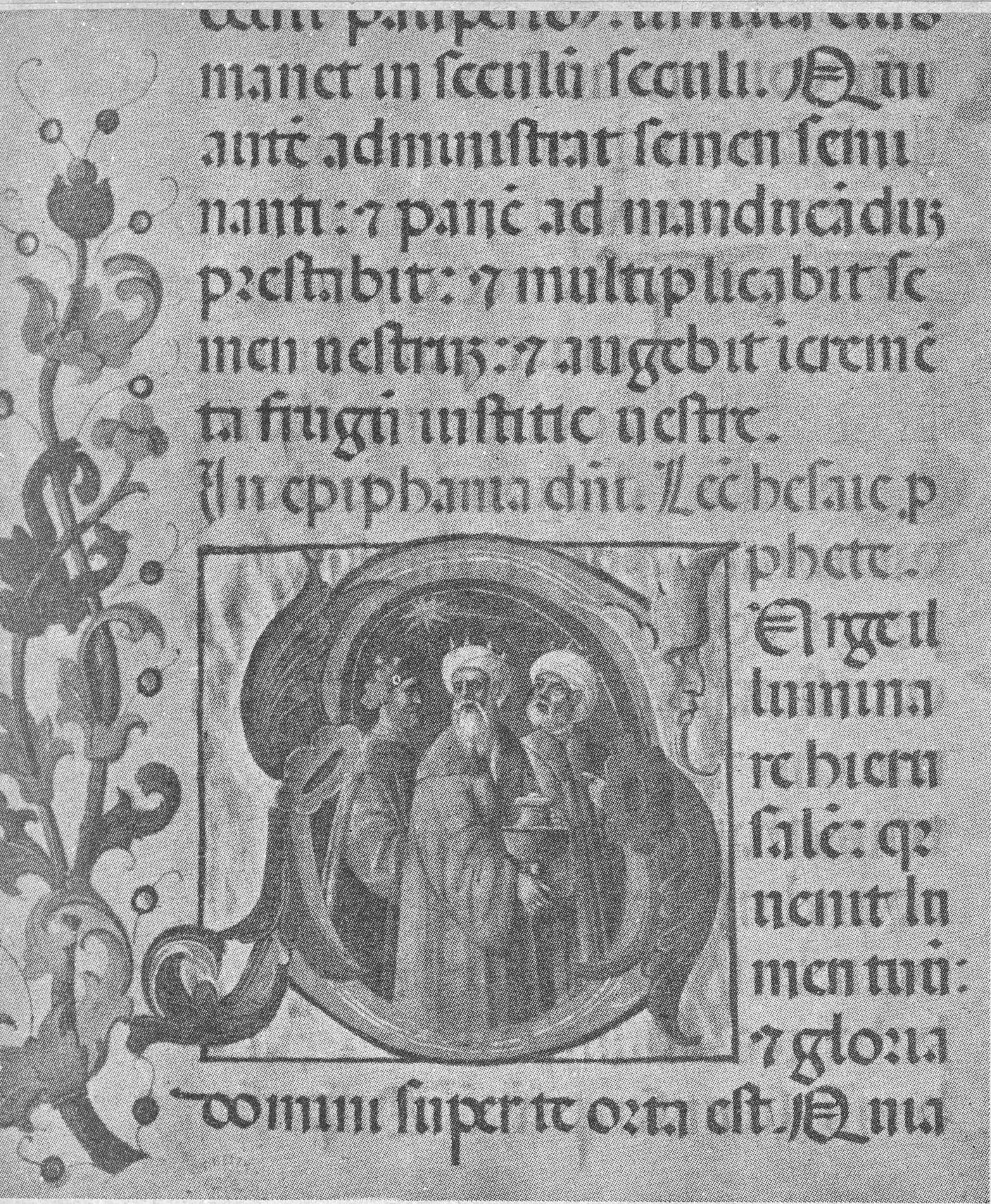

Among all the legends that surrounded Christianity in the Middle Ages, the story of the Magi prevailed, eclipsing every other tale!
The imagination of the Middle Ages built a splendid legend upon the coming of the Magi to visit the Child Jesus, bearing him frankincense, myrrh, and gold; yet the story is not a mere fancy or an invention of the imagination, but a fact which the narrators afterward embroidered.
"Caspar" offered gold, "Melchior" gave frankincense, and "Balthasar" brought the dear Child myrrh; and the Little One smiled upon them and accepted the gifts with thanks; then, that night, they slept in peace!
It is said that "Caspar" came originally from Tarshish, and Balthasar from Sheba, both towns lying on the road to India.
Tarshish stands on the shore of the Red Sea, and Sheba stretches along the coast of the Indian Ocean and the Persian Gulf; and it is thought that "Melchior," whose name is Semitic, was a king of the Arabs before Islam, in his
kingdom lying near the Red Sea and facing India.
What proves that the three kings had a connection with the south Arabian lands is that the youngest of them was a slave, and "Zimbabwe," where the Arabs then dwelt, lay within the land of the slaves.
There is a curious legend which tells that a contrary wind blew up and cast
the three kings upon the land of the English after they had left the Holy Land — and inns bearing their names remain there to this day; then they visited the king who was
held in prison together with Paul the Apostle. Even after their death the kings continued their journey: Saint Helena carried their bodies to Constantinople, where a sumptuous tomb was made ready for them.
One day, Saint "Eustorgius" was speaking with the Byzantine Emperor about their need of treasures with which to adorn the new church in "Milan," and of glorious historical relics; so, together with the statues, the Emperor presented him with the remains of these kings, preserved in his empire. Frederick Barbarossa invaded Milan in the year 1162, and the remains were moved to a safe repository; but the invader soon seized them and presented them as a gift to the Archbishop of "Cologne," who prepared for them a magnificent shrine, which escaped the uprising of the French soldiers! And when "Cologne" was struck in two wars, the shrine remained unharmed; and the devout Germans gaze upon it, repeating: "The three kings have never ceased to offer their gifts"!