naturally, to produce bodily effects: the movement of the blood quickens and rushes to the places in need of activity, and the motion of breathing changes. All this is natural, and it causes no illness, because the activity feeds the necessary movement; and if the person escapes without being harmed by the animal itself, the effect of the battle ends at that point. But if he grows angry or afraid and cannot manage resistance or response, the effect spreads over various regions. Let us suppose he does not know his enemy, or that this enemy remains within two bowshots of him for days on end—and this happens often in our society: a man may be thwarted at his work by a chief he detests, the mere sight of whom stirs the depths of his soul, and yet he can do nothing but show him respect and courtesy; or he may find himself living with a wife (or a husband) who is forever disquieting and vexing him. In such conditions the activity remains pent up in the body; it does not seep outward in a headache, nor does the stimulus fade away; and the result is a lasting disturbance which exhausts the strength, crushes the will, and produces many bodily disorders—and this is the road by which illness begins.
The quantity of emotion can show itself in three possible ways: movement, speech, and thought.
Movement is stronger than speech and expression, and speech is better than thought—though this does not deny the importance of thought.
Some try to fit their lives to surroundings they detest by turning their thinking into another channel.
The danger does not depend on the kind of emotion, but on the results issuing from it; and the person's constitution and surroundings become exposed to illness.
One doctor carried out an examination of a thousand patients with diabetes and diseases of the heart, and found that one of them had been suffering mental pains in the course of it, being on bad terms with his directors; he strove beyond his strength to rise so that they should have no authority over him, and he married, and the responsibility increased.
Thus the doctor found that the
illness comes after a great failure in one's work, or the sudden death of a person one loves.
Early upbringing and environment have a great effect on the growth of the personality; exposure to shocks at an early age causes illness more than heredity does. The traces of inherited disease appear in the blood of the parents or of one of the relatives; but heredity does not lie in a broken bone, for example, or in the psychological condition.
Yet the child in many cases follows the paths of his parents, since they are the people who influence his personality most of all.
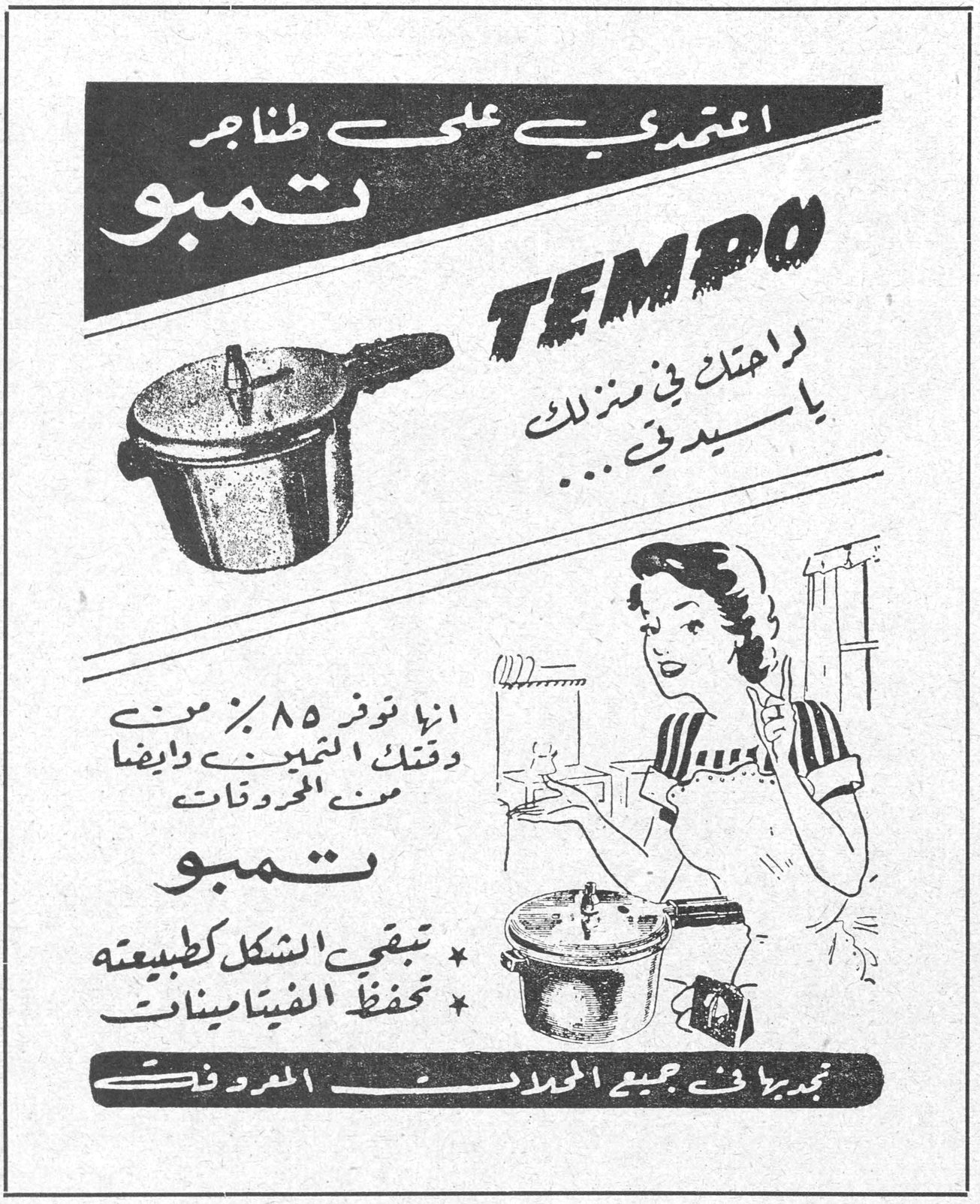
Tempo — TEMPO
Rely on Tempo pots, TEMPO
Your comfort in your home, Madam...
They save 85% of your precious time—and of fuel as well
Tempo
* Keeps food's appearance natural
* Preserves the vitamins
You will find them in all the well-known shops