Doubt, and want of faith, weaken the vitality in your own soul and drain it from your child's spirit, so that his aptitude for learning and knowledge shrinks.
Sullenness, harshness, and coldness are poisons that strip the child of his strength. The child needs an atmosphere of tenderness and love to help his growth; he looks about him, searching for loving persons on whose pattern to weave, for he seeks to find a mold upon whose shape to form his life.
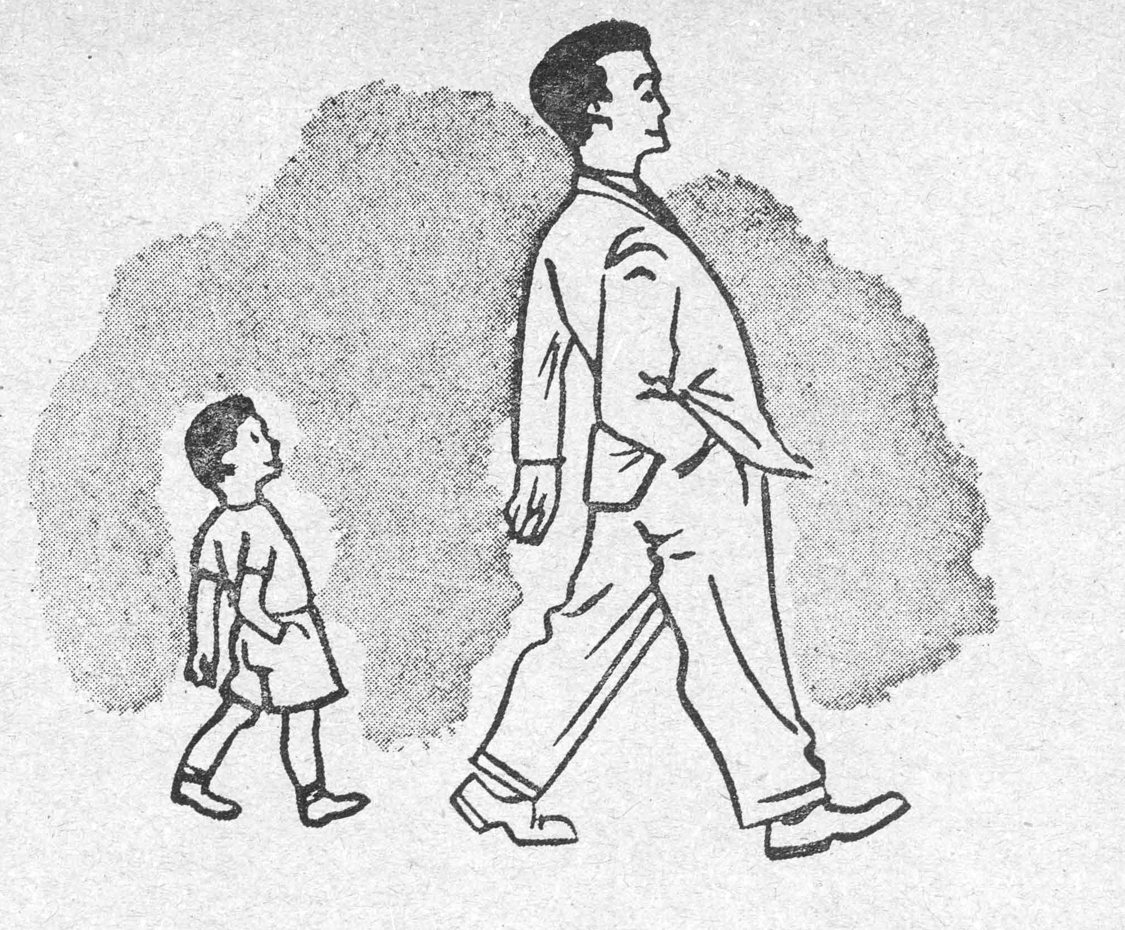
Watch a little girl of three: how she follows her elder brother, repeats his words, imitates his games, and cries if he will not let her use his bicycle or his chair.
Then look at this boy of six: do you not see how he follows in his father's footsteps?—"What do you want to do, Father? May I come along with you? Is this how you hold the knife?"
Your home is a school in which your child trains himself without knowing it; from you and from his father he takes
his bearing, his voice, and his way of dealing with others. A loving father, understanding of his son, told me that he was at the washbasin scrubbing his teeth, his left hand resting on his hip, while his right foot stood set against the other. It is a somewhat comical stance—and the child, four years old, stood watching his father and imitating him; without noticing, the father spat, and the child followed him with the very same act, imagining that he was cleaning his teeth—and the two laughed over the joke in an atmosphere of love and understanding.
It is your duty to live a calm life with your children and your husband, if you want them to follow in your steps; and be worthy of your child's trust, or else you will lose him.
The child by nature loves to try certain things out for himself, but civilization cuts across the natural channel—for it means waiting in order to learn. If you are patient, you will spare him the hardship of the collisions
he meets in the course of his growth.
In every situation we wish to give our children something of what we have gained from the experiments of life, and in this we cannot fix an absolute right or wrong: some peoples eat four meals a day, while we content ourselves with three; we see woman in one country as the mainspring of practical activity, while among us the man holds the reins; there are peoples who hold the cow sacred, while we permit the eating of it. Our children, however, must be taught our own ways—and only our love makes them follow them.
It is easy work, yet it is the educators' first duty; for what your child does not learn today he will meet tomorrow. The more you kindle the flame of enthusiasm in his soul, the greater grows his ambition to add to his learning; but if it goes out, his life is at an end. Educators, then, must urge the children on, with encouragement and allurement, to press forward along the roads of life.
The schools have improved their buildings to aid instruction, and much money is thus spent on aids to explanation, on moving pictures and music, and the administrations study books to find the best educational method. Then, at home, the family sets apart a special room for the young and puts into their hands games suited to their age. All this is among the merits of the age; but more important than it is the person's own self: what is our feeling toward our children? Have they trust enough—the wellspring of friendship and companionship?
This is the time in which the young have need of us, that they may grow up in an atmosphere filled with gladness and love, to face difficulties with a smile of hope!