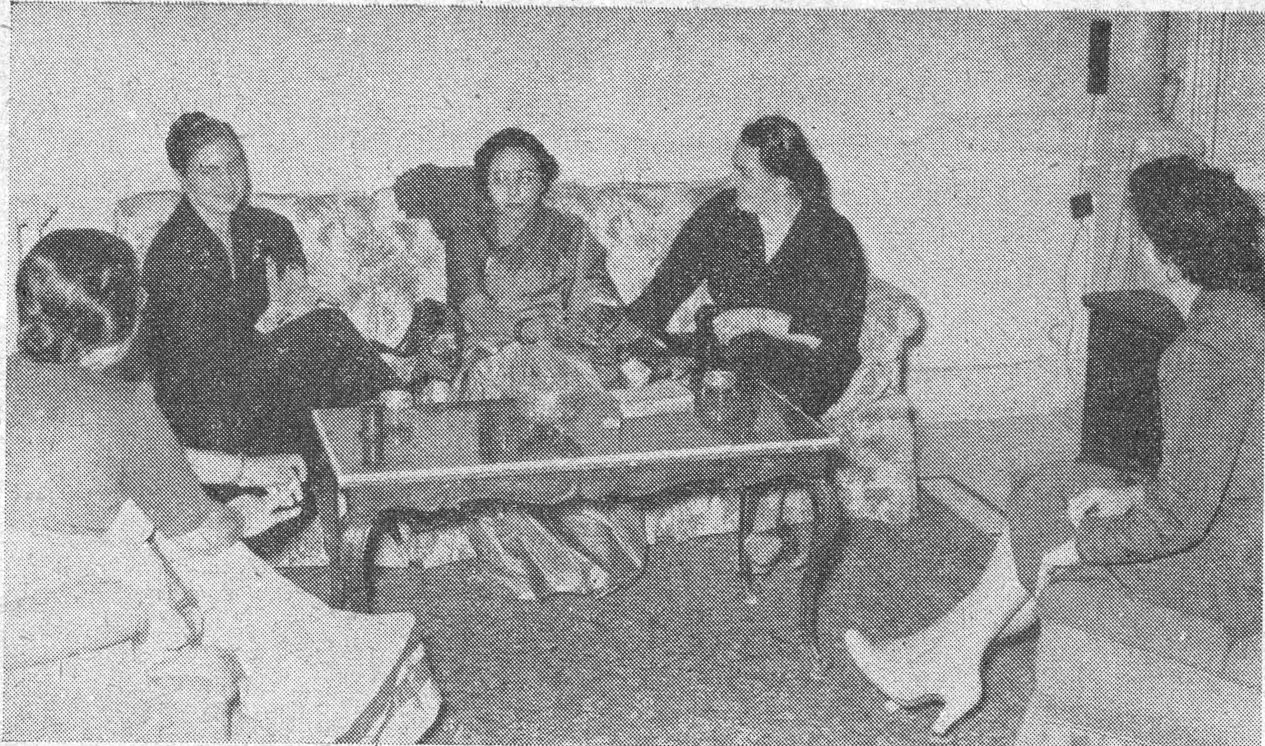
In the picture appear, together with the wife of His Excellency President Chamoun, Mrs. Qudrawi, wife of the head of the Indian news office; at her left, Mrs. Aizaz Rasul; then Mrs. Zahia Salman; then Mrs. Suad al-Radi, wife of the Ambassador of Iraq.
• Among the prominent personalities who visited Lebanon during the past month was a brilliant Indian figure: Mrs. Aizaz Rasul, the Indian deputy and veteran of the struggle, an active woman who has written for herself a glorious page in the history of her country. For 17 years Mrs. Rasul has represented her province in the Indian national assembly, and she was the first Muslim lady to enter that assembly. Mrs. Rasul has four children: two daughters — one of whom took a master's degree in agriculture at the University of Wisconsin in the United States, while the other is studying law — and two sons, one of whom is studying engineering in Germany.
Mrs. Rasul was among the Indian parliamentary delegation that visited Turkey at the invitation of its government; and on her way home she would not fail to stop over in Lebanon, where she stayed as an honored guest of the wife of the Iraqi Ambassador and of the wife of Mr. Fidawi, head of the Indian news office in Beirut.
Mrs. Rasul paid a visit to Mrs.
Zahia Salman, and the two of them had the honor of being received by the wife of His Excellency the President, accompanied by Mrs. Suad al-Radi and Mrs. Fidawi. The distinguished guest was full of admiration for the Lebanese First Lady, and the First Lady, for her part, showed every appreciation of this visit.
Mrs. al-Radi gave, in honor of her guest, an elegant tea party, to which she invited a number of ladies of note; in its course Mrs. Rasul spoke of the general renaissance in India, and of the women's renaissance within it — which made each of the ladies present wish that her stay in Lebanon might be prolonged, so that every Lebanese woman might make her acquaintance and learn of the great works she has performed for her homeland.
• At five o'clock on the afternoon of Tuesday, December 7, there opened at the UNESCO Palace the "Autumn Exhibition of Painting and Sculpture," organized by the Ministry of National Education and Fine Arts under the patronage of His Excellency
the President of the Republic. A very large crowd attended the opening, spreading out to visit the three spacious halls among which the exhibits were distributed — canvases, drawings, sculptures, and ceramic works by a hundred artists, men and women: established masters, rising young talents, amateurs, and students, representing the most varied tendencies, styles, and directions, whether in expression or in artistic craftsmanship.
The exhibition gives a complete idea of artistic activity in Lebanon — its present state, its future possibilities, and the directions in which it is moving.
The exhibition will remain open to the public until January 8, 1955, every day from ten to one and from four to seven in the evening. Do not let the opportunity slip; make certain, rather, to set aside a suitable time in which to wander among these works of art, and come away with a comprehensive idea of our artistic possibilities — today, and tomorrow.
With mid-December, three years pass since the departure of literature's lost one, the poet Fouad Suleiman. On this occasion a prayer service for his soul was held on Sunday, December 12, at Fiaa in the Koura, the poet's home, in which a company of family, devoted friends, and admirers took part.
We recall on this occasion that the permanent memorial committee is still hard at work, in fulfillment of the departed man's mission, on the publication of his literary works. Of these there have appeared so far: The Moon's Path; the Tammuziyyat, Part One; and Songs of Tammuz (poetry). In press are Parts Two and Three of his Tammuziyyat, and a book of literary criticism. May God have mercy on Tammuz.