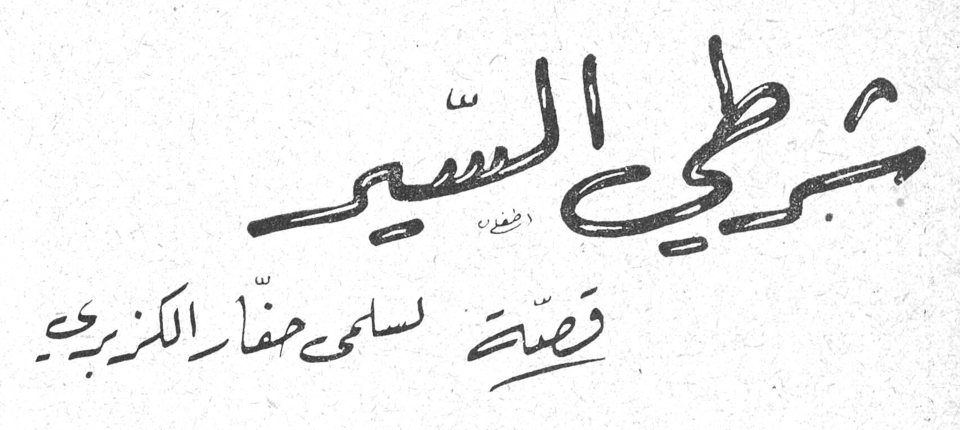
From "Fragrances and Wounds" — a collection of stories now in press
A strange story that happened to one of my friends with a faithful public servant who stands long hours every day, upright on his feet within a narrow, confined circle, to perform his sacred duty; with a patient citizen who works to preserve order and the safety of lives, exposed to the blaze of the sun in summer and the bite of the winds in winter for the sake of earning a few counted liras... exposing himself to the various ailments that usually result from long, fixed standing, and exposed as well to the rudeness of pedestrians and drivers of weak conscience and stony heart.
Yesterday, while I was picking a few flowers from my garden to adorn the house with them, the sound of a car stopping reached my ear. I turned toward the street and saw my friend Alya step down from the car, slam its door hard, and come toward me. Sadness was plain on her features, as usual. I called out to welcome her:
— Welcome, Alya! What is this sweet surprise? Do you come like this without telling me?
— I was sure I would find you, since I know you rarely leave the house in the morning. Shall we go in?
And we went in together. I did not suggest that we stay in the garden, because I was certain she would refuse. For nearly two years she had forbidden herself everything pleasant, even the enjoyment of the open air. Often I tried to persuade her of the need to bow to God's will and accept what had happened, but my attempts went with the wind. This young woman is the dearest to me of all my school companions, my most cherished friend. My heart aches for Alya! The merry Alya of yesterday, whose ringing laughter and echoing jests reached the very stars, has become today — though she has not passed her twenty-third year — a gaunt specter wrapped in black, a pale face in which burn two beautiful eyes that fill with tears at the slightest
cause. As for her charming mouth, which was scarcely ever without a smile, it has turned against her ever since it ceased to call the beloved's name.
I wondered at her sudden coming and realized it had some important motive, for she had not visited me since her grievous calamity befell her. At first I used to go and console her every day; then I came to visit her once or twice a week, until she volunteered to serve a small orphanage and began attending daily to the running of its affairs. That was about a year ago. My visits to her grew fewer, because she began going every morning to the orphanage, driving her car herself, then returning at noon to her parents' house after spending four hours arranging the registers, entering the accounts, and writing the daily report. She smoked a great deal and refused to see anyone, except the president of the charitable association that supported the orphanage, if she happened to come before noon to look into its affairs. Often she would bring home with her handwork — sewing and embroidery — with which she amused herself, then presented it to the association, which sold it, the orphanage benefiting from the proceeds.
I offered her the tobacco box and sat down before her, gladness flooding my soul, expressing my joy at her coming. She thanked me warmly and said:
— My condition is as you have always known it. I am not dead, to be counted among the dead, for I rise and walk and eat and drink... nor am I alive like the living, for I feel no working of life, no stirring of it within me; I expect nothing of my tomorrow, just as I care nothing for the pleasure of my today. Only, I wish my tie to the past never to be cut, so that I may live in it, with its delight and its pain, if there is no escape for me from living! I have come now, Da'd, to bring you a little of my new trouble. I have not seen you for two weeks — that is, since life tightened its grip on my throat once more. You know my story with the traffic policeman. He has vanished from his post, and I used to suffer and rejoice at once in casting a glance at his face and his figure once or twice each day from behind the dark glass of my spectacles — and you understand the worth of that glance and its importance to my thirsting soul and my deprived eye. That policeman's presence opened for me a way of living in the memory of the dear past; it spared me having to console myself with pictures and dreams, and it brought a great peace to my soul, as you know. What can have happened to him, I wonder? I must find him. I must know his fate.
I answered her calmly and hopefully:
— The matter is simple, Alya. Might he not have been transferred from his post in the "Salihiyya" quarter to another district? I believe the traffic