The policy of dividing the Arab elements and communities goes back to the era of Sultan Abdul Hamid
It was fated for the Ottoman Sultanate to live with its limbs disjointed, from the time when each of the foreign powers set about steering the Ottoman elements and communities in directions of its own choosing — directions calculated to lead to mutual repulsion, so that those powers might attain, in the fullest manner, their share of the inheritance of the "Sick Man."
And when Sultan Abdul Hamid (1876–1909), in the face of this foreign policy, was compelled to take refuge in the Islamic League and began to unite the Muslims around the Caliphate, the discord among the Sultanate's communities increased. For this policy led the non-Muslim communities to regard the Sultan as caliph of the Muslims and not as king over all the Ottomans. And while Europe — Russia and France above all — was laboring to gather the scattered Christian elements and communities in every region of the Sultanate and working to rouse them against it, the Sultan went on applying the policy of dividing the elements by every means; in line with this policy he separated the Bulgarian Church in Sofia from the Orthodox Patriarchate in Istanbul.
Meanwhile the Ottoman Arabs had begun to feel the stirrings of national sentiment from the late nineteenth century onward, under the influence of the foreign missions, schools, and consulates. The Sultan feared the consequences of cooperation between the Muslims among them and their Christian compatriots, whom he regarded as
the arms of the foreigners, and he hastened to sow dissension between them — above all in the lands of Syria, which had cut its path toward modern civilization before any other. He likewise continued dividing the Muslims themselves: he would set the Emir of Hail, Ibn Rashid,
against the Emir of Riyadh, Ibn Saud; enlist the Sharifs of Mecca against the Imam of Yemen; and stir the latter against the Emir of Asir — this besides casting enmity and hatred between the Kurds and the Armenians, and between the Arabs and their Circassian compatriots.
This policy — the policy of "divide and rule" — which the Sultan pursued, as the foreign powers pursued it toward Muslim and Christian in Turkey, led in the end to
making the meaning of the word "nation" inapplicable to the Ottoman people, given the divergence of its communities and elements in their aspirations and hopes, not to mention their divergence in upbringing and in
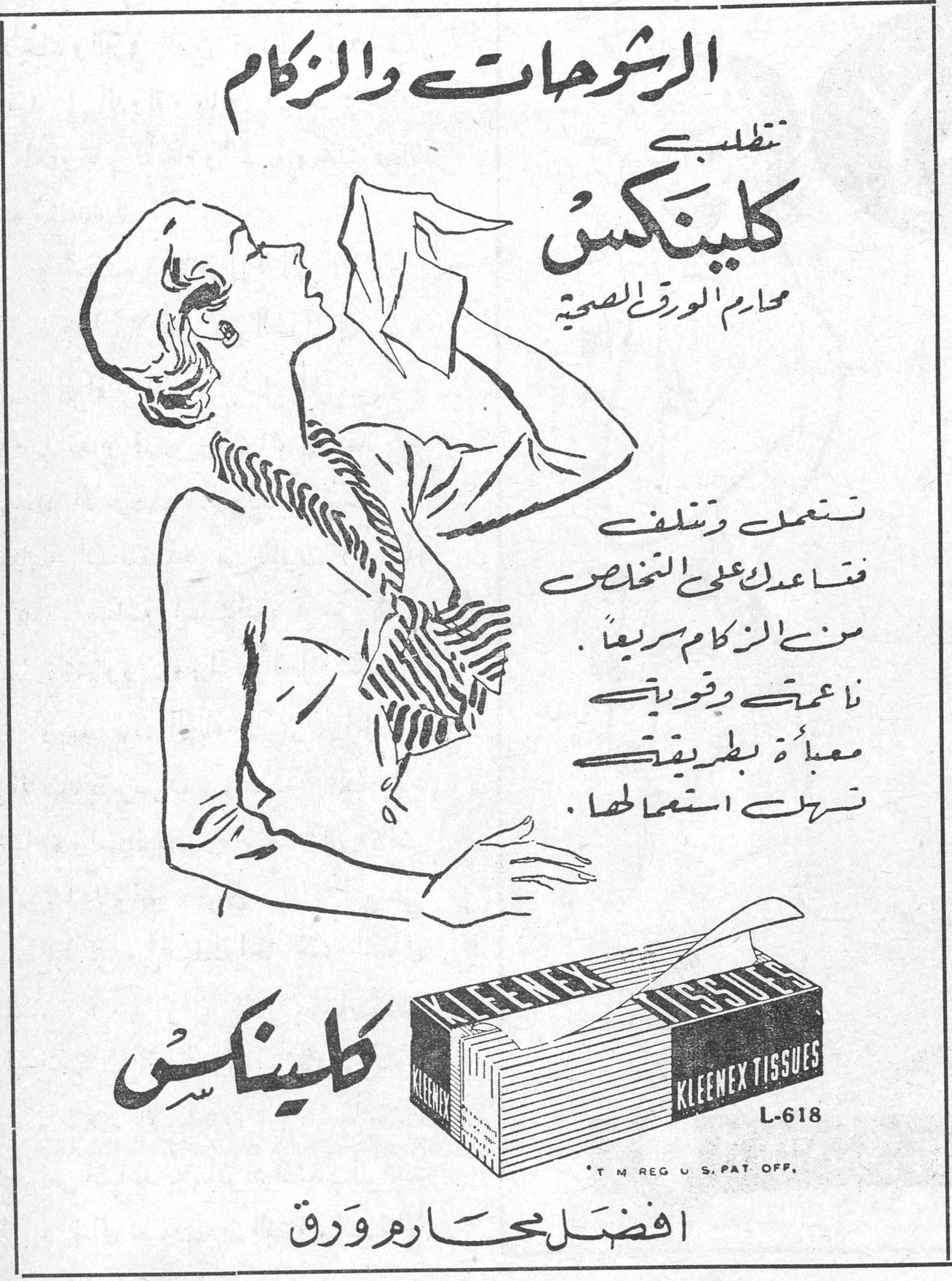
Kleenex Hygienic Paper Tissues
For sniffles and colds, ask for Kleenex hygienic paper tissues
Use them and throw them away, and they help you get rid of a cold quickly. They are soft and strong, packed in a way that makes them easy to use.
Kleenex
KLEENEX TISSUES
L-618
'T M REG U S PAT OFF'
The best paper tissues