daughter will enjoy a life of ease.
Q — The beauty of a piece of cloth caught my eye and I bought it, and the seller told me it was Western goods.
After I returned home, my neighbor assured me that she had bought its exact like, and that it is of home manufacture. So I marveled at this seller; had he told me it was national goods, I would have taken pride in it and held it in the very highest esteem.
What is your opinion of this?
S. D.
A — This seller of yours is not the only one who professes this principle, and the fault for it comes back to us ourselves. For among the great mass of the people there has spread the silly notion that "everything Frankish is fine" —
and even that would not matter greatly, did they not stoop to belittling our own goods.
This feeling of inferiority, and this scoffing at the citizen's capability, are a humiliation the soul refuses. Our competence has become plain, and the days have proved it. Be assured that national goods occupy a large part of our market today — and yet they keep passing them off upon us. In the face of this, it has become incumbent upon us to lift our morale, to strengthen our confidence in our own powers, and to take pride in what we have, as an encouragement to it and a spur to progress in the field of industry and production.
Q — I grew up in a house of standing and wealth, and was my family's only child. I drank from life all that pleased and delighted me, heeding no advice. After my father's death I carried what remained of the money off to the lands of the West and lost it here and there in pleasure and extravagance. Between one night and the next morning I had to live somehow; life showed me its true face, and I entered it humbled. I worked as a porter, then as a servant in a kitchen, then as a newspaper seller. And so on, until circumstances led me to Africa, where my luck shone and I gathered a considerable fortune. I returned to my
people vastly rich and full of dignity, and they never cease pulling at me with their embarrassing questions about all my past.
Do my confessions lower my standing, or demean me among them?!
A. H.
A — Do not wrong yourself with these illusions. And know that the money you have gathered is no more precious than the harsh experiences that accompanied you and curbed the impetuosity of your recklessness.
Had you not suffered in winning your daily bread, and come to understand life's harshness, your hands would not have kept the money you gathered; and by this story of yours you stand as a living example to our reckless youth.
Q — I am a man's wife, and the mother of three children. Today's teeming life demands, if one is to keep pace with one's surroundings and the age, expenses that take a large part of the income. I have met with no approval for an idea that occurred to me — namely, to share with my husband in productive work — although this would not keep me from performing my household duty, especially as my children are of school age. Is there any blame, or any touch upon dignity, if I carry out this wish?
R. A.
A — I salute in you this noble feeling, provided your household duties allow it. Productive work is better than squandering time without profit. There is no criticism whatever to be laid against you — we are in the age of light. You would work to support your husband, and that is the pillar of the marriage bond; and you would produce in your hours of leisure, and in that lies all dignity.
Q — My neighbor and her husband go out every evening to the gaming circle, according to her arrangement, without fail, and leave their sick child in the charge of the servant. The first watch of the night passes... and the child's screaming stretches in my ears with a sound that cuts the heart. Zeal and pity came over me; I went in to him and did not find the maid — there she was in the street, meeting a friend of hers. I gathered the child in my
arms and patted his shoulder, and he laid his fevered head upon my breast, comforted. What a painful state of affairs!! And who is responsible for it?!
L.
A — God bless you, virtuous lady... You performed a woman's duty, you answered the call of humanity, and you kept the sanctity of neighborliness: you were the highest example.
The responsibility falls, without question, upon the woman. It was she who consented to found the home, and it is her duty to care for it. What ails her, that in this civilized age of ours she has taken to loitering away from her duty, permitting herself what is not permitted, and turning away from guarding her kingdom — the ailing one and the suckling within it — toward a den in which degradation flounders, killing her feeling as a woman, scattering her duties, and holding the sanctity of motherhood in distaste? It is a calamity!!... Woman must turn back from this, that her affairs may be set straight, and return from her straying to her fold and to the discharge of her first duty.
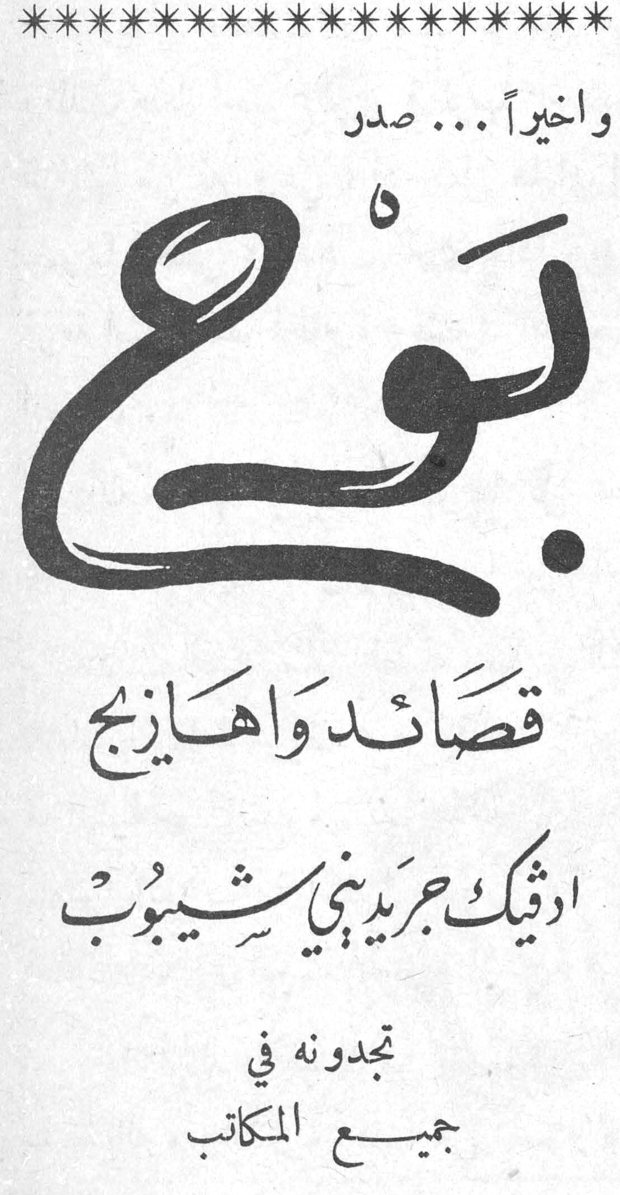
Bawh — Poems and Chants
And at last... it has appeared
Bawh
Poems and Chants
Edvick Jureidini Shayboub
You will find it in all the bookshops