being the feeling of emptiness; the feeling that a woman has come within sight of the autumn of her life, and that her task in life has nearly reached its end. Her children have gone out into the world and no longer need her, and here she is, threatened at every moment with illness and collapse.
Q — And must these fears beset every woman and rob her of sleep in the period after forty?
A — No. Some women pass through this stage calmly and without the least bodily or health disturbance — that depends on the woman's own nature and on the circumstances surrounding her. Whenever abnormal symptoms appear, the wise course is to go back to the family doctor, to have the causes of these symptoms diagnosed and to receive guidance and counsel on what should be done. The important thing is for the woman to grasp that whatever comes over her is only a passing thing; it will vanish after a while, and the waters will return to their courses with a little positive will and a family cooperation built on love and understanding.
Q — Where does modern thinking stand regarding the period of "middle age" in woman?
A — I can say this: the phrase "middle age" has vanished from the modern woman's lexicon. Modern thinking turns toward uncovering the latent possibilities — ideas, feelings, and vital forces that can be set free — turning the woman's thought away from her condition toward a lofty aim, by which she triumphs over her passing weakness and returns to her former self.
Q — On whom does the chief responsibility in this fall?
A — On the woman herself, without a doubt — for this age of ours is an age of emancipation, and she must be brave and decide her destiny for herself, not letting flimsy traditions hold her back from reaching her goals — bending aside with them in surrender.
The woman must make herself ready, bodily and mentally, to face this real transitional stage — it is like the stage through which we passed from adolescence to maturity — and we must adjust ourselves within the family and social setting with full awareness and deliberation.
Q — And how should a woman look upon this transitional stage?
A — Once a woman has passed forty, she must first of all think with the mind, not with the emotions. If any changes come over her, they do not come suddenly; they proceed gradually, according to a slow natural order. The bodily change may be accompanied by a development in feeling, so that a woman sometimes feels herself thirsting for tears, and weeps without cause — there is nothing strange in that and
nothing to fear: tears are a means of easing the soul. And a woman may find herself anxious over the most trifling causes, flaring up at her husband, scolding the children, and falling upon the maid!
Q — And is there a physiological cause for this behavior?
A — Of course. The changes are accompanied by an internal upheaval: the ovarian secretion lessens, which in turn affects the pituitary glands, whose secretion increases a little; and this in turn leaves its
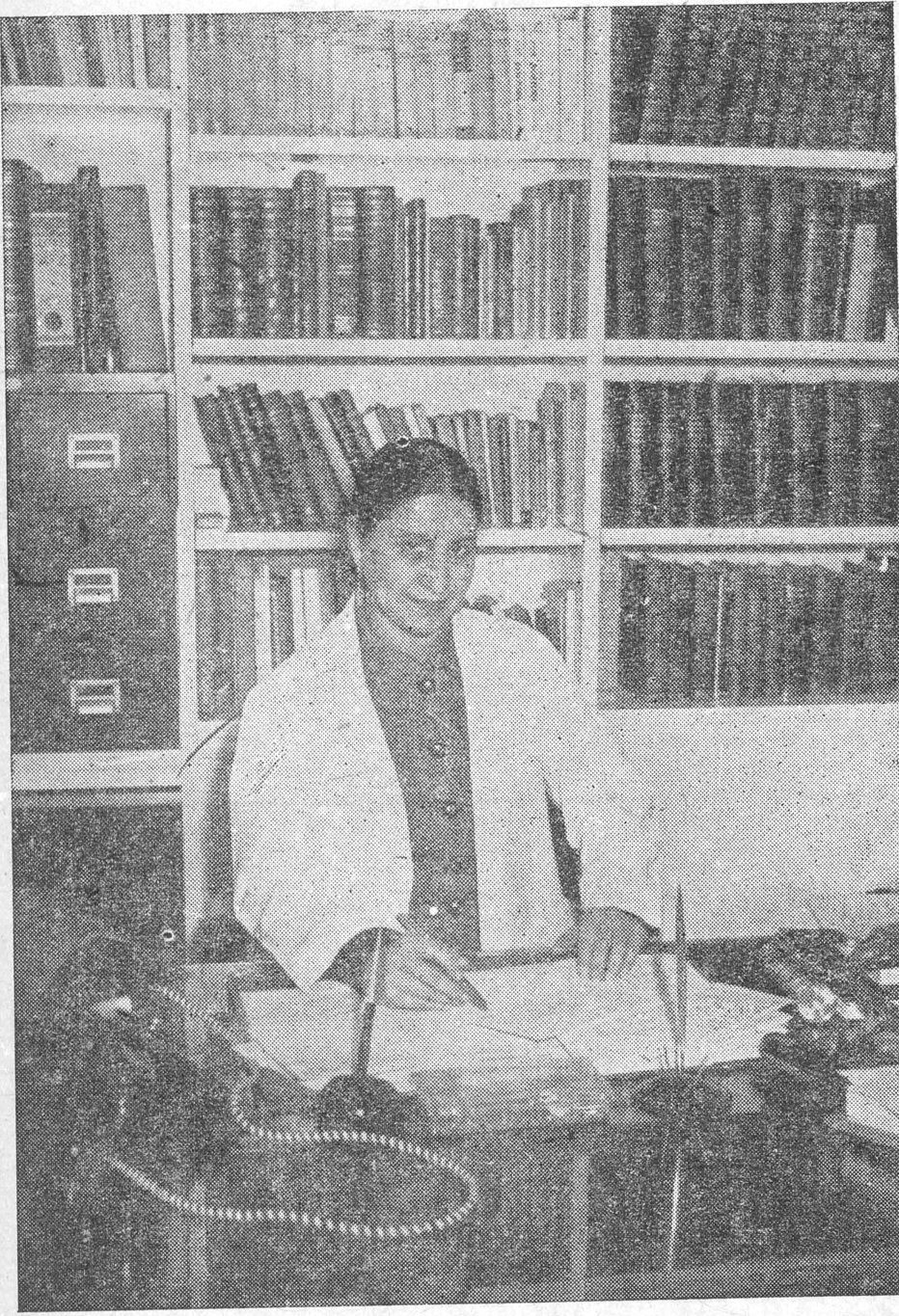
In her private clinic, at her desk...
mark on the thyroid glands; the heartbeat quickens and the perspiration pours. In short, the glands fall into a state of disorder and imbalance — and this is the cause of the mental disturbances and of the jarring of the nervous system, which shows itself in the form of emotional outbursts. And during the cessation of the menses there sometimes appears a degree of irritation or inflammation, and vaginal bleeding may occur, followed by emotional effects that are hard to bridle.
Q — And what is the way to limit these symptoms and disturbances?
A — There are soothing remedies that modern