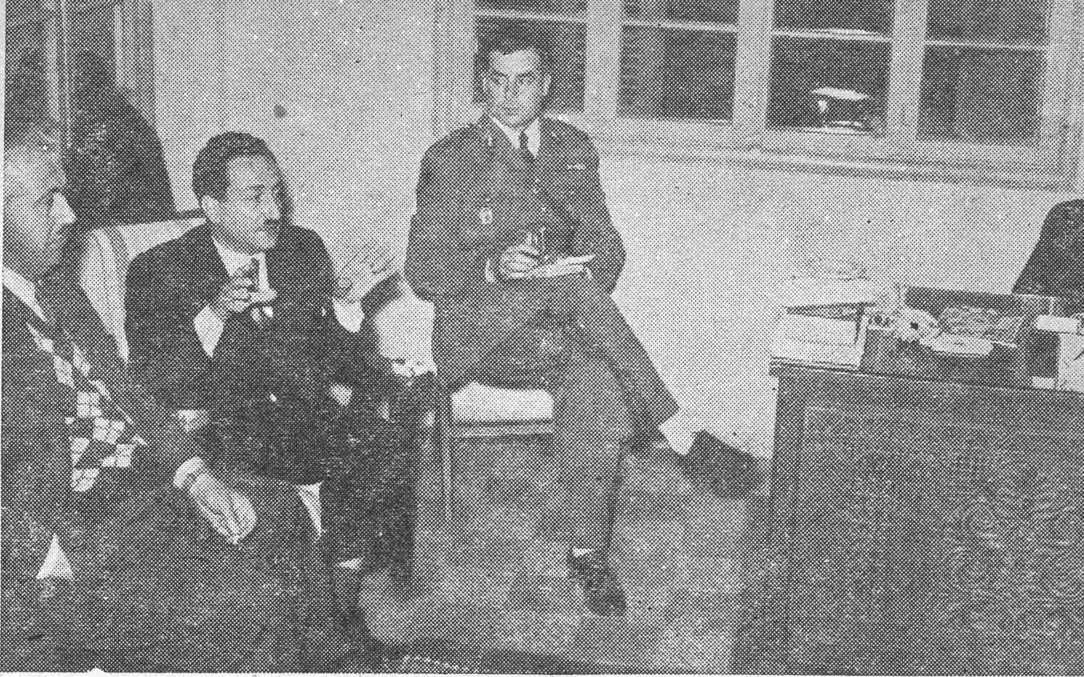
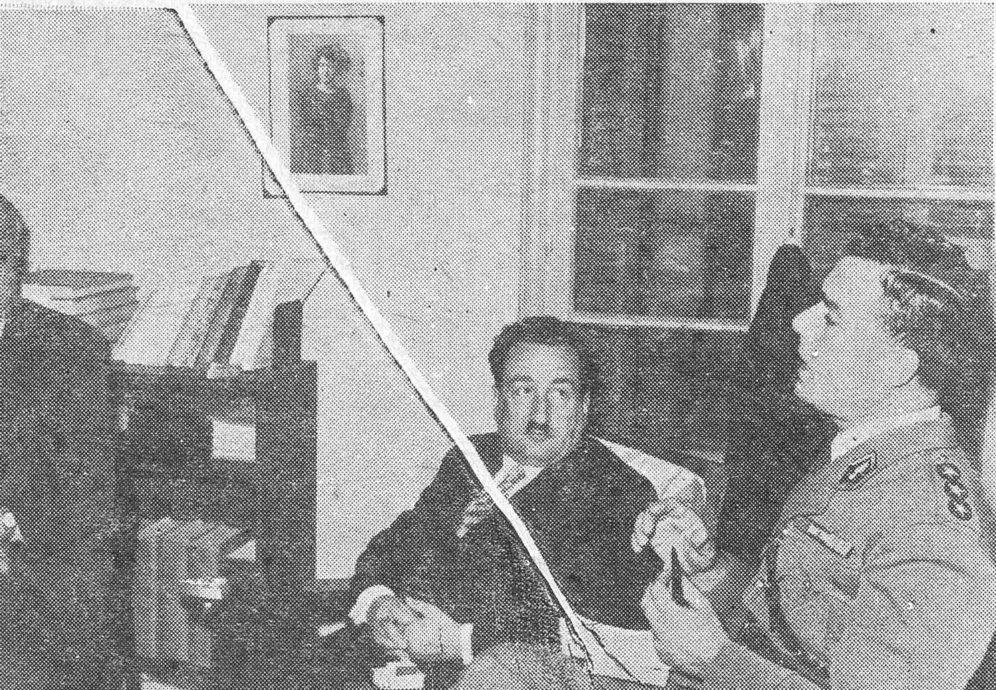
Mr. Rushdi Ma'alouf explains his point of view — Miss Ibtihaj Kaddoura, Captain Harakeh, and Mr. Ibrahim Hajjal listen
At the symposium of “The Woman's Voice”
With Captain Youssef Harakeh, Ibtihaj Kaddoura, Ellen Rihan, Fouad al-Said, Rushdi Ma'alouf, and the head of the drivers' syndicate, Ibrahim Hajjal.
Traffic in the Lebanese capital is affected by the following matters:
- The condition of the streets and the parking places. - The question of the electric tram. - The manners of the drivers and the manners of the people...
If you were to “steer” your steps to the offices of “The Woman's Voice,” and cross the narrow passage leading to the editorial room, you would come face to face with Miss Ibtihaj Kaddoura at the “head” of the symposium, “driving” her questions at the “pole” of the new and blessed traffic movement, Captain Youssef Harakeh; keeping pace with her, her “municipal” colleague Mrs. Ellen Rihan, who took care to guard the “rear” of the flying debate, which the economist Mr. Fouad al-Said aimed like a piercing “arrow”; all of which prompted the journalist Mr. Rushdi Ma'alouf to put on the guise of the “scorpion” whose “beneficial” sting has so long
held readers fast; and this plan of attack and defense ends with the “planet,” Mr. Ibrahim Hajjal, head of the drivers' syndicate, who circles along with all the opinions and comes to rest only beside the “pole” — naturally!
*
Kaddoura: Our purpose in taking up the problem of traffic just now is the signs of steady improvement we have observed of late, carried out under the supervision of the worthy Captain. In our symposium today the various points of view opposed to the new traffic system will be set forth, and we ask Captain Harakeh to be so kind as to answer...
Al-Said: The problem which the responsible authorities are working to solve is caused not so much by the abundance of cars as by the need for a technical engineering design embracing the whole city — one that works to profit from every meter that can be added to the breadth of the streets, so that their margins may serve as parking places holding the greatest possible number of cars... That is, if everyone in their driving applies the one-way rule, Sense Unique. And how quickly they are thwarted by the disproportion between the hugeness of the buildings, with the multitude of cars attached to them, and the narrowness of the street onto which they look. None of this can be blamed on the age of the streets, for we still see new streets being cut and new buildings going up, each encroaching upon the other in just this fashion — take, for example, the Plaza Hotel...
Ma'alouf: The problem, in my view, is not a problem of “moving” but a problem of “stopping!” Traffic regulation was made to secure the interests of the people. How, then, do we guarantee a man who wants to buy a cinema ticket or a piece of cloth that he can finish his errand in a third of an hour? And does it harm the owners of commercial establishments if a private car stops in front of them for about an hour, as—
Captain Harakeh: By what right do car owners “take possession,” free of charge, of the most