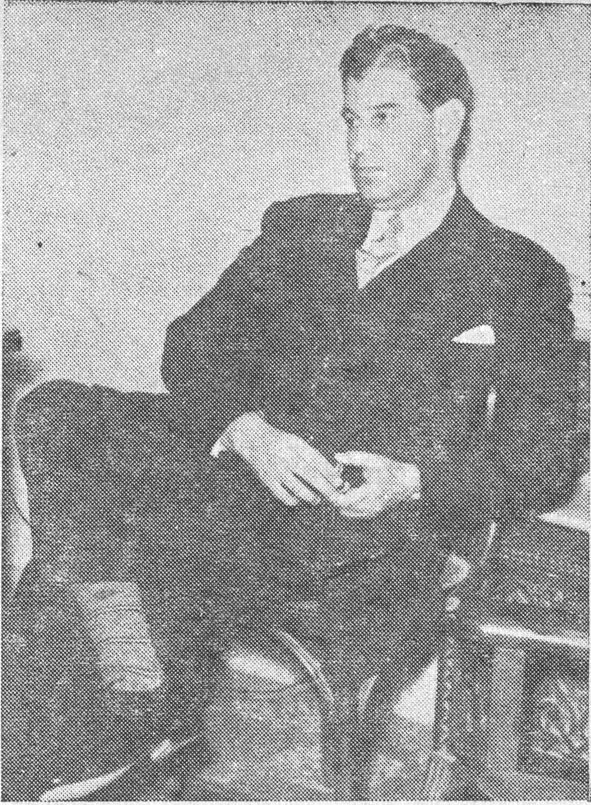
Mr. Fouad al-Said poised for the attack!
expensive land in Beirut?
Hajjal: It has likewise been shown by trial that private cars obstruct parking, since their drivers are away from them — unlike the taxi, which is always on the move.
Rihan: What is done in every city of the world is to create parking grounds outside the town, if need be, from which those moving about fan out by taxi, service, or bus; nor is it too much to ask the citizen to bear some responsibility for the sake of the public interest — that must come before the private interest, which in this country we have grown used to having come to us smooth and sweet!
Harakeh: Yes; and we must not forget that among the constituents of our daily life are essential factors that must be regarded — doctors' clinics, travel bureaus, airline companies, bank offices, newspaper offices, the seats of the diplomatic corps; in a word, everyone who performs a public service — the public at large must appreciate his work and labor to ease it.
Ma'alouf: I do not see that the system of the Plaque for certain classes of people and not others solves the problem; very often it is unfair. If the Captain will consent to come with me on
a short tour through the main streets, I will show him spacious areas that could be put to use for the parking of the private cars, which suffer some pinching under the new system...
Kaddoura: And now let us pass to the problem of the tram, and ask the head of the drivers' syndicate what his colleagues complain of.
Hajjal: The tram is the knot of all knots. There is no final solution to the traffic problem without its abolition.
Kaddoura: Does the tram reach every street?
Al-Said: Of course not. But Beirut's “tributary” streets all empty into the “main” streets that carry the electric lines; so
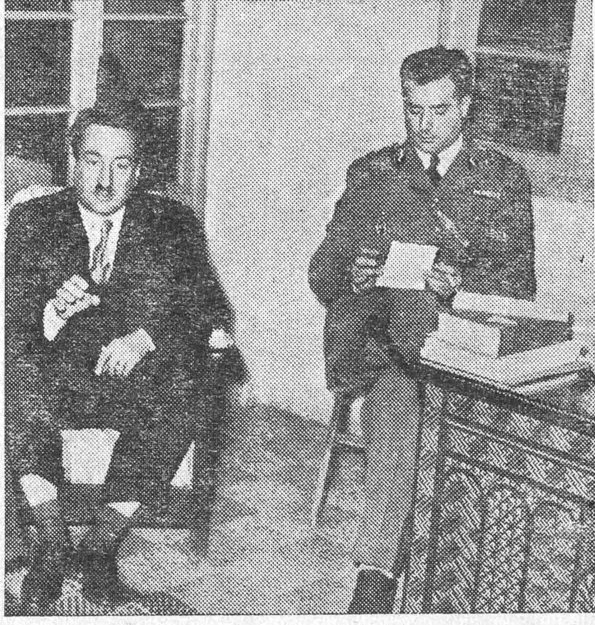
Captain Harakeh takes down Mr. Rushdi Ma'alouf's objections...
the one presses on the other and causes this vexing congestion...
Ma'alouf: The cities of Europe have profited by using a kind of tram that has the bus's advantage as regards electricity and the car's advantage as regards rubber wheels, and is distinguished by running along the side of the road.
Harakeh: Our daily life also rests — quite apart from novelties and plans — upon a working class that finds in the tram its sole means of getting about, for the great social service it renders. So
we hold that doing away with it is unsuitable; rather—
—is allowed in Egypt? Lest our lot become the lot of the flying saucers... no sooner touching the ground than off they shoot into space again!
Harakeh: First, I have trustworthy information from Alexandria: private cars there are allowed to stop not an hour, nor half an hour, but only twenty minutes of it. Second, as to the merchants: I have received from their leading men in Beirut expressions of gratitude that their doorways are clear of cars. They prefer that buyers make their way to them on foot rather than that their shopfronts be screened all day and all night; besides which, the business of stopping in the Queue is far easier than pulling out of it, with the Manœuvre that requires, blocking the arrival of another car — to say nothing of the consumption of gasoline, the waste of time, and a general commotion the street can well do without. And I cannot help alluding to the owners of private cars and their unjustified abuse of the police in this matter.
Hajjal: It has likewise been shown by trial that private cars obstruct parking—
—ways can be studied by
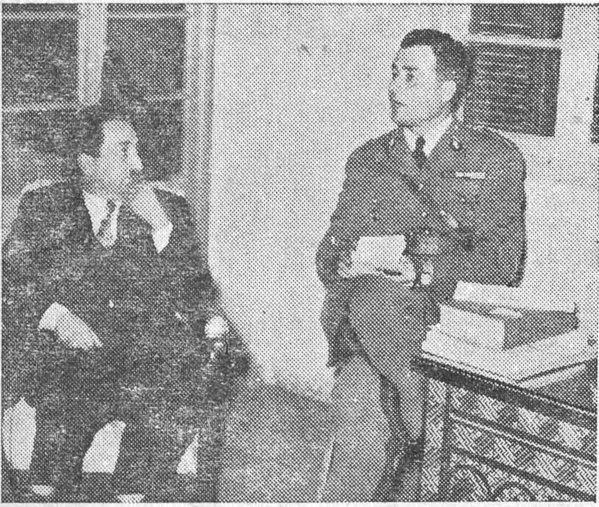
Captain Harakeh explains the theory of one-way traffic