The campaign launched by the magazine The Woman's Voice, in the person of its editor-in-chief Mrs. Edvick Jureidini Shayboub, concerning woman's right to the family allowance, was one echo among the echoes produced by the successive appeals and articles I had stirred up in the daily press on the position of the woman employee in all aspects of the question.
How pleased I was the day The Woman's Voice charged me with raising the subject of the family allowance among women employees. I carried out a limited count in the ranks of the women employees who maintain their children and yet draw no family allowance for it, and I sent this small survey, with photographs of some of the women in this position, to Mrs. Shayboub, who made of it a successful report on the subject in the pages of The Woman's Voice.
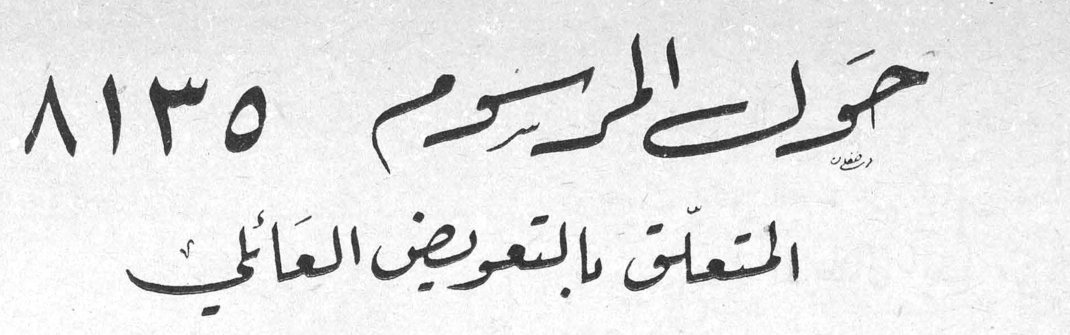
I went on pursuing the campaign concerning the position of the woman employee in all its aspects, whether over the radio or through the daily press, until on January 17, 1955, Decree No. 8135 was issued concerning the renewal of the family allowance, the fifth paragraph of whose first article provides as follows:
"There shall benefit from this allowance the woman employee who proves that she alone supports her children by reason of the father's death, or his incapacity, or his absence from the country for a period exceeding two years."
Here I cannot but transcribe a passage from an article that was relied upon in the deliberations of the committee which issued the said decree:
"There is also the question of the family allowance. The woman employee draws no family allowance even when her children are in her charge and on her shoulders.
"It may be said that the State has the right to refrain from giving the married woman employee the family allowance, so as not to open the way for two spouses to draw, at one and the same time, a family allowance for the very same children. If we grant, for the sake of argument, the soundness of this statement as regards the State, we cannot grant its soundness or its conformity with the spirit of justice and equality
as regards the woman employee. The male employee draws, automatically and periodically, a family allowance for every child born to him, without being obliged to present any documents beyond the new baby's identity card; whereas the woman is obliged to present a certificate of divorce or desertion, proving with it that she is unable to compel the husband to provide maintenance, or a document confirming the husband's death. No other document is accepted that proves the children are in her charge practically and in actual fact — even if the husband does not work in any State department and draws no allowance and no salary from the State treasury, and even if the husband is an emigrant."
That is what I said in the article referred to.
It becomes clear from reading the paragraph of Decree No. 8135 concerning the woman employee that the sole benefit she has obtained from this decree is her right to profit from the family allowance in the event of her husband's absence from the country for a period exceeding two years.
Discrimination therefore still stands, so long as the woman, unlike the man, can profit from the family allowance only in the event of the husband's death, his incapacity, or his absence from the country for a period exceeding two years. It is a step, no doubt of that; but it does not do justice to all women employees, and the question is a question of principle, not a question of benefit to a few numbered persons.
If there is a solution that truly does the woman justice, removes the discrimination standing between her and the man, and does not burden the treasury with the double payment of the family allowance to the woman and the man at once, then I believe it is this: that the woman employee whose husband draws no salary — and consequently no family allowance — from the State treasury be given a family allowance for her children, regardless of the husband's position and condition, whether on his material side or in his attitude toward his family.
For I know men who work in private establishments and draw no family allowance for their children, while