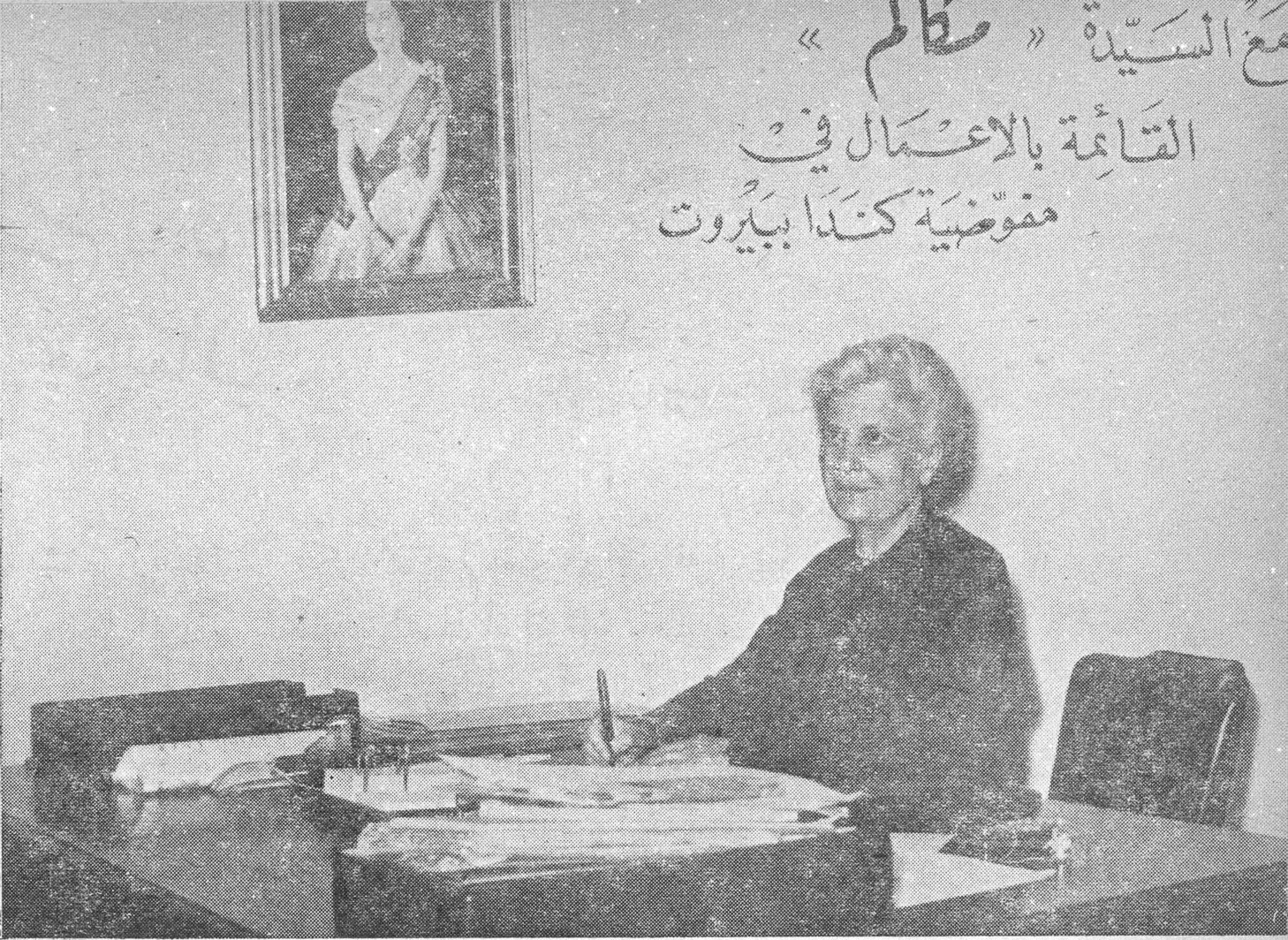
Mrs. MacCallum — the first “Lady Chargé d'Affaires” in Beirut.
A statue they wanted woman to be... and a statue she tried to remain. And so she remained — in her guarded vitality and her shrunken, huddled being — giving life without living it, until the age of speed came marching upon us. And the statue stirred!.. It walked, it spoke, it stretched out its hand to give and to take... even in the field of politics... God be praised!
Come to a splendid apartment on Clemenceau Street... to the Legation of Canada... There Mrs. MacCallum works in the representation of her country. She is the only woman in the diplomatic corps here, and her activity is confined to fostering friendship and understanding and to encouraging the movement of trade between her country and ours.
I met her in her workroom... at her desk, over which a woman's hand had played with grace, lending it harmony, taste, and order. I set about spurring my tongue's mettle to begin the talk... to speak... and I set about casting my questions strong, massive, solid, to match the atmosphere — or so I supposed! — and to clear the
small great barrier that separated my chair from hers! It was as if she felt it too, for she rose and came to sit beside me, listening to me as I listened to her... and the stream of talk poured forth...!
Such is the magic of chairs... and what magic!
She is happy in my country, and happy to live in it canopied by beauty on this side and on that! She is one of those who love walking in the open air and climbing mountains, and she has found in Lebanon what she used to find in her own country: splendor in nature and beauty of form. Canada is the land of lakes and young forests, and it is counted a summer resort for most of the inhabitants of the United States.
Our lady was born in Turkey and came to know our lands under Ottoman rule; from that time her interest in the Near East has grown day by day. In 1925 she began to write on its affairs and to direct public opinion in North America toward its problems and perplexities. She was living at the time in New York. She worked for two years as a teacher at one of Canada's
universities, in the Arctic region — where the sun deserts the day for a stretch of time, where the cold wages a white war upon men, and where even children are spared most of the diseases dealt out by the cold of the northern regions. Then she moved to Columbia University, where she completed her advanced university studies; at International House she was able to meet students representing most of the countries of the world, particularly the Arab lands; she also used to attend the meetings of the members of the United Nations organization around their green table, in the company of some colleagues from International House, most of whom served as advisers to their countries' delegates.
For seven years before the Second World War she worked in New York at the Near East office, writing on the region and analyzing its problems in speeches, lectures, and articles.
Nor did Mrs. MacCallum forget to tell me of her country and its people, who trace their origins to all manner of lands. Canadian culture bears a European and an American cast, and it is worth mentioning that forty percent of the country's inhabitants speak French, which is taught in most schools there as a second language.
Mrs. MacCallum has loved every task she has been charged to perform, for through it she came to know many personalities — among them, for instance, the women representatives of India at the United Nations and at the many Geneva conferences. She is a great admirer of Mrs. Vijaya