April eleventh marks the twenty-fourth anniversary of the death of Gibran Khalil Gibran. On this occasion, dear to our hearts as Lebanese and as Arabs, we bring our readers a conversation about the man remembered, from the lips of the artist Youssef Howayek, following the invitation extended to him by the people of Bsharri to erect a memorial to Gibran.
...In the hands of the artist Youssef Howayek was a picture of the memorial he had only just finished designing. He spread it before me and set about explaining his plan:
“The Gibran memorial, as you see, comprises a wall fifteen meters long and four meters high, to be built of cream-colored stone, plentiful in Bsharri. Gibran's head, of silver-colored copper and larger than life, is set in the center, and at its two sides are two columns ending in two torches, lit by night... On one of the columns are inscribed the titles of Gibran's works in Arabic, and on the other the titles of his works in English. In the middle of the memorial, on both sides, stand four panels of silver-colored copper, of human size, representing the most important of the drawings Gibran made.”
•
...My interlocutor left off explaining, laid the picture of the memorial aside, and, with a long sigh, fixed his gaze upon the unknown, trying to sink into the depths of his memory and draw from it what the long years had kept his tongue from telling... I respected his moments of silence and musing; for our artist Howayek — I know him — is a mass of feeling, and this hour is his alone, to speak in it, as he pleases, of a friend dear to him...
•
“...Our first acquaintance was on the benches of al-Hikma, in the closing years of the last century... Gibran a comely-looking youth, fluent in English, come from Boston to study Arabic. He was skilled at talking of what he knew of the arts of literature, poetry, and philosophy, and I was skilled at listening to him, deeply affected by his ways of thought. From this a friendship grew up between us, whose foundations were cemented by our common artistic bent... I, in the world of art, an infant crawling; he already near the confident step... Witness — had it a tongue to speak — the carob tree standing to this day on the heights of Ashrafiyeh: how many a sitting we had there on our weekly outings, exploring the horizons of Shakespeare, Aristotle, and al-Ma'arri, then bending over our colored pencils,
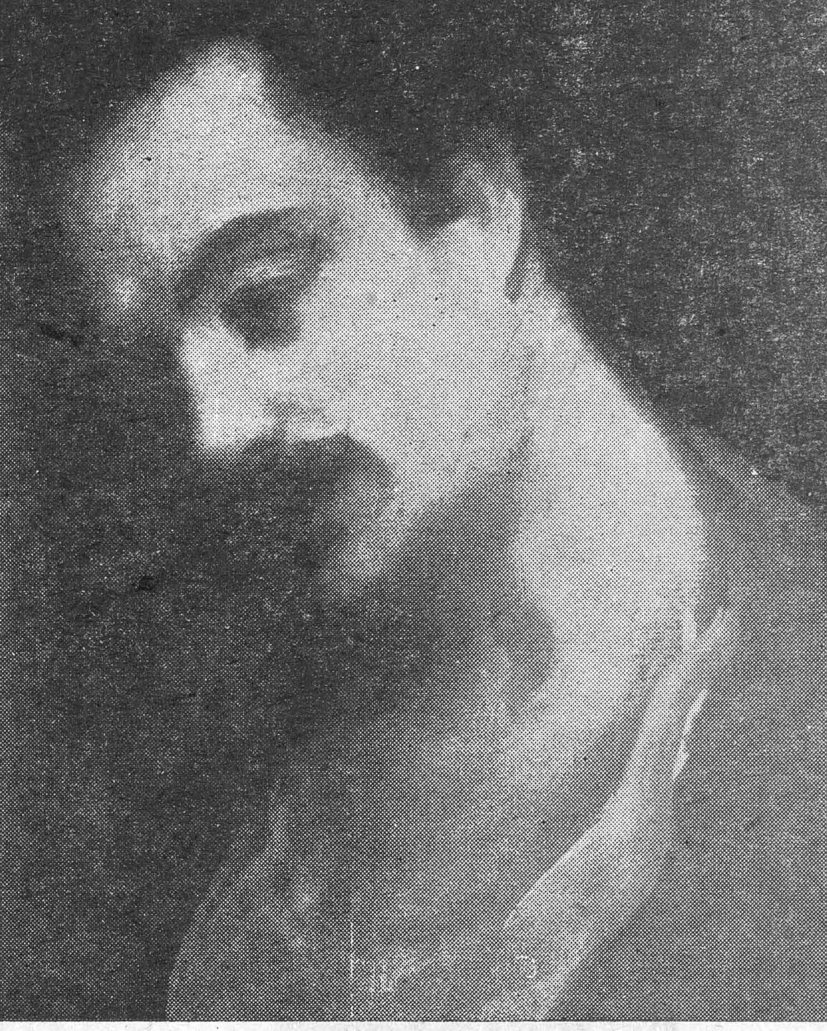
Gibran... by the brush of the artist Youssef Howayek
snatching from nature glimpses of her sweet face — glimpses still dear to me among my artistic firstfruits... And I know well, to this day, where in those drawings Gibran's pencil passed over mine, finishing the red of a sunset glow or correcting the green of a bough... In those days we were seldom apart, except at the hour when the school bell startled us into line, in readiness for the walk... ‘Gibran in front,’ the proctor would insist, ‘and you, Youssef, are tall — fall back to the rear...’ How that regime used to make us seethe with anger, which afterward, in lowered voices, we would pour out in the shade of our carob tree, ending in a general feeling of discontent... with the state of the school... with the state of the country!!”
“Like a dream four years passed, at