— despite the legend of reasons — that you cannot build ethics upon a foundation of this kind.
It may seem a strange thing to say that a book, despite the unsoundness of its principal source, may remain outstanding. Yet that is what I say of this book, and without hesitation: "Russell is still Russell" — that astonishing intelligence which has never touched a subject without lighting it with a spark of his shrewdness and wisdom. The book takes up many of the most important questions of the age. Can a high level of morality be maintained if religious belief retreats and withdraws? Russell debates the question on its positive and negative sides and answers yes. How can you believe with certainty in both praise and blame without believing in absolute will? Bertrand Russell answers that you cannot believe in them and at the same time believe in absolute will. And, of course: what is our hope for the near future?
In answer to that question Russell enlarges upon what he has lately been declaring in the newspapers, the magazines, and the broadcasts: that the outbreak of an atomic war would end not merely in victory for neither of the warring parties, but in a frightful destruction that would carry us backward to the Dark Ages. He believes the only way to avoid this is to make both sides realize that war is an old notion whose use has lapsed, and that both are losers, as has been shown — the victorious state will inevitably be the more devastated. He proposes that one of the great, relatively neutral states — India, for instance — should invite a committee of specialists to submit a detailed report on what the consequences of such a war might be. If the two parties are convinced of the truth of that report, the way is opened for a further opportunity, in which they agree to hold a conference to examine the points of dispute in the light of reality. Each of the two sides holds in its hands
cards which, if used, could greatly ease the sharpness of the world's tension. Suppose the Kremlin permitted free elections in Germany, and Washington recognized Red China: two principal danger points would vanish.
Russell has lived an opponent all his days, and even now, at eighty, he is no less what he was at thirty-three. So let us wash our hands of his case — and read him in everything he writes.
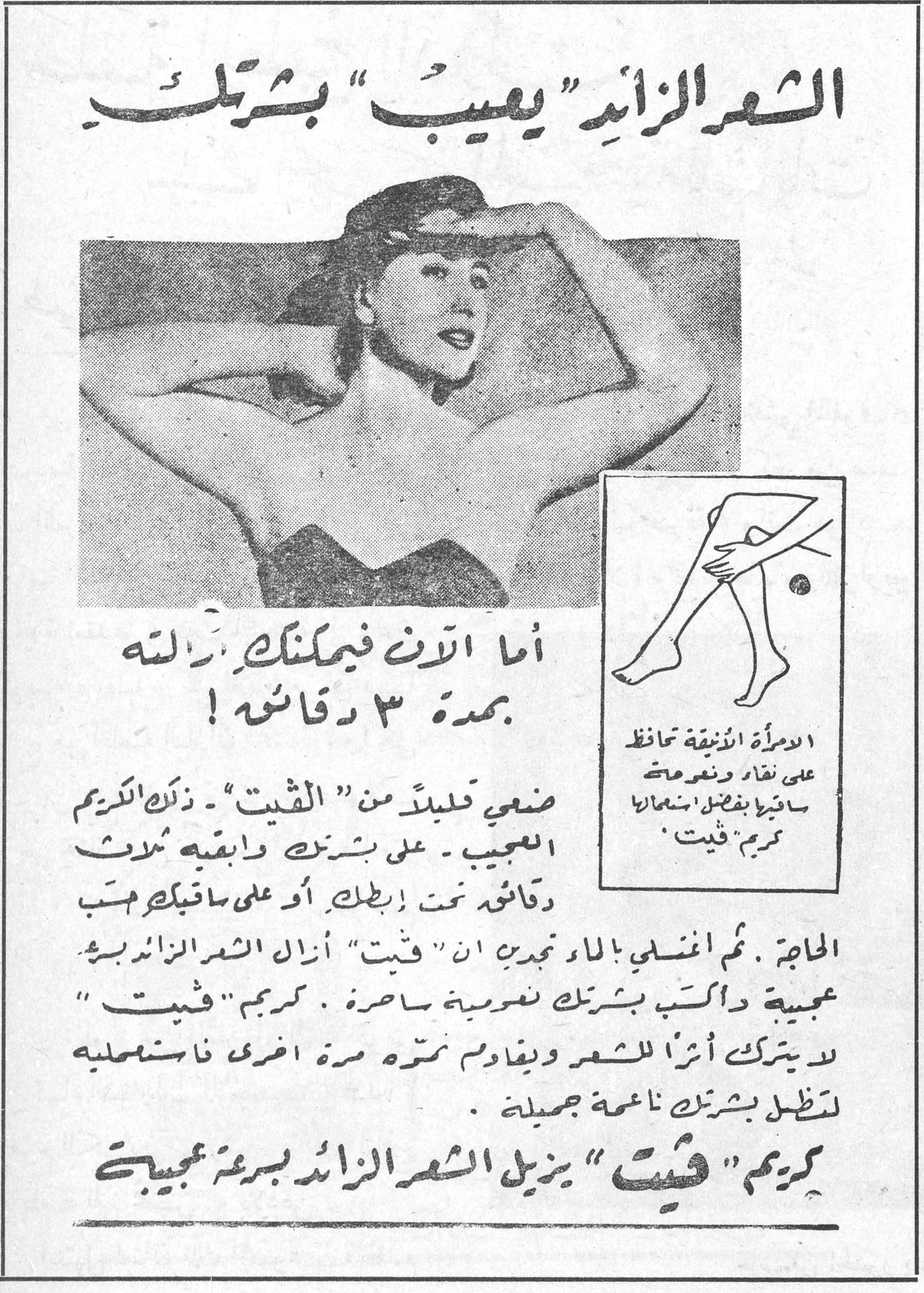
Superfluous Hair "Mars" Your Skin (Thibet)
Superfluous hair "mars" your skin
But now you can remove it in 3 minutes!
Apply a little "Thibet" — that marvelous cream — to your skin and leave it three minutes under your arm, or on your legs as needed. Then wash with water, and you will find that "Thibet" has removed the superfluous hair with wonderful speed and left your skin fresh and enchanting. "Thibet" cream leaves no trace of hair and checks its growing back — so use it, that your skin may stay smooth and beautiful.
"Thibet" cream removes superfluous hair with wonderful speed
[caption:] The elegant woman keeps her legs pure and smooth thanks to her use of "Thibet" cream