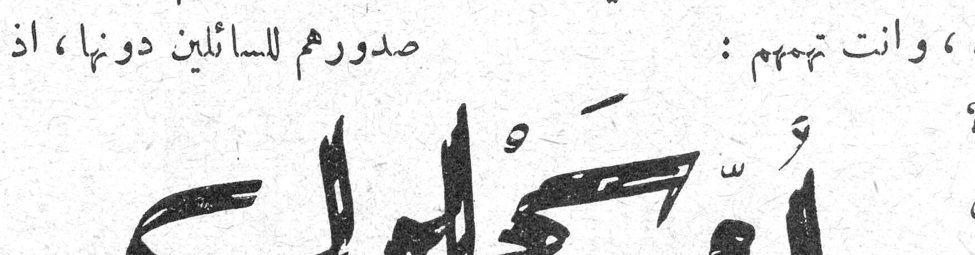
Does man surrender to his helplessness? He tries to wrest strength from weakness, and loftiness from lowliness — even if that strength and loftiness lie in another life not his own... nay, after his life!
Are you perhaps one of those who frequent the mosques on Friday, going there to perform the congregational prayer?
There you are, having finished the prayer; you tuck your shoes under your arm, ready to leave, and stand at the door struggling to put them on, while the surging throng around you urges you to hurry.
Have you never, in that situation, felt something take hold of your foot, trying to help you at your task, bent with the hem of its tattered garment over your shoe, wiping away the dust, its tongue murmuring a prayer full of supplication, entreaty, and pleas for mercy?
You need not trouble yourself to examine this thing crouching at your feet; it is familiar to you, no stranger, and there is nothing to be done about it but to toss it a coin, muttering:
— Umm Sahloul... you, always?
The woman accepts your gift cheerfully, and soon lifts her hands to heaven, calling down its bounty upon you and its blessing over you; then she turns from you to someone else, head bowed, bent of stature, taking the hem of her tattered garment to her face to wipe it, then applying it to her nose to blow it.
"Umm Sahloul"... is there anyone among the mosque-goers who does not know her?
For twenty-five years she has been there, shuffling along with an abject gait, wasted of frame, in blue rags!
You never see her but with her head lowered, as though she were tracing the prints of feet, or as though her eyes suffered some disease that kept her from facing the light, so that she shuns it by looking down.
You never hear from her anything but that feeble, humble tone as she stoops over the worshippers' shoes, appealing to their hearts when she says:
— Have mercy on a mother supporting her orphan child... have mercy on her, and God will have mercy on you!
People came to know Umm Sahloul by these peculiar marks, and those who most resented her
were the beggars, who found in her a dangerous rival crowding them out of easy earnings; so they harried her with every color of harrying, dealt her painful beatings on purpose, seized from her whatever alms and gifts she had gathered, and blocked her way whenever she came along it.
Yet the woman endured and held her ground, bore whatever hardship and persecution came her way, and kept moving from mosque door to mosque door, catching the worshippers as they came out, helping them into their shoes and wiping the dust from them, as though she were about to kiss them in humility and abasement.
Umm Sahloul was not beloved among her fellows of the begging and mendicant trade, nor, in the quarters she frequented, was she beloved among the common run of people; they shrank from her, were
weary of her, and she scarcely found acceptance or favor with them.
And Umm Sahloul marveled at those who opened their hearts to beggars other than herself; for it escaped her that beggary must be dressed in a striking show if it is to move souls to pity. The voice of supplication, however weak, must be loud enough to shake the ears; and the beggar must have such bandages and burns and crutches as catch the eye...
This poor woman possessed none of all those effects: no bleeding wounds, no swollen foot, no green turban towering up to butt the stars, nor that hoarse, flayed voice raised from its owner's throat like a slaughtered bull giving up the ghost.
Umm Sahloul was incapable of joining the guild of hardened beggars; she was no mendicant furnished with the tools of that time-honored art... She was a human creature for whom the fates had chosen that portion of vagrancy, and she fought and strove to support her only child...
The woman did not lie in her claim that she had an orphan child in her care. But for this child, her fate would have been a different fate; and in all likelihood, had it not been for this child of hers, she would have taken leave of life long ago. But the day she clasped him to her, a newborn, she felt the flame of motherhood kindle within her — and how it blazed! — and she set her resolve on turning that trivial living scrap into a being of standing and consequence.