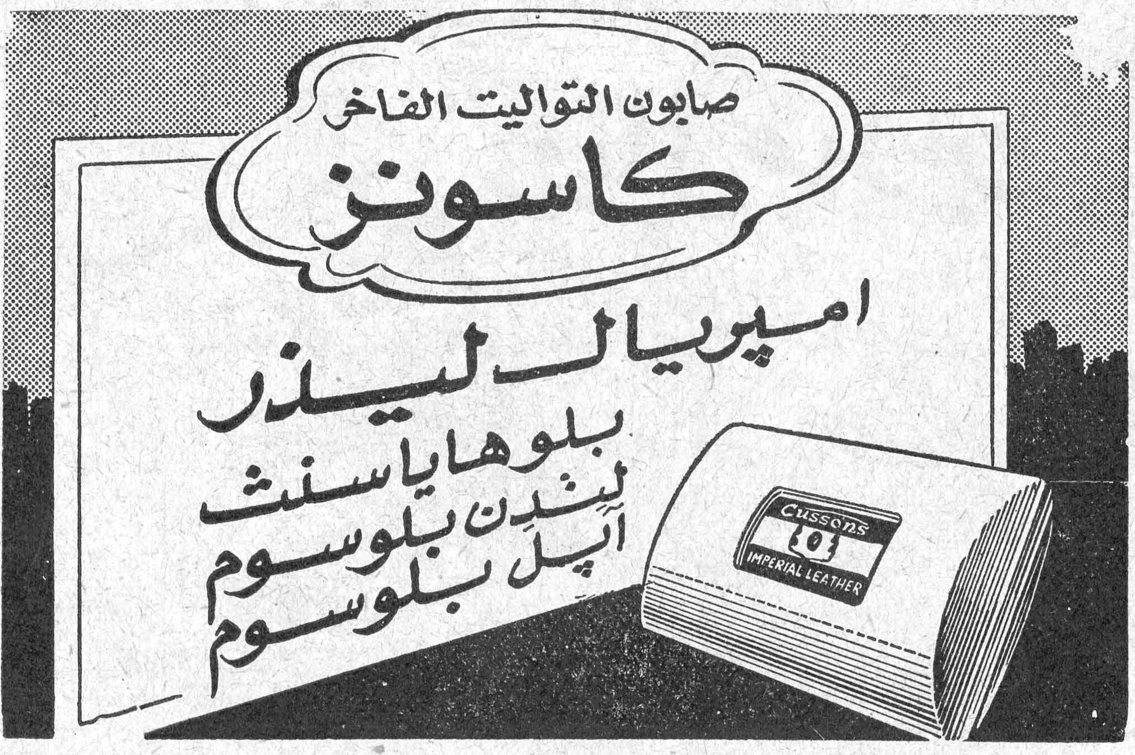
Cussons Imperial Leather Soap
The luxury toilet soap
Cussons
Imperial Leather
Blue Hyacinth
Linden Blossom
Apple Blossom
Cussons — IMPERIAL LEATHER
Nisan — a melody every young man hums between his lips, and few have the power to set down its notes and play it in a book whose strings the printing press has tuned..
This lyre on which Nicolas Qorban played his melodies was not made of wood — not of wood only; he kneaded it of perfume and roses and butterflies' wings, of the juice of grape clusters and the honeys of bees that love "Nisan." And the fragrance of bosoms has its share in the dough of the lyre; its materials were carried in baskets plaited of leaves and blossoms, and it was fashioned in a hut.. or huts, and dried in seclusion over the fire of the burning body that looks out from every letter of "Nisan," despite "al-Hajj's" insistence in the introduction that it is matter and spirit both.
The great truth in "Nisan" is that Nicolas Qorban is a poet, of delicate feeling; and I have felt that feeling so keenly that I grew afraid of scratching it — with a sparrow's down or a butterfly's wing — were I to tell him frankly that among his daughters in "Nisan" there is this scrawny one or that lame one, or an infant girl he ought to have waited for, to let her grow, and then presented to people mature. Perhaps he feared she would die before anyone knew her — and I could wish that "A Nightingale's Nest," for instance, had died — or had never been born.
Once only in "Nisan" did I come near to cursing his coupling of words, when my eye and my feeling were pricked by "The Pregnant Lip" — its name, its description, and its comparison to "the red panties"... My soul was reconciled to him when I read the poetry in "The Lust of Color,"