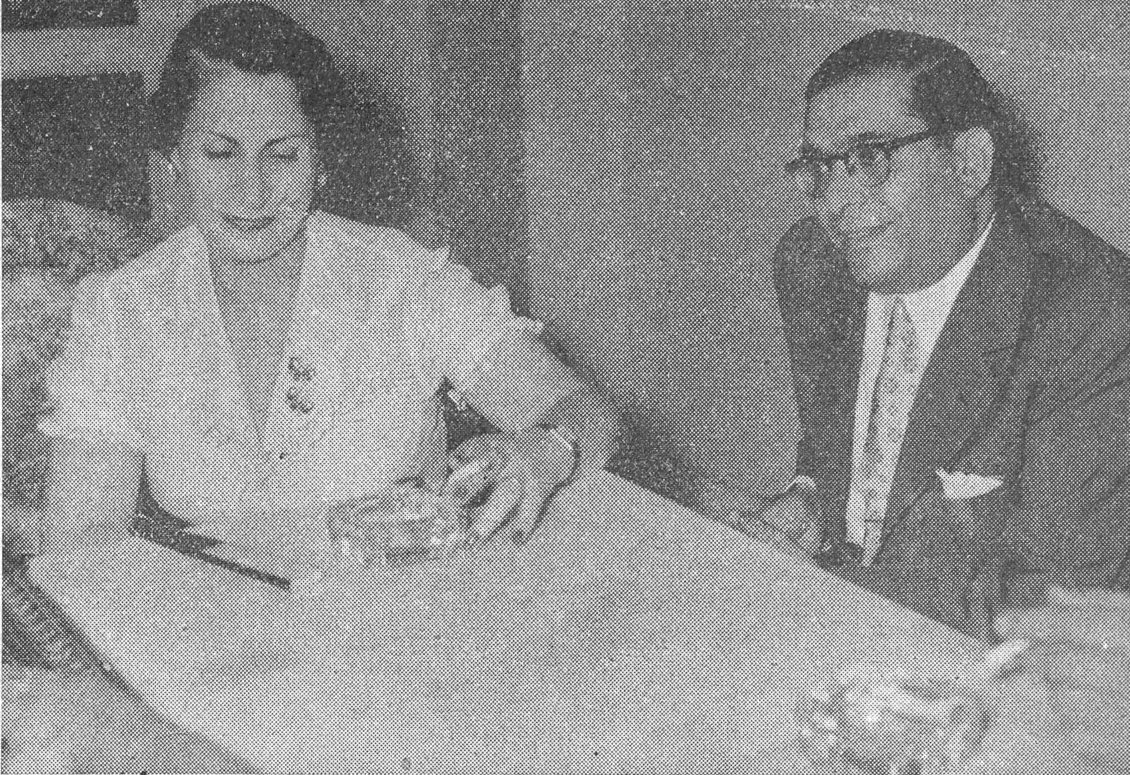
The poet Chafic Maalouf with his wife

Chafic Maalouf... we knew him first of all as a brother of the late Fawzi Maalouf... Then he brought out "'Abqar," and eyes and hearts flocked to it, savoring with relish its lofty poetic meanings, and confessing that there is a close kinship — other than the kinship of blood — between the author of "On the Carpet of the Wind" and the author of "'Abqar"!
After years of waiting there appeared from Chafic Maalouf "Every Flower Has Its Fragrance," then "The Call of the Oars," and thousands of admirers in every Arab land fell eagerly to reading them, spellbound by the poetic images scattered here and there — magnificent canvases painted by the brush of an artist of fine taste, versed in the secrets of beauty...
And the throngs of admirers went on watching and hoping to meet Chafic Maalouf, resident of Brazil, and to hear him — until this summer came, and he returned with his gracious wife to Lebanon; and Lebanon received them, among the honored emigrants it received, with open arms and with eyes brimming with tears of joy!
Truly, among the pleasures of a lifetime is an hour passed with Chafic Maalouf at a poetry evening or a reception! Today "The Woman's Voice" has the honor of presenting him to its readers as he sets out his position on the questions of poetry and letters in this age... — The Editors —
— Literary circles know you as the poet of "'Abqar." Do you agree that "'Abqar" is the summit of your poetic production?
— I agree that "'Abqar" stands at the summit as a poetic edifice that exacted efforts from me over long years. Yet this does not prevent much of my verse from rising to that very summit. There is work in my poetic production that yields nothing in worth to the best I was granted to compose in "'Abqar."
— Since your return to Lebanon, have you felt that there is a poetic blossoming and renewal among us?
— I felt that when I visited my homeland eighteen years ago, and I followed the progress of the renaissance after my return to the Mahjar. We had the poetry of geniuses, and we had the poetry of imitators. Today, however, I see in the homeland a slackening in the poetic production we want: those standing fast in the field are few, and the innovators are more balanced and mature than before.
— Have you made any attempts at colloquial verse? And what is the value of this genre, in your view?
— I can almost say I have made no attempt at colloquial verse. As for my opinion of it, I once set it down in the pages of al-'Usba magazine, where I said:
"No one is unaware that among men of letters are some who once called for setting the popular tongue in the place of classical Arabic — one writer even wrote to us saying: Compose for us in the language of the people, that the people may understand it. As for you, poets of the classical tongue, you have come to compose for yourselves, and so that some of you may read the others." For all the exaggeration that mars this statement, it is not without truth. We answered him at the time by saying: "That is not the fault of the language but the fault of its children; it is more fitting that they should rise to it than that it should sink to them." It escaped us at the time to cite what al-Ta'i said to a man who heard him recite at a gathering and asked him: O Abu Tammam, why do you not say poetry that can be understood? He answered: And you — why do you not understand the poetry that is said?
"Nor are we of those who bear enmity toward popular literature: many a piece of it deserves to be ranged among the masterpieces of the classical tongue. But each of the two literatures has its own style and its accustomed atmosphere. The one does not delight us because its fabric is the speech of the people, nor does the other excel because its phrasing is classical and its brocade firm — but because upon each its author has bestowed the robes of art and draped it in the mantles of beauty, so that nothing veils it from the heart."
— What has pleased you most among the manifestations of the renaissance in Lebanon during the last quarter-century?
— The progress of culture, of woman, and of building in Lebanon's capital