the serving-maid. The maid did not come; instead there came toward us a young girl of a beauty the like of which no human eye has ever fallen upon — if indeed I do not declare it impossible to believe that any beauty like it exists...
"'What do you wish?' The girl put this question to us after wishing us, with lightness and grace, a good evening. And she went on:
"'The maid is lying in her bed; she is ill. But can I serve you in anything?' One of us answered her, saying:
"'The wine has run out; would you be so kind as to bring us a few bottles of it?'
"And another said:
"'Hand us some of the wine, Gretchen — it is here, beside us.' She answered, as she took the empty bottles from the table — Why not? Then she vanished with briskness and speed!
"Her figure as a whole, when she turned her back to us, appeared more wonderful still than at the moment she came toward us: for the little cap with which she covered her lovely head was set on in a fashion than which nothing could be more graceful, more bewitching, or more striking to the heart..."
The poet's account runs long; then he says:
"The image of this girl pursued me, from that moment, forever and everywhere. It was the deep, first influence that a feminine being exerted over me...
"And when it became impossible for me to find a pretext to see her in her house, I took to making my way to the church — there where I quickly discovered the seat she was accustomed to occupy. And so
I came to feast myself with gazing at her, freely, through the whole time of the prayers."
•
The place Goethe speaks of at the opening of his account was a country house standing in one of the suburbs of Frankfurt — something of house, inn, and shop all at once, in that quiet, shaded retreat of earth.
And Gretchen, the gentle creature who had poured this emotion into his soul, was none other than a daughter of the owner of this house, linked by some tie of kinship to certain members of the
club, her eyes wearied by nights of vigil spent in ornamenting and embroidering.
How keenly she felt the weight of the artificial social distinctions that set her apart from the rich, and the trace of this feeling would show in her talk with those she liked. Whenever she addressed Goethe in those days, she would repeat to him this phrase: "... I, who am nothing but a poor girl!"
As for this social gap between her and the boy Goethe, it was, in the eyes of the small poet-lover, nothing but a shadow of crime and one of the manifestations of
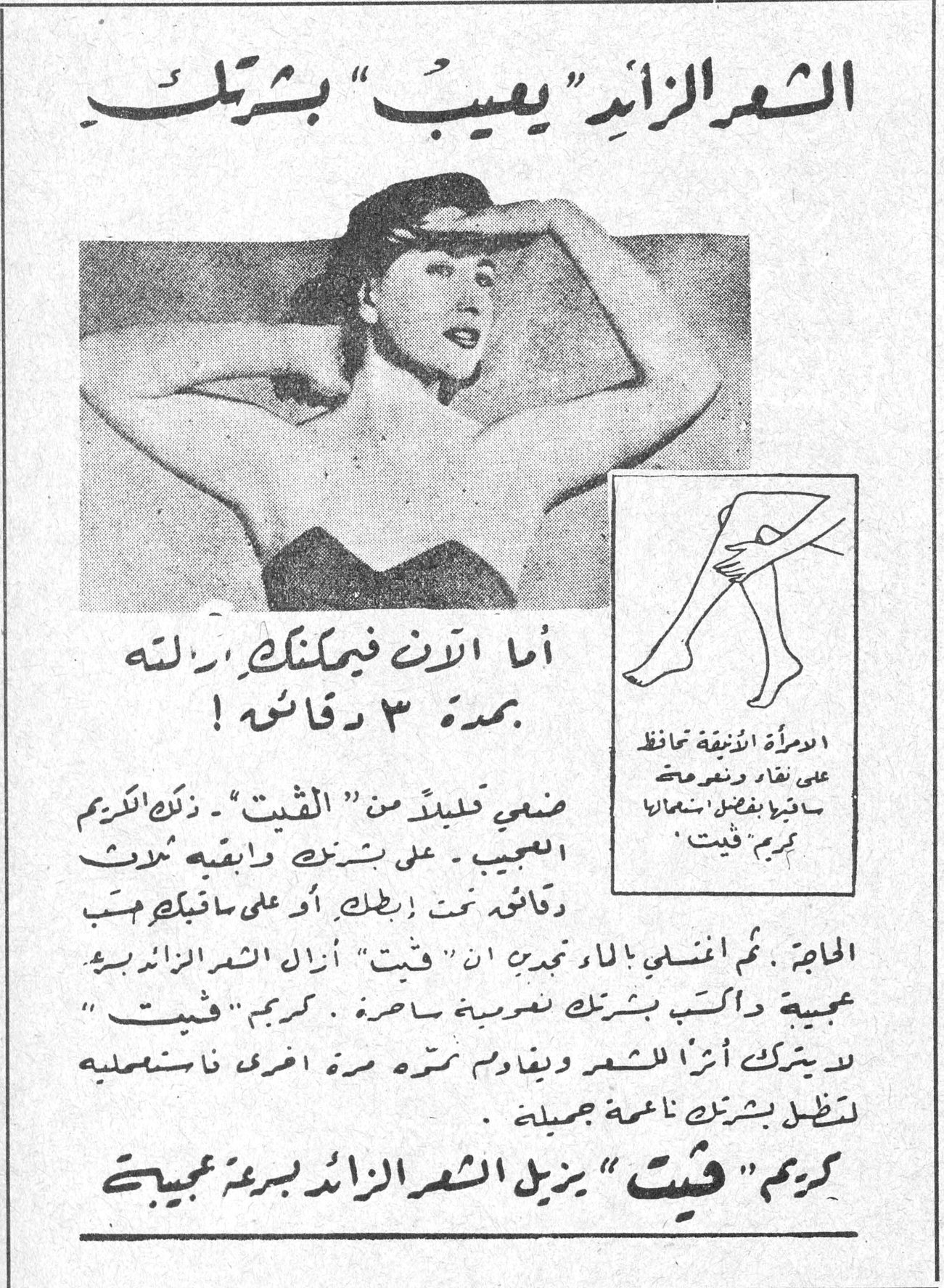
Superfluous Hair Mars Your Skin (Veet)
Superfluous hair "mars" your skin
But now you can remove it in 3 minutes!
Apply a little "Veet" — that marvelous cream — to your skin and leave it for three minutes under your arm or on your legs, as needed. Then wash with water, and you will find that "Veet" has removed the superfluous hair with marvelous speed and your skin has become soft and enchanting. "Veet" cream leaves no trace of hair and checks its growing again, so use it, that your skin may stay soft and beautiful.
"Veet" cream removes superfluous hair with marvelous speed
The elegant woman preserves the purity and softness of her legs thanks to her use of "Veet" cream