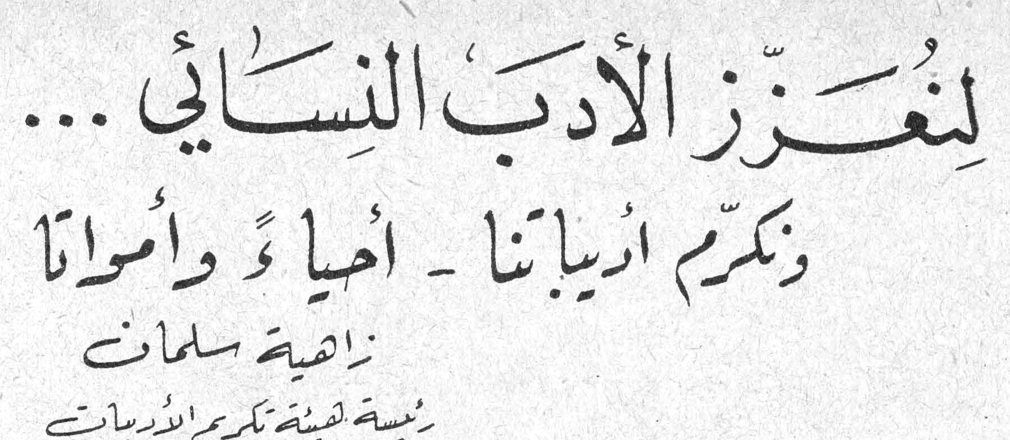
There is no doubt that the greater share of honoring the people of letters rests upon the shoulders of history, and no doubt, too, that immortality is one of its gifts and one of its verdicts. Yet, though we bow to the truth of this reality and its logic, we may not content ourselves with the verdict of history alone as the reward of our generous elite; nor may we drink, unweaned, from the springs of these men and women of letters without a glance of thanks and a measured appreciation, in acknowledgment of the favor and in fidelity to the pledge.
Most of us have grown used to honoring our writers after their death, as though their death alone reminds us of them; so we hasten to honor them by holding a memorial gathering propped up by a number of orators, whose echo, however strong and piercing, soon sinks and scatters the moment the assembled company disperses.
•
The Committee for Honoring Women Writers is still young. It is fostered by a number of people bound to literature in general, and to women's literature in particular, by a tie of affection, understanding, and appreciation; for the sake of this literature their spirits have joined hands, their thoughts have met, and their opinions and their word have been united.
Among the first works of this body, which counts among its members writers, thinkers, and social reformers, was an invitation to hear a lecture on the literature of Salma Sayegh, prepared by Mr. Edouard Honein and delivered in the lecture hall of the Ministry of National Education on the seventh of last June, attended by a choice elite of citizens. Mr. Honein spoke of Salma's beginnings and her ambitious girlhood, and her overflowing motherliness; then he passed to the personality of Salma the writer, which was distinguished by vitality, delicacy, and sincerity, as he had felt it in what she wrote and in what she said from platforms here and there.
Salma's literature, as Mr. Honein described it, is the literature of the essay, read and savored by all; her style is distinguished by grace and elegance, for it is the fabric of her soul and the child of her particular stamp. The Committee for Honoring Women Writers
will publish a booklet on Salma, to serve as one of the scholarly and literary references about her as writer and woman of letters.
As for the Lebanese University, it has established, in solidarity with the committee, a scholarship seat to be awarded yearly to the outstanding woman student in Arabic literature, bearing the name of Salma Sayegh — thereby encouraging women students to study our Arabic literature, and immortalizing the name of our woman writer in the literary and scholarly atmosphere in whose shelter she lived until the last days of her life.
The Lebanese University will also establish, alongside this, a permanent platform for women's literature, where lectures will be given that will serve as literary lessons, benefiting the public and encouraging women writers to continuous production. Who says our women writers do not thirst for encouragement, for every encouragement? Many a gesture of encouragement works wonders. However strongly the impulse to write and produce may burn within her, the woman writer is always trying to draw near to the spirit of her readers; her aim is to refine that spirit and to guide it, and often she diverts it and wins its favor with tact, wit, and understanding — knowing that in many cases she writes to gratify a desire in her own soul. In both cases there is, in what she writes, a palpable appeal, direct or indirect, to the reader, that he may answer her calls and savor her art.
The works of our committee will not stop at this limit, for it will organize competitions in composition and in oratory — the first to be named for Mayy, and the second for Julia Dimashqiyah — competitions among the girl students of the various secondary institutes, to spur the students' talents, to awaken in their souls an inclination toward literary production and toward Arabic literature, and to reward her who deserves reward. For the budding woman writer deserves to be a pampered daughter, if only in her own circle. And the committee will strive its utmost to extend a helping hand, every help, to the woman writer who needs it, to answer her call, and to defend her rights should the matter require it; for the mission of the Committee for Honoring Women Writers is to strengthen women's literature and to honor its pillars, be they living or dead, with a positive honoring. Who can deny the existence of singular pens which, were certain obstacles cleared from before them, would give and create? The hands that give, however great and generous they may be, undoubtedly long for someone to press them with the clasp of thanks and admiration — and who is worthier than we, the public of the cultured and lettered, to undertake this task? And who is worthier than the elite to honor the elite??