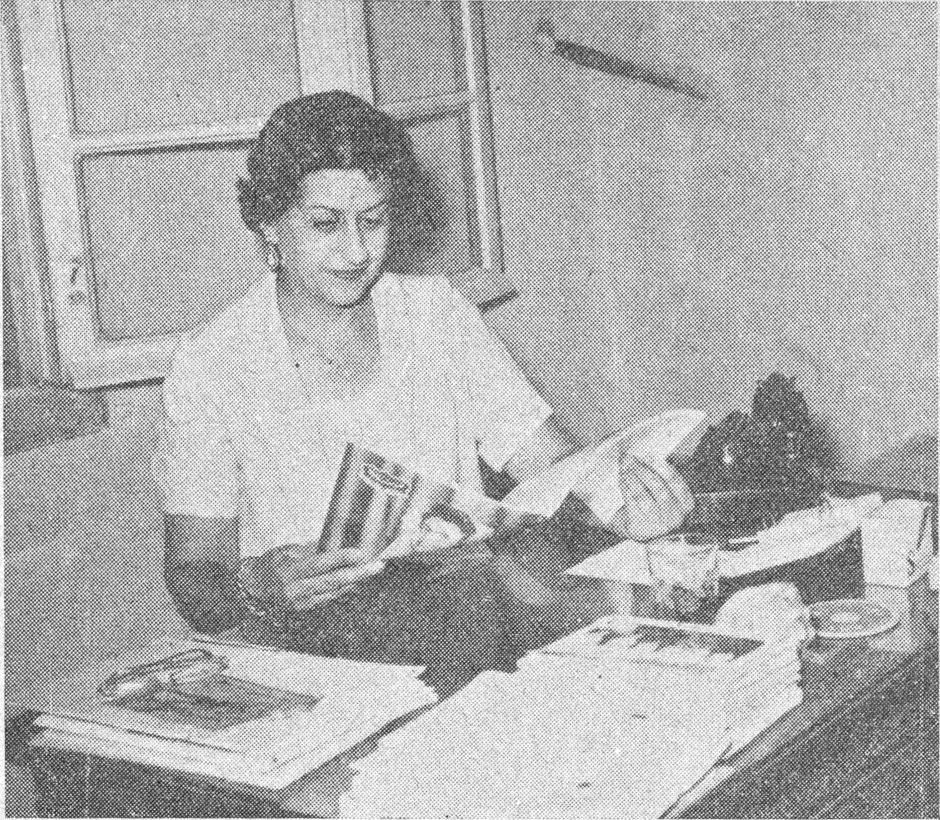
Miss Mokarzel in the editorial office, leafing through the latest issue of the magazine
"The new Lebanese generation in America is hungry to know a great deal about its country and its people..."
"The American woman, alone, enacts civil legislation — and she has proved a great capacity."
•
A noble womanly face among the faces of our emigrants in America: Mary Mokarzel, proprietor of the New York newspaper "al-Huda" and of the English-language paper, the "Lebanese American Journal," which she edits herself. Her life, then, carries a journalistic mission, in whose loftiness and importance Miss Mokarzel believes, following the teachings of her father and her uncle, the late Salloum and Naoum Mokarzel.
She launches into talk with the utmost simplicity and
without any pretension, and through her talk you sense that she knows what she is saying, and says it with confidence and certainty. You are captivated by her optimism and her positive view of the future of the rising generation of Lebanese in America... "It is an awakening, with a noble turning back toward the heritage of the forefathers," she says, and she goes on telling you news and anecdotes to win you over to her view, as though you were not more eager to know all this... than she!
And it delights your senses that the new Lebanese generation in
America has come to feel pride in its origin and a longing to know everything that bears any connection to that origin:
How they flock to the "native" parties, and how eagerly they take to learning the dabke and the ataba!
How endlessly they ask about the traditions and customs of their people!
How intensely they yearn to visit the green homesteads and come to know the life of their peaceful village on the hill! At times their ignorance of their mother tongue holds them back, and they stand perplexed at the crossroads, gazing long with eyes and heart toward these lands, while mind and will, and interests with roots and branches, bind them to their second homeland...
"What prepared the way for this change," says Miss Mokarzel, "is the shift in the Americans' view of immigrant peoples. At the very outset it was tinged with a certain disrespect reserved for the dark-faced strangers — Italians, Spaniards, Syrians, and
Lebanese — unlike the English, the Germans, and the Scandinavians. But the modern American mentality has changed through its schooling in the true democratic spirit. And so the causes of the complexes that threatened the souls of our children in their first days of settling in America have disappeared.
"The Lebanese and Syrians of America today have a face than which none is
nobler or brighter of brow. They are in an excellent material condition — and material means are a great pillar of social standing — and thus the sons of our colony have come to occupy prominent positions, whether in government institutions or in private ones; and this fills us with pride..."
— And how do our emigrants feel about the Palestine question?
— No doubt there are among them some who are swayed by the vast propaganda on which the Zionists work without respite; they have their dangerous means, which we cannot possibly match. But the majority of our countrymen read our Arabic newspapers and grasp the question with the importance it deserves — and they come forward with donations generously.
— And how many are the Arabic newspapers that shoulder this national responsibility?
— In New York there are six papers: "al-Samir," owned by Elia Abu Madi; "Mir'at al-Arab";