"al-Islah"; "al-Sa'ih"; "al-Bayan"; and "al-Huda" — the last alone is a daily, while the rest appear weekly or twice a week. And in Detroit there are three papers: "al-Sabah," "Nahdat al-Arab," and "Lisan al-Adl."
— Do these papers have particular political or sectarian leanings?
— Emigrant Lebanon, however long its absence lasts, remains the miniature image of resident Lebanon — and all its political and sectarian leanings show themselves in its press as well.
— And what is your position on the attacks by certain papers on the policy of "al-Huda" with regard to its opposing Israel?
— Is that conceivable, when the policy of "al-Huda" has been drawn clear for more than half a century — namely, "the service of the Lebanese cause"? Every friend of Lebanon is our friend, and every enemy of his is our enemy. And I reckon no enemy of Lebanon in its present day exceeds Israel in danger. We have published dozens of articles against Israel, which may be consulted. As for certain colleagues hurling accusations arbitrarily, or for some purpose of their own — that is what I did not expect...
— And what is the position of "al-Huda" on the Arab cause?
— My late father had warm friendships with some of the great men of the Arabs — and among our principles is the effort to bring about economic cooperation among the Arab states, to raise the material standard and, in consequence, to raise life in all its departments... We work for Lebanon, but we are the friends of the Arabs.
— And may we hope your stay among us will be long?
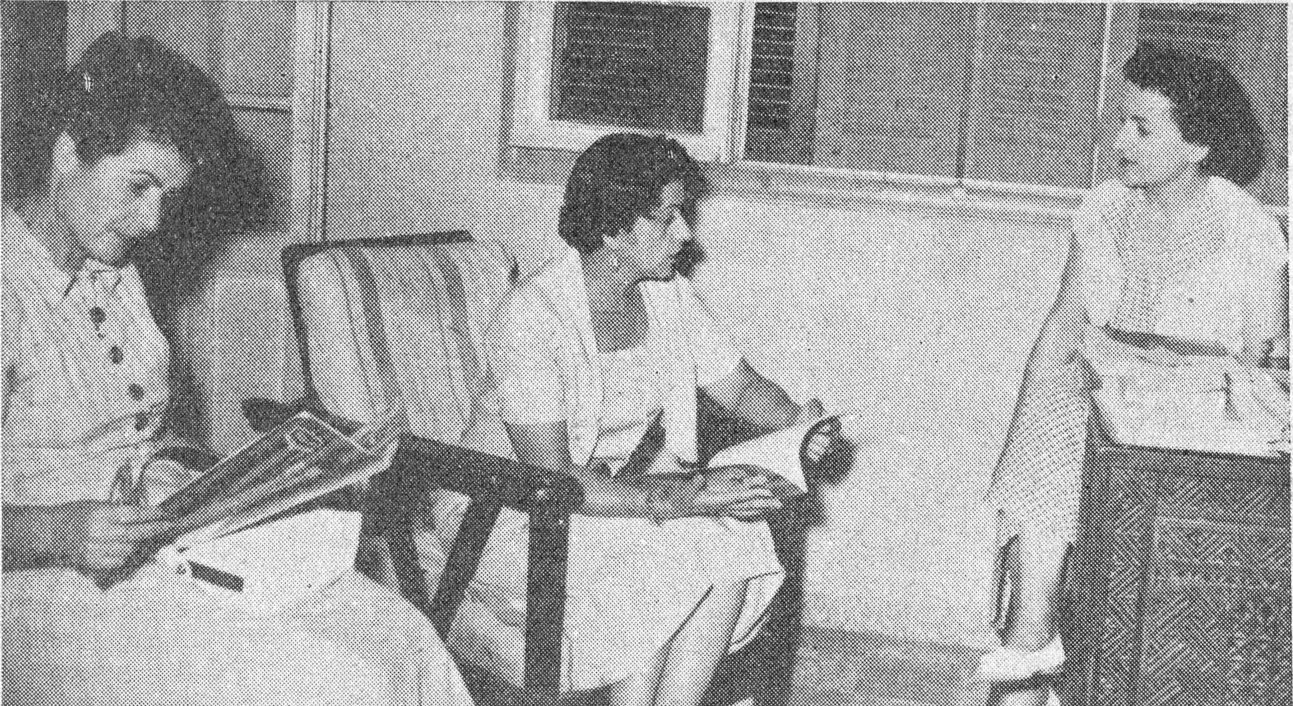
Miss Mary Mokarzel talking with the editor-in-chief; on her right, Mrs. Loreen Rihani
— It was not my intention to stay long this summer, out of regard for my many duties, which demand a speedy return to New York. But Lebanon captivated me — and my brother too — so I weakened before carrying out my plan, and extended my vacation. There is nothing in the world more beautiful than this country, my friend, and life here is a
blessing of the Creator beyond all price.
— Surely you have some criticisms of the way life runs among us?
— What I fault most in life in Lebanon is the absence of civic responsibilities. The law here does not protect the sick, the unemployed, and the hungry, as is the case in America, where the law provides that no one shall go hungry, and the sick person has a right against the state to the securing of treatment — and this, in my view, is woman's task. In America it is woman alone who enacts the social legislation on the problems of health, poverty, and education — while the man does not feel that any responsibility of this kind rests upon him, because woman is active and cultivated, and knows the needs of her fellow citizens and their rights against the state; and in her long practice of enacting civil laws in their various fields she has proved a capacity without equal. Would that our women followed in their footsteps and gave their efforts a positive meaning deserving of abundant thanks.