connection with its changing? Did Mr. Hallward put deadly poison in his colors, so that they have turned to torment me and rob me of my sleep? It calls me every night to see its hands stained with blood, and its eyes striking sparks that terrify me. I must kill the painter; I must ruin his happiness as he ruined mine. — And the painter was killed at the hand of his dear companion Dorian Gray. He killed the man who had so often given the young man his ideal counsels. He killed the man, and the picture grew more hideous and more ugly, and its owner more criminal and more dissolute. And here he is today, killing his chemist companion, after turning the painter's corpse to ashes. And here he is, days later, murdering the only brother of his friend, the girl who took her own life.
Dorian Gray did not change; he went on keeping his beauty and his youth. Only that picture changed. It alone changed the course of his happiness. Why, then, should he not break it and throw it away? Why not tear it to shreds with the knife with which he had killed his first three companions? A strange idea — it must be carried out.
And Dorian Gray advanced upon the painting, the criminal knife in his hand. When he had stripped away the carpets and the coverings, he screamed with his tormented voice a resounding scream. For the picture was stained with blood, and over its features hung the marks of crime. The picture was looking at him with sharp, cruel looks that all but tore his heart apart. But he sought to destroy those looks with a thrust of his knife — which rebounded upon his own image, then sank in and came to rest in his depths.
...And the oil painting returned to its vigor and its charm. It returned bearing the true, beautiful image of Dorian Gray. It returned to laugh at the corpse sprawled on the floor — the corpse that crime had corrupted, whose youth had been shattered by immersion in vice, which had spread hideousness over its features. The painter Hallward had not painted merely the picture of a man; he had painted the picture of a spirit and a soul. He painted that soul in moving colors — colors that move with the inner
influences that grow within a man, and with the good and the evil that accompany them.
Oscar Wilde did not merely tell us a story; he portrayed for us the tendencies of the human soul. He told us of the effects that appear upon it in the wake of criminal thinking and wretched inclinations. He told us the story of a struggle between a man's conscience and his obstinate passions. He told us the story of every human being, and of every individual's inclination to evil as much as his inclination to good.
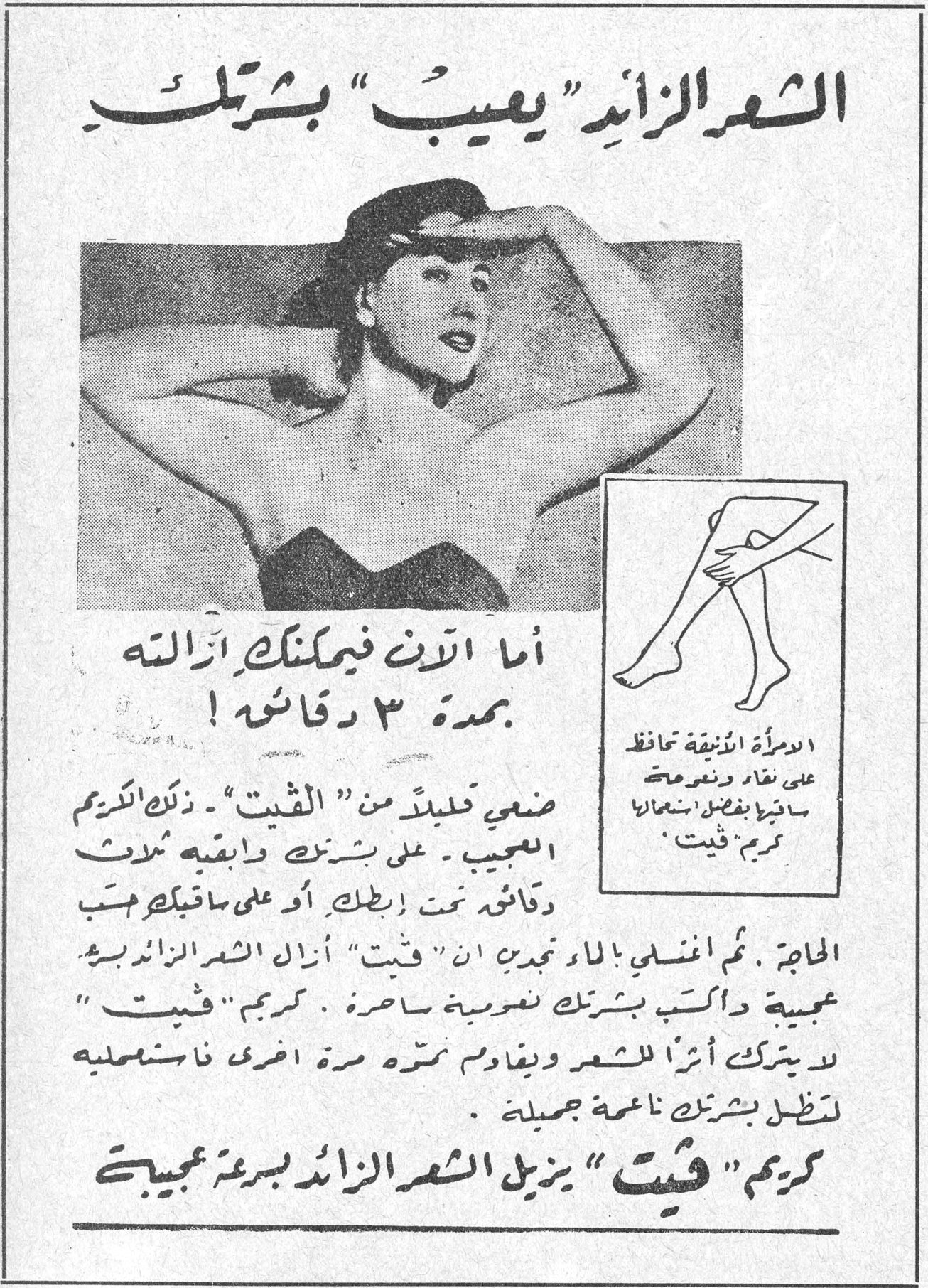
Superfluous Hair "Mars" Your Skin — Veet Cream
Superfluous hair "mars" your skin
But now you can remove it in 3 minutes!
Put a little "Veet" — that wonderful cream — on your skin and leave it three minutes under your arm or on your legs, as needed. Then wash with water, and you will find that "Veet" has removed the superfluous hair with wonderful speed and left your skin smooth and enchanting. "Veet" cream leaves no trace of hair and resists its growing back — so use it, that your skin may stay smooth and beautiful.
"Veet" cream removes superfluous hair with wonderful speed
The elegant woman keeps her legs pure and smooth thanks to her use of "Veet" cream