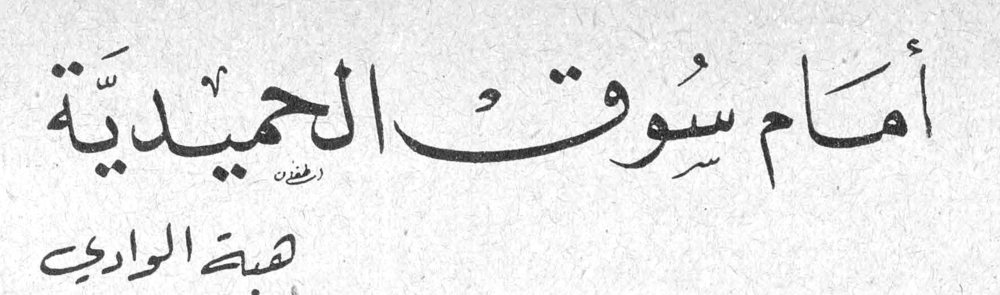
Do you know it? This beautiful souk, the elder of the Eastern markets? Have you passed by it one day, and its dignity seized you, and its awe pressed upon your souls, so that you wished you were versed in some word of reverence, or could perform one simple act of the gestures of esteem: a nod of the head, or the lifting of a hat!
This wondrous souk — resting-place of brides' dreams, of children's joys, and of the head-shaking of the destitute; this joyous ambush laid for the wit and the elegance of the pampered!
Have you walked slowly through its reaches, and the ghosts of its builders stole into your imaginations, and from its antiquity the refreshing perfumes of the East drifted to you, kindling in your spirits a poetic lamp steeped in the landmarks of history!
Have you looked again at its name, and somber veils were drawn down within your hearts, recalling that tyrannous Ottoman, that "Abd al-Hamid"!
Here is the Ukaz of women: within its corners the marks of taste and the gifts of choosing and selecting contend; the brilliance of setting off one's features and the genius of matching race one another; and money is squandered there in torrents!
Here the dark beauty pauses, and the fair one draws out her deliberation: shall her choice fall to the green silk, or to the embroidered white? Will she accept thick broadcloth for a garment, and leave the polished velvet and the gleaming threads? And which of the fabrics harmonizes with her femininity?
Why does the face of every seller within you look distorted, deformed, as though it were the
face of a comic actor peering out from the acts of a solemn play? Is it that the majesty of the old refuses to let the new be its equal? — so you insist that your patrons wear a flowing robe, a cap, and shoes of silk!
O grandson of the industrial civilization that filled the heart of Damascus to overflowing with ripeness, and nurtured with its earnings the life of souls around the farms and the towns and the plains!...
O symbol of possession and of pride, and link of the old with the new!
O artery throbbing with abundance and with work! The Persian and the Indian make their way to you; each finds in you an outlet for his longings for his calm, far-off land, and breathes in your enchanted air the scent of textiles and perfumes and essences, and is content with the sounds of the ceaseless hammering and the steady beating upon tin and gold and silver, and delights in the sweetness of the disorder within your quarters, the splendor of the entanglement of your corners, and the harmony of the interlacing of all your reaches!
And the Westerner comes to you, pacing your length, astonished at the authenticity of your Easternness, taken by your keeping of the covenant — you who are neither shut away in a museum nor hidden in a house of antiquities!
O hiding-place where power and craft are kindled, O quickener of ambitions, O great souk! Beneath your arcades stand the local industries, nourished by the honorable endeavor to raise high the name of the homeland; and before them, the polished skill of the fearsome machine, protected
by foreign capital! The one, with the spontaneity of its knowledge and its overflowing will to be something!
And the other, with the terror of its power and its skill, the eminence of its kind, and its backing of abundant money! And the one, with the tremor of its dread that tomorrow it will be said: Were the men of labor in your past better than you, O Arab, in your present? Is even the Umayyad merchant more skillful than you, O wakeful one?!
By what wisdom does the Umayyad Mosque crouch at your end? It reads itself as an attempt to bind religion and the world together, and ponders deeply the spirituality of those who seek you. Does it go on laughing at the ambiguities of existence, and at the contradiction of conditions and things and times? Is it because the religions of heaven have all claimed kinship with it, taking it now for a synagogue, and now for a church and a mihrab! — so that it alone has known the great heart of God, and plunged into His folds and His deepest depths!
Does the mosque not weary of the clamor of the souk — it, the abode of humble silence, the lair of asceticism and of awe! Or is it the souk, surging with sounds and movements, that melts away in shyness before the hushed praises and the silent, divine gestures!
By what wise mind was the mosque built at the end of a souk!
Was it one embittered with the world who set the symbol of religion there, proclaiming the two opposites!
Or one with an inborn whim for planting a living jest, and for turning things upside down, who willed that the souk should embrace a mosque!
Or was it, perhaps, some man who loved you, O Souk al-Hamidiyya, and would have nothing less than that grandeur should ascend in you by degrees, until it reached its summit in a mosque he built at your end!!