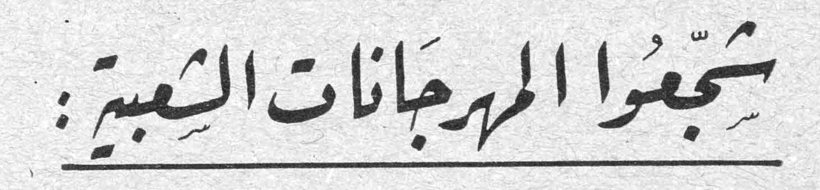
Visitors to the mountain — tourists, emigrants, and citizens — beheld the varieties of folk festivals, which reached the height of their activity last month, when the little village became a gathering of thousands of souls, as though all Lebanon had moved there, until, for all their breadth, its squares, roads, and balconies grew too narrow.
My word will be confirmed by whoever attended the "Festival of Flowers" in Bikfaya, or the "Festival of the Vine" in Zahle, and the other festivals of last September.
In the succession of these occasions, year after year, there is abundant benefit for Lebanon. They are a school for those in charge of the organizing, who learn from trial and error until our festivals keep pace with the like of what we see in the advanced countries. And they are a school for the people itself, who grow familiar with the atmosphere of these folk festivals and take pleasure in it, and so await the return of their seasons to flood them with the joy of meeting and with innocent gladness, on a sound national plane.
In the past we appealed to the government on the necessity of encouraging these folk festivals, so that they might, of their own accord, take the place of the sectarian festivals — the latter feed the spirit of odious fanaticism and divide the ranks of the citizens, and we have paid dearly for that, and are paying still; while the former are a natural field for positive participation, understanding, and love. And if the folk festivals had no virtue but this one, it would suffice!
In the past we said it as a passing word; today its usefulness looms far larger, and so we sincerely call upon those responsible to adopt our humble opinion, for the good of this gentle country, which the sects and factions tear apart, and whose weak point is exploited by those with suspect designs...
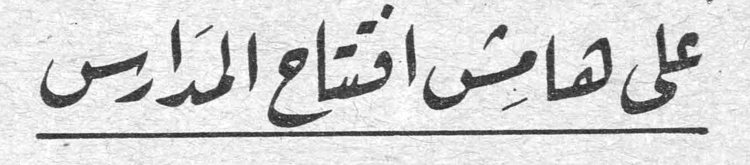
We are in the year 1955, in its tenth month, and this month has a special meaning for two groups of people: the teachers and the parents...
At the beginning of every October, parents feel the weight of responsibility and its gravity — the darlings of their hearts are about to begin a new stage of the long, arduous road to the shrine of knowledge and learning. What a responsibility this is! Where is the best school in which to deposit the most sacred thing we possess — to decide, in a word, a destiny: our children's success or their failure, their happiness or their misery??
Where is the better home, in which the child has an independent being, where the parents strive to discover his talents, to direct them and nourish them, so that no energies are squandered, and the child is not driven, against his will, down a path not his own, to gratify his parents' pride?
Where are the parents who watch selflessly over their children's good, working with them in the spirit of cooperation with the school, and not in the spirit of their own tyranny and selfishness — as though their children's being a part of them obliged the children to absolute obedience and to going along with their every wish, or else be counted undutiful rebels?!
The twentieth century's view of education has grown, and its conception has changed from what we knew in the era gone by... Tremendous discoveries have been recorded by the masters of education... Yet I fear that Lebanon, and the sister countries behind it, still flounders in error, far from the true understanding of the teachings of this age and its innovations, ignoring the importance of building the child's personality and of securing the school atmosphere that understands the meaning of discipline and of cooperation with the home in discovering the child's capacities and working to develop them...
Until our schools become what they ought to be, parents must be wise in choosing their children's schools.