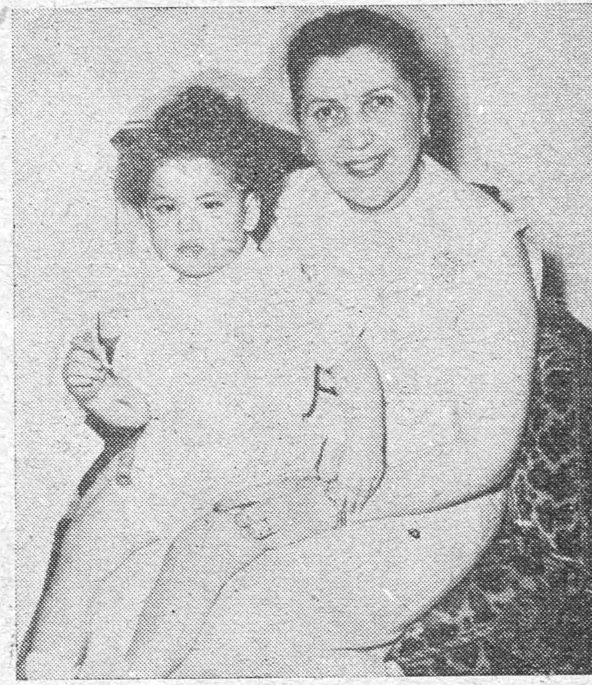
"He is my chief preoccupation," says Eva
our own, with a weight that commands notice. In addition to her university education — a degree in the science of history — she has acquired rich experience over ten years as the wife of Dr. Charles Malik, Lebanon's ambassador in Washington and his country's permanent delegate to the United Nations. In Washington, Eva was no less active than the cleverest women of the world's diplomats; she raised the brow of the Lebanese woman and commanded the respect of the most refined circles.
To her alone goes the credit for founding the "Lebanese House in Washington," which became a model of taste and art. She is one of the founders of the Lebanese Women's League and one of those laboring for the flourishing of its projects.
At the beginning of last month she returned to Lebanon with her husband and their only child, Habib — here where the field is favorable for fruitful production and constructive work.
Welcome...
Q — Which of the two roles is the more important in a woman's life: the role of "the ambassador's wife," or the role of "the mother"?
A — Before my child Habib came, I devoted all my time to the duties of the embassy, but matters changed greatly after I became a mother. I value the role of motherhood at its true worth, and I know for certain that a newborn child in Washington demands of his mother all her time and attention. Hence it was not easy to reconcile the two great tasks without one of them suffering neglect...
In my opinion, for the ambassador's wife to master her role as she should, it is necessary that material means be at her disposal — something lacking at the Lebanese embassy in Washington for many reasons... How many times did I break off nursing my child to answer the telephone after the maid had gone! As for the nurse, her minutes are all counted!
Q — Was your return to Lebanon entirely by your own desire, or would you have preferred to remain as the lady of the Lebanese House in Washington?
A — I am very happy at my return to Lebanon and at being reunited with family and with the roots that bind us to this beloved land. There is nothing in this that diminishes my pride in the honor I gained as lady of the Lebanese House in Washington, serving my country's cause as best I could...
It is in the nature of diplomatic posts that they do not last long — and if they last, they harm either the interest or the person. Our lot was "the work of founding," and perhaps ten years is enough! It was an opportunity granted to us, and upon the foundation we laid, whoever comes after us will build.
Q — Speculation has multiplied about "the way" in which your husband, Dr. Charles Malik, will employ his intellectual energy in Lebanon — what do you know on that score?
A — I prefer that Charles answer this question himself. What I do know is that he is returning to the intellectual, scholarly life — he longs to devote himself to writing and to teaching at the American University of Beirut.
Q — There are those who affirm your indirect contribution to the world fame your husband has attained — how much truth is there in that?
A — It would be more accurate to say that in our work we were "a team"... Charles needed no help of any kind in his work. As for me, my province was the social and family field and official invitations; my task was to preserve harmony, and I worked by the inspiration of the higher interest. Given how short time usually was, each of us managed his own field independently without referring back to his companion — for we understand one another; we work in solidarity, on a basis of respect and trust, so that neither of us trespasses on the rights of the other...
Q — Now that you have settled in Lebanon, do you intend to resume your activity in the social field?
A — I long very much to return to the field of social service alongside my sister woman, but that is out of the question at present, given my