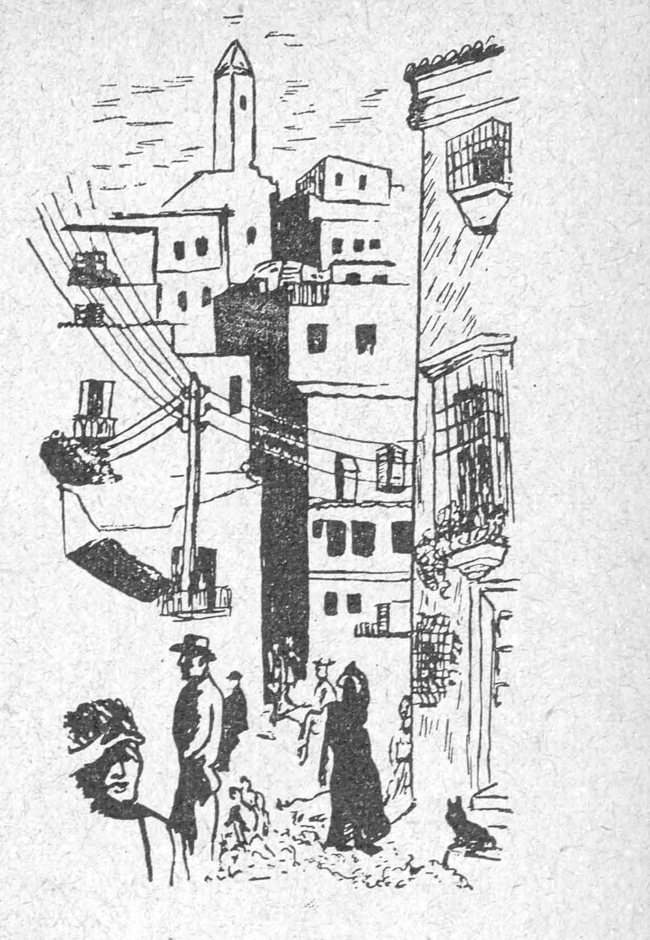

A few years ago, while I was at work on a book about Spain in its golden age, I had in Seville — where I had gone to celebrate the feast of the Lord — an encounter that has always seemed to me one of the strangest things that ever happened to me in my life.
It was the eve of summer and the heat was terrible. Awnings had been stretched above the narrow streets, casting deep shade. But the sun pelted the squares mercilessly with its rays. That afternoon I made my way to the palace of the Duke of Alba, hoping to enjoy the sight of a lush and lovely garden and, in one of the rooms, a splendid ceiling made — so it is said — by Moorish captives before the fall of Granada.
A disappointment awaited me. The keeper announced to me that the palace was under repair, and that no one could visit it without written permission issued by the Duke's representative. Since I had nothing else to do, I resumed my stroll. The streets in the old quarters of Seville are narrow and winding. It is pleasant to wander at random through them under the shelter of the eaves, but it is easy to lose
one's way among them. That is what happened to me. I had given up all hope of getting out of this fix when I caught sight of a man coming toward me. I went up to him to ask him to direct me to my road, and he said:
— You will never manage it. I will walk a few steps with you and set you on the right way.
And he insisted on guiding me, assuring me that it would not trouble him in the least.
I said to him:
— I have come from the palace of the Duke of Alba. I wanted to see the Moorish ceiling, but I was not allowed to visit it.
— So Arab art interests you?
— Of course. I have heard that this ceiling is among the finest things one can see in Seville.
— I believe I can show you something no less splendid. If you have ten minutes, I will take you to it.
I thanked him warmly, and we retraced our steps. We chatted of one thing and another until we found ourselves before a large house painted a yellowish green. My guide knocked at the door with his hands, and one of the servants, after a glance through the window, pulled a cord.
— What house is this?
— It is my house.
The heavy iron door swung wide and we entered the courtyard. We crossed it and took a narrow passage. Suddenly I found myself in the midst of an enchanting
garden. Three of its sides were bounded by high walls whose old red tiles, blackened by time, were covered with roses of intoxicating fragrance. The fourth side formed a Moorish loggia. When we entered it I saw the magnificent ceiling. It appeared to have been taken from the palace; its colors were brilliant. A veritable jewel!
In the shade of a palm tree I saw a lady seated on one of those earthenware benches that one sees in the palace gardens, absorbed in her embroidery. He said to me:
— Allow me to introduce you to my wife.
She was of exquisite beauty, with wonderful eyes, a straight nose with delicate nostrils, and a soft, pale skin; not a line marred her face. She could not have been more than thirty, yet it seemed to me that something in her had died — impossible as that was, considering her age and her beauty.
She asked her husband:
— You two, no doubt, would like to sit here?
— If you permit it, and only for a few minutes.
— I will leave you to yourselves.
She gathered up her silken threads and the piece of stuff in her hands and rose.
We sat down on the bench painted in gay colors. I offered my host a cigarette. He glanced at the volume of the novelist