enjoyed great wealth, but that wealth had dwindled by the time my friend Don Pedro succeeded his father. So all Seville was astonished when his engagement was announced to Soledad, daughter of Count Acaba, for debts weighed heavily upon him and his reputation was bad. But Soledad was beautiful, and Don Pedro was madly in love with her. They married. He worshipped her with that burning passion of which none but Spaniards are capable. But, as ill luck would have it, he soon discovered that she did not love him, and he grieved deeply. After suffering terribly over it, he ended by telling himself that hers was a nature of the utmost nobility, an ideal spirit, which kept her from stooping to earthly passions; and he resigned his affair to God."
I was beginning to feel somewhat impatient: this Spaniard let his eloquence run on at length. He continued:
"You know that the opera season in Seville lasts only the six weeks that follow Easter. The Aguria family, like everyone else, had a private box at the theater. They attended the opening night. During the interval Count Acaba, Soledad's father, came to her box accompanied by a young artillery officer whom Don Pedro had never seen before. But Soledad, it seemed, knew him well. The Count said:
— Here is Pepe Alvarez; he is back from Cuba, and he asked me to bring him to you.
Soledad smiled as she held out her hand to him. She presented the newcomer to her husband, saying:
— Pepe is the son of the notary at Carmona. How often we played together in our young days.
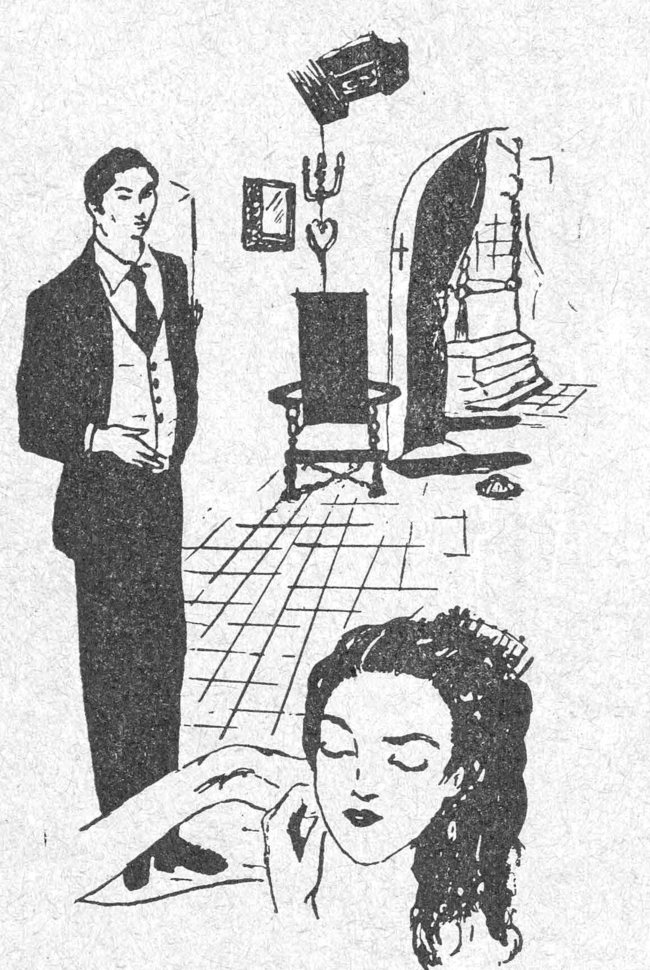
The Aguria couple and Pepe
Alvarez met often during the feasts and seasons of Seville, and Don Pedro found the young officer a companion of pleasant company. The tragedy would never have broken out but for the unintended chatter of the Duchess de Santaguador, Don Pedro's cousin. One evening, as the two of them were dancing, they passed close by Soledad and Pepe Alvarez, and the Duchess said to her cousin:
— Soledad is looking radiantly beautiful tonight!
And Don Pedro added:
— And she seems very happy!
— Is it true that she was once engaged to Pepe Alvarez?
— Certainly not.
But this question troubled Don Pedro. When he and his wife had come home, he repeated the Duchess's remark to her. Soledad said:
— As a matter of fact, I was engaged to Pepe!
— And why did you never tell me so frankly?
— It is an old story! He went off
to Cuba and I thought I should never see him again. But have you lost your trust in me?
— No. All the same, you must stop seeing him.
— And if I refuse?
— I shall kill him!
The day after this conversation, Soledad pleaded that she was suffering from an indisposition and did not leave her room. She did the same the following day. Don Pedro visited her in her chamber morning and evening, and they would talk together. On the third day Conchita de Santaguador was giving a ball, the last of the season, which no one belonging to their narrow circle would miss. Soledad announced that she was still out of sorts and would keep to the house. Don Pedro asked her:
— Are you refusing the invitation because of our conversation the other night?
She answered:
— I have thought long over what you said, and I found your demand unreasonable; yet I accept it all the same. And the only way to break off my friendship with Pepe is to avoid meeting him in the places he is likely to frequent.
— Do you still love him?
— Yes.
— Then why did you marry me?
— Pepe was in Cuba, and no one knew when he would return. He might never have returned at all. And my father implored me to marry you.
— I pity you.
He went alone to the ball and entered the gaming room. There was a vacant seat at one of the tables, and he sat down to play baccarat. Luck