Around the year 1820, Ferdinand Wieck was the greatest piano teacher in Leipzig and one of Germany's great musicians.
Clara was the second of his daughters, and from her earliest years she showed a passion for music. When she reached the age of five, Wieck began teaching his daughter to play the piano.
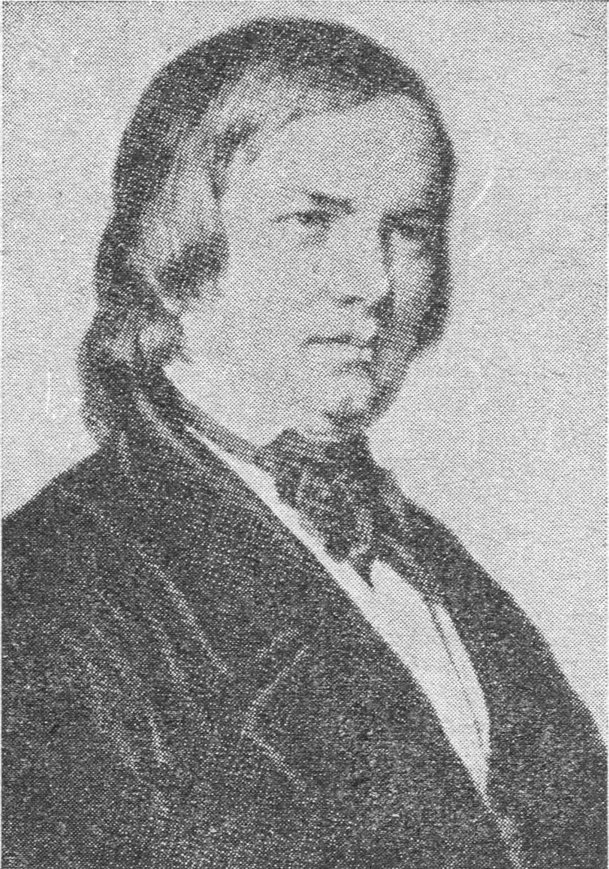
In the year 1828 a new pupil, eighteen years of age, arrived at Wieck's. He was a student at the school of law, the son of a father who worked as a book publisher. His name was Robert Schumann.
This youth had passed through the transition from childhood to adolescence in distress and turmoil. With adolescence, his childhood gaiety and his lovely candor turned into gloom. He became withdrawn into himself, absent-minded, indolent... taking refuge at the piano every evening, improvising and sobbing.
His father discovered the musical instinct in him and wanted to send him to Weber to study under him. But this father died suddenly while Robert was still sixteen.
Schumann, then, is eighteen when he begins serious piano lessons with Wieck. As for music itself, he learned it not through abstract theory alone but through a deep study of the lives of the great musicians. Bach was his greatest idol.
But this restless adolescent soon leaves Leipzig and Wieck and departs for Heidelberg to
continue his law studies there. Yet his life remains, even so, in a turmoil that knows no rest, for he is forever wavering, and he writes to his mother on this subject:
"My whole life, for twenty years, has been nothing but a continual struggle between poetry and prose, or, if you will, between music and the law. And now here I am between two paths, and this
question terrifies me: which life shall I choose?"
In this turmoil and this distress he begs his mother to write to Wieck: "Ask him what he thinks of my future." And Wieck answers: "I take it upon myself to make of Mr. Robert, your son, within three years, one of the greatest living pianists, because of his intelligence and his genius.
He must come to play with a precision and a warmth greater than the warmth and precision of Moscheles, and with a grandeur mightier than the grandeur of Hummel. And I give you the proof in the person of my daughter, who is eleven years old, and whom I have begun presenting to the public."
Madame Schumann sent the letter to her son, and Robert answered her:
"I compelled my soul to decide for itself; it placed the future in the two pans of the scale and chose the weightier pan. I did not find the act of choosing difficult..."
•
Schumann is now living once more at Wieck's. Yet he was not happy. He is one of those who are never happy! He wrote letters throbbing with pain. No doubt he was not at ease where his livelihood was concerned, his poverty denying him many things. But the chief cause of his despair was deeper than that, and more wretched. Here is the letter that recounts his sorrows and reveals his hidden ailment:
"My life is dreary and without joy, and it is a blessing that I do not live alone, for in solitude I easily turn into a man who loathes people. And it vexes me to see none but stupid mortals. Yet in the depths of my being I am not so very miserable, for music grants me all that people refuse me. The piano tells me