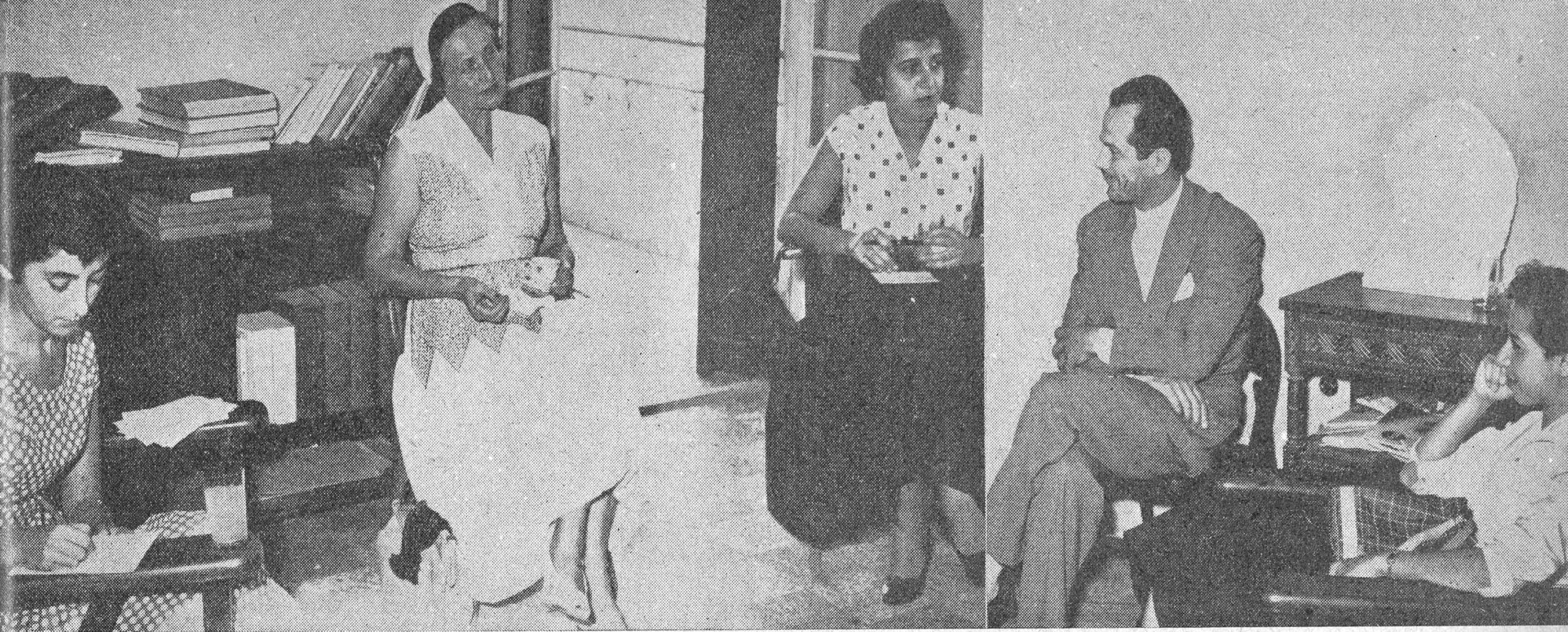
From left to right: Nihad Bishawqi, Alma Kabir, Afaf Abd al-Baqi, Camille Munsif, and Layla Labaidi.
It was most enjoyable, The Woman's Voice seminar on 'the furniture of tomorrow.' It brought together specialists and enthusiasts of the art of home decoration. Mrs. Alma Kabir and Mr. Camille Munsif were the highest authority on the subject of house furniture and furnishings, and the Misses Layla Labaidi and Nihad Bishawqi and I were the eager ones, keen to learn of everything new and useful in this art that embraces us at home, at the office, and in public places. And the mainspring of the whole affair was, of course, the editor-in-chief, Mrs. Shayboub!
No sooner had we gathered and taken our seats than a volley of questions poured down upon both Camille Munsif — trained in Paris in this branch of the arts, and known among us for having decorated many of our houses and hotels — and Alma Kabir, that lady who stands behind the industrial renaissance in Jdeidet Marjayoun...
The first question, and rightly so, went to Layla, who will shortly be mistress of a house and wants its modern dress to suit her life and her personality. She wished to grasp the chief characteristics of modern furniture, so as to follow them in furnishing the home of her future... Kabir expounded at length on the rise, or birth, of the modern style, saying it was the product of an industrial life from which servants and
retinue have withdrawn. Modern furniture demands no great effort in its use and upkeep; it is simple, highly useful, with harmonious, beautiful lines suited to the lines of the human body in its various restful positions.
We were following her talk with keen attention when she concluded by saying that the birthplace of modern furniture is the northern European countries — the lands of Sweden and Norway. She explained the event's occurring in those lands by their people's love of using the raw materials found there in abundance — such as wood — in their most beautiful forms. Thus they devised those simple, beautiful, restful lines... We did not all accept this theory, and I could not help setting before her my own conviction, founded on study: that the modern style in furniture is the fruit of the mingling and blending of different civilizations. These modern lines have existed since ancient times in Japanese furnishing, and Eastern furnishing generally... And who among us does not remember the low divans, the tables rising barely above the floor, and the cupboards set into the walls, with which our houses abounded not so long ago?! After these civilizations became acquainted and their arts intermingled, the first signs of the modern renaissance appeared in various countries