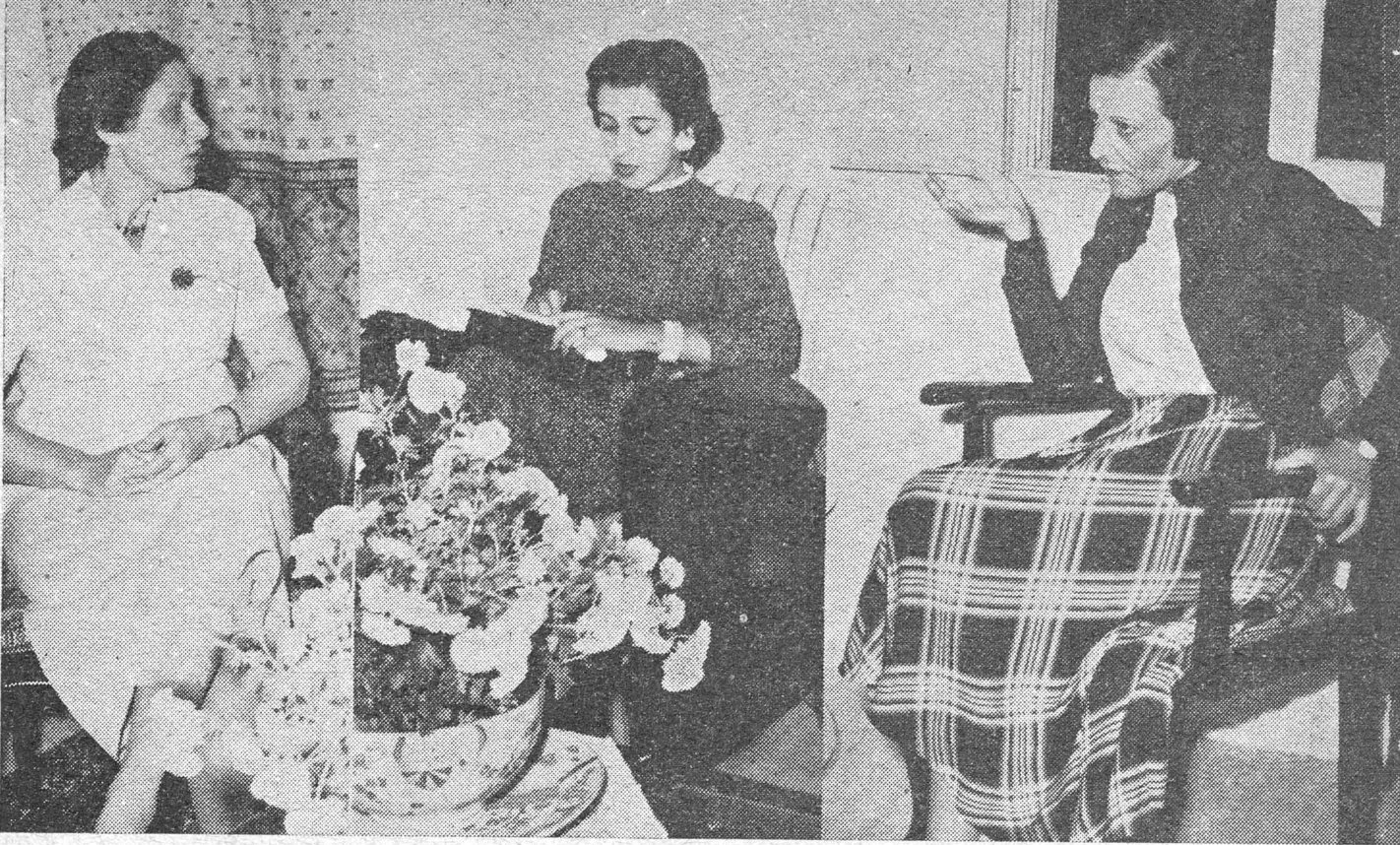
The credit for winning the round went to the pair Ghorayeb and Aqrawi!
character in everything — in architecture, in order, and in adornment — while Beirut has no color of its own, no personal stamp to set it apart from the other cities of the world.
Logically enough, the talk soon passed to culture and learning in Lebanon. Aqrawi said that this is a second face of the city of Beirut: no special character, no fixed arrangement, no unified system! And the tangle of cultures all but obstructs the course of our mental and psychological life.
Rose Ghorayeb sighed and began to speak of the decline of our schools and our poverty in institutes of high, useful culture. Then Najjar asked her about all those Anglo-Saxon and Latin cultures sweeping the educational field. Are they not to the pupil's advantage?
Before she could get an answer, Ghorayeb dotted the i's. She made us understand that the use of the term "Anglo-Saxon culture" is a mistake, since no such culture exists among us, but rather an Anglo-American culture. And the difference between the two is vast! The first is far superior to the second!
As for Aqrawi's answer, it filled our hearts with alarm for those small pupils who spend many years in toil and weariness before
winning their first certificate. "These cultures are not suited to the pupil at the elementary stage; at the secondary and higher stages, however, there is no harm in them." The small pupil who spends most of his day at study and learning cannot achieve a balance between the hours he spends exercising his mind and those he spends exercising his body. The child's personality does not grow as it should when this method of instruction is followed.
On Ghorayeb's expressive, sensitive face there showed agreement with what Aqrawi was presenting about the unsuitability of those cultures. She went on to join her in saying: Latin instruction is classical — instruction with a great deal of exactness in work and of mental drilling from the very first classes. The pupil, even at the age of five, has so much homework that he works many hours at home upon returning from school; whereas Anglo-American instruction, with all its points of weakness, demands less effort of the pupil and leaves him a wider margin for rest and for attending to other duties. As for instruction in Lebanon, it is an imitation of all these cultures. It has borrowed them without any alteration, renewal, or blending.
Aqrawi spoke of the modern
ideas that have begun to storm the field of teaching and education in France, demanding liberation from the many fetters that bind it, above all the baccalaureate examinations.
In answer to a question from Edvick Shayboub she said: France's backwardness, in times past, in the arena of educational liberation resulted from the many restrictions that accompanied — and at times still accompany — the certificates and the public competitions, among them the question of age. Past a certain age the pupil is not accepted into certain institutes and competitions. For this reason the baccalaureate program has become difficult and stuffed beyond all need. Students have taken to racing against the years and cramming their brains with minute, deep, difficult information.
Najjar agreed with this analysis and told us how Anglo-American instruction requires of the student only general knowledge up to high school; as for the compositions and literary exercises for which French instruction is famous, they are demanded of him only after that certificate, and in a lighter, more merciful form. Here she asked Aqrawi about the number of kinds of baccalaureate existing in France, which she had heard exceeded seven. Aqrawi denied that all these kinds of baccalaureate exist, and said that the difference among the existing kinds is slight — only in certain non-essential subjects.
Ghorayeb completed the answer for her, explaining that the difference among those baccalaureates appears in the upper classes only, when the student is allowed to choose the ancient languages instead of arithmetic and mathematics, for example.
The difference is one of kind, not of grades, as it is among the