A Child Analyzes a Poetic Scene in Two Books!
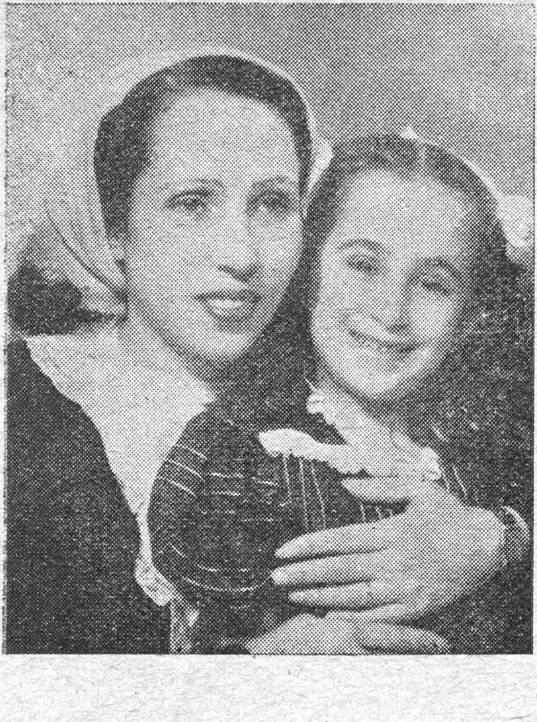
Nasima with her mother, three years ago
Nasima has only just stepped into her twelfth year, and at a very early age she showed an overwhelming inclination for reading. "And weighing and comparing is, for her, something she cannot do without," says her mother, the writer Jihan Gazawi Aony. How will this big child arrive, here, at a comparison between love poetry as woman writes it... and as man writes it?
Slowly, stealthily, she drew Bawh from my side as though she were a practiced thief, and with a movement that mingled a girl's coquetry and a child's sudden leap, with all its overpowering curiosity... she managed to carry it off by force.
Her laughter rang out as she took refuge beside her father, holding the book behind her back.
— For shame, Nasima! Did I not tell you to read nothing but what I myself allow you to read?!
So I said, stretching out my hand and asking her for the book.
She said, as she handed it to me, her feigned mischief betraying a visible hurt:
— You are cruel, Mama... and... mistaken, sometimes...
Tears welled up in the two olive eyes, then mingled with a pale little laugh, and she went on, without looking at me:
— I don't think I do any wrong if I read a few passages from this book by Edvick Shayboub, for its words, as far as I can see, are sweet, warm, pure — as though she had meant to say: possessed of a graceful artistic style, a warm feminine breath, and a rare and lofty love poetry —
I was taken, in my turn, with that critical phrasing I love in her for its naive expression and its artless construction, so I held back from checking her attempt, and she went on chattering, reassured, confessing without hesitation and without any bid to appease:
— I loved these chants very much. I read them all, and learned some passages of them by heart. How sweet they are, Mama, and how delicious... I love to read them always... and I don't know why they forever remind me of Fairuz's songs — free and floating, with their enchanting melody, their tender ring, their pride and their faithfulness.
— It is as though Nasima had meant to say, in that for which expression failed her: that these verses make her feel in them the spiritual worth of woman — as in Fairuz's songs — and her chaste freedom, with its gentle pride, its proud longing, its hallowed fragrance. This pride, and that longing and that fragrance, all of which speak of a soul brimming over with values, rich in ideals — how could they ever issue from a man, so long as there lies in his depths, and in them, his clamorous instinct, seething with the blood of sex... —
I was thinking of this when I heard Nasima murmuring, her two dainty lips parting over these words which she had memorized from Bawh — among all she had memorized — with no condition and no restriction, because she had found in them a lofty meaning among the meanings of the chaste love poetry she holds dear, in one
of the most wonderful scenes of innocent childhood:
"And yesterday's little girl comes back today, wrapped round in a sash of sorrow; the path knows the fall of her slow steps, and the grains of dust stir in welcome, and the valley is on the point of asking her about her companion, who used to make her taller by a finger, but the echo holds back, remembering the ring of the doubled laughter — that laughter which once, in a time gone by, tickled the valley at every dawn. Is it true that it has passed, never to return?"
And Nasima left off her sweet murmurings to run on, reciting in a heedless rapture, into another piece, before I asked her to hurry back to her close-ranked, waiting lessons.
But did Nasima heed — did she grasp — what was passing through my mind? And was it in my power, after that, to silence her, when she had begun to say to me, carried away, protesting, pressing her point:
— When I read these passages, I feel as though there were some gentle angel toward whom my soul keeps gazing, never ceasing and never tiring; and I read a passage once and once again and feel in it the sanctity of the word, the melody, and the expression; and I go on to compare it with the other things they have loaded into the schoolbooks for us, and I find a difference — and what a difference...
Her dreamy eyes wandered off into the distance, and after a moment she said to me:
— To tell you the truth, Mama,