
In the last issue we reported the news that the Young Women's Christian Association had invited Dr. Salwa Nassar, head of the physics department at the American University of Beirut, on the occasion of United Nations Day on October 24, to speak on the use of atomic energy for peaceful ends. Readers will also remember that Dr. Salwa Nassar represented Lebanon at the United Nations conference held in Geneva last August — a conference rightly counted a historic event, equal in importance to the meeting of the Big Four in July of the same year.
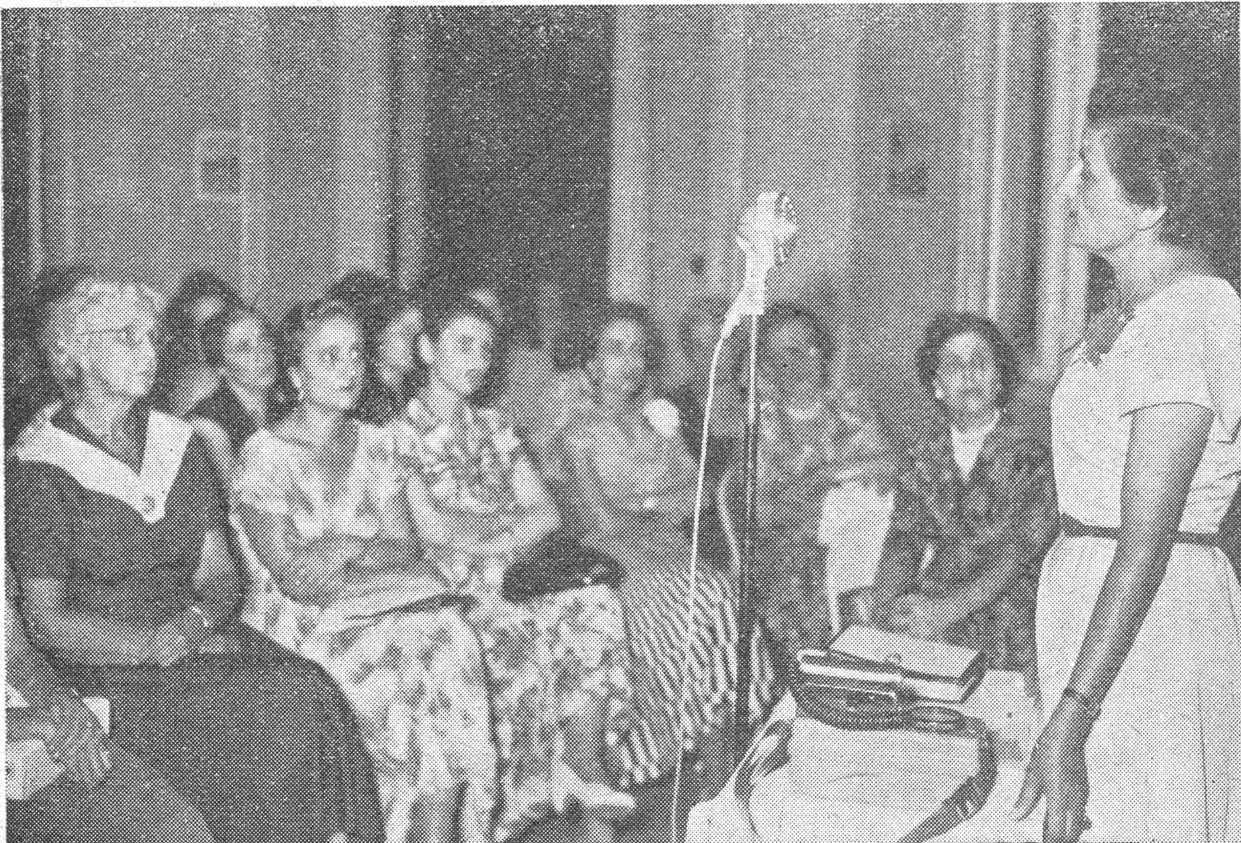
Dr. Salwa Nassar delivering her lecture in the hall of the Young Women's Christian Association
In response to the editors' wish, Dr. Nassar has kindly summarized her lecture, so that its benefit may reach all our readers:
Early in 1955 the United Nations organization invited 84 states to take part in an international conference to examine the uses of nuclear energy and to exchange information on what scientists have attained in the atomic sciences, particularly on the applied side. Seventy-three states (Lebanon among them) accepted the invitation and sent 1,400 government representatives to Geneva; more than 3,000 observers from industrial establishments and universities attended the meeting; and the newspapermen and correspondents,
numbering over 900, discharged their arduous task most creditably.
Although representation at the conference was on an international (governmental) basis, the spirit was purely scientific, no less so than at any ordinary scientific gathering, and the discussions were conducted on the basis of science, not on the basis of the state.
The conference took up all aspects of nuclear energy. The printed papers numbered 1,100, of which 450 were discussed in the course of 200 hours of meetings, and all this information will be published in 19 volumes.
The subjects may be divided as follows:
1) The atom for generating power and electricity — nuclear reactors.
2) Radioactive materials and their use in industry, in agriculture, and in medicine (in diagnosis and in treatment).
3) Scientific research.
4) The effect of radiation and its possible danger to the human race.
The papers presented made it plain that the consumption of power in the industrial countries is increasing at the rate of 5% to 6% a year — that is, in 1975 the consumption of power will be one and a half times what it is today, and in the year 2000 it will exceed three times as much; which forces us to find a source of power and of electricity generation other than the sources used today, such as coal, oil, and waterfalls. This is quite apart from what is required for industrialization and for raising the standard of living in the backward countries. The use of nuclear energy to generate electricity is coming as a rescuer from the crisis before it arrives: Britain, for example, is setting aside 300 million pounds sterling to complete 12 nuclear reactors within the next ten years, to generate 20,000 million watts.
The use of radioactive materials has lately spread — in agriculture, for instance. Last year some American scientists made a study of the fertilizers ordinarily used in growing sugarcane in Puerto Rico, where the farmers were spending close to 3 million dollars to fertilize their fields. The scientists mixed certain radioactive materials into the fertilizers and traced them by means of a Geiger counter through all the stages of the sugarcane, and they found that the cane absorbed nothing of these fertilizers, and that the three million dollars were going to waste.